Summary information and primary citation
- PDB-id
-
1snj;
DSSR-derived features in text and
JSON formats
- Class
- DNA
- Method
- NMR
- Summary
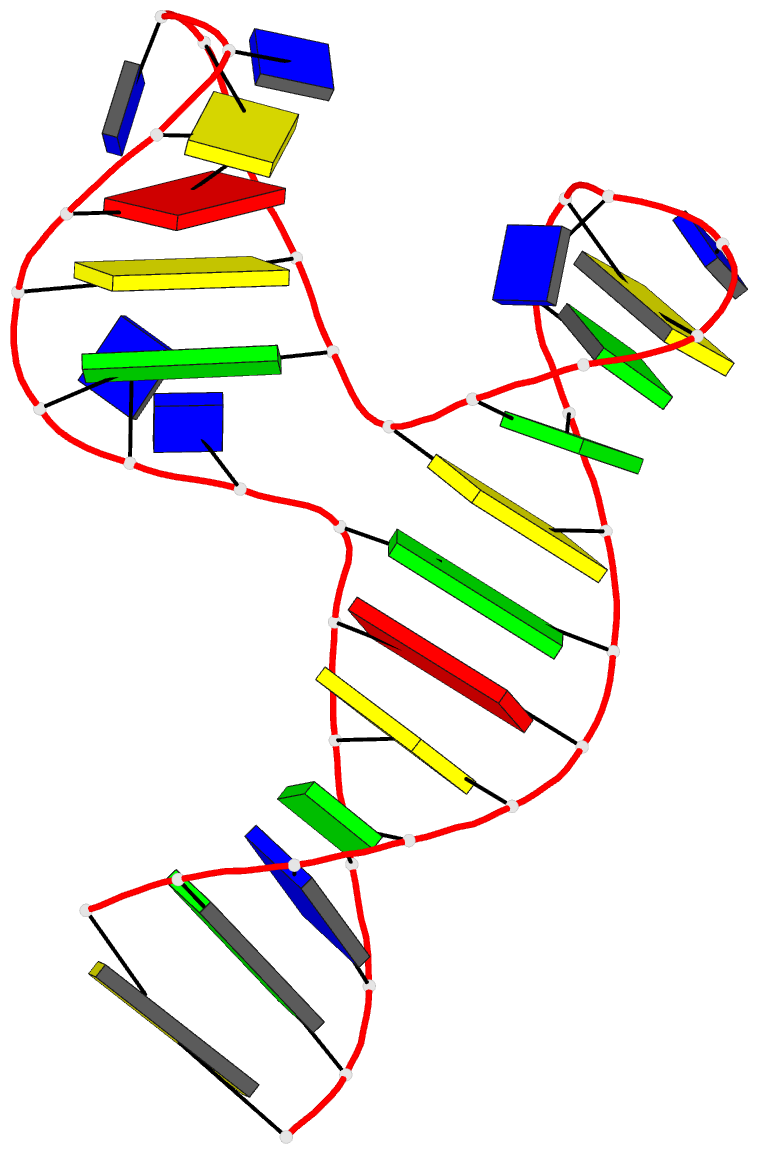
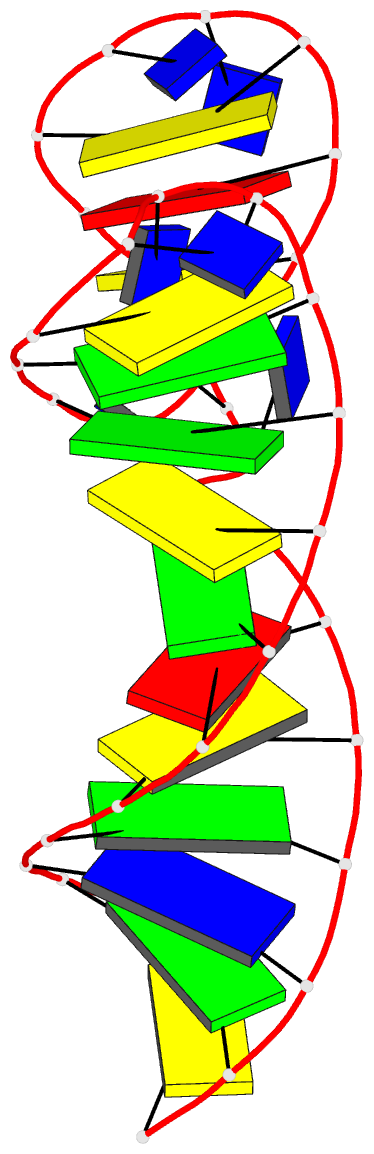
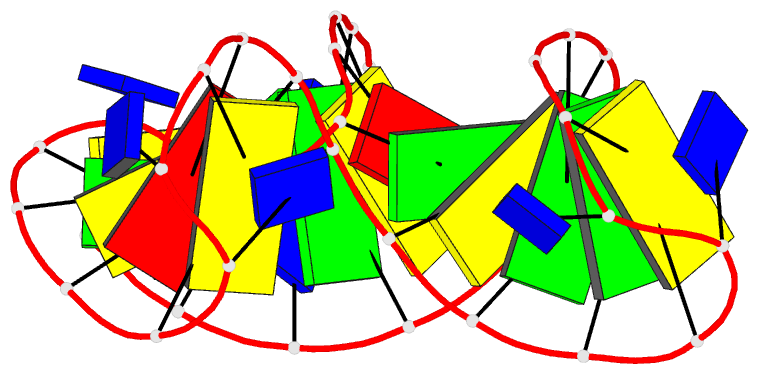
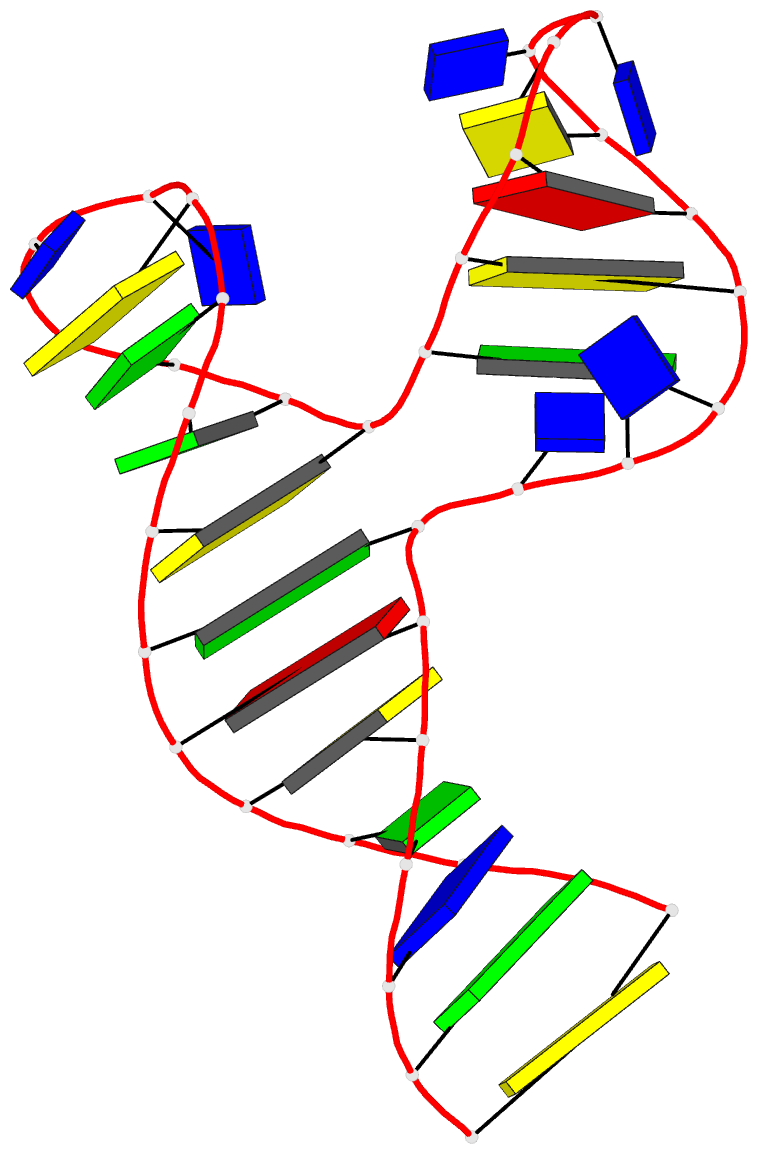
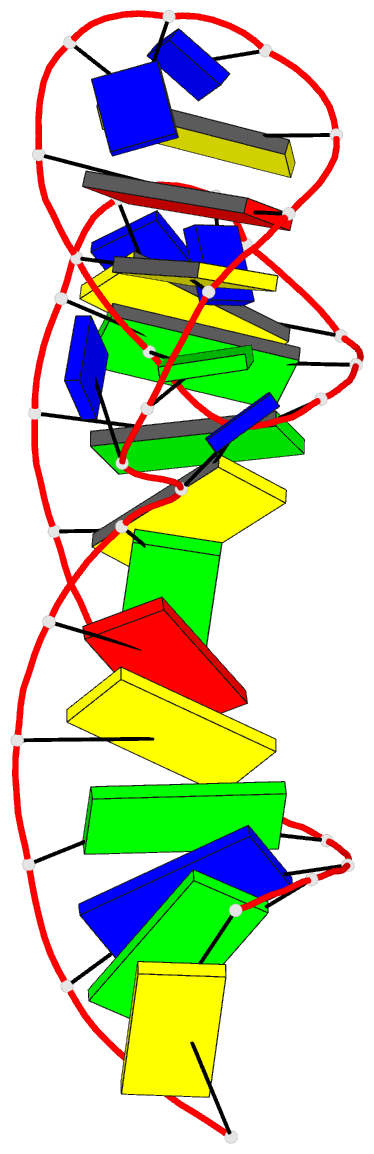
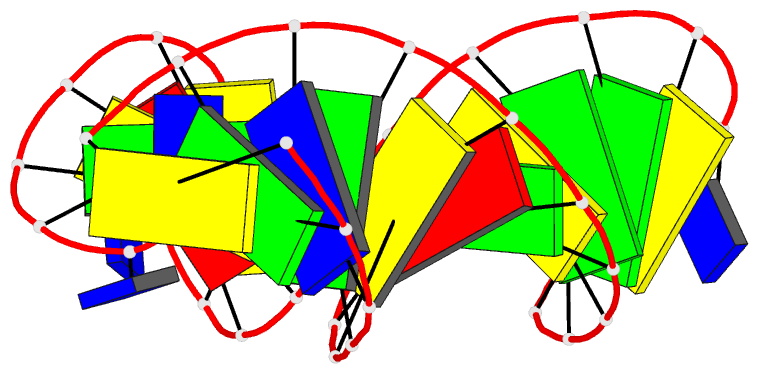
- Solution structure of the DNA three-way junction with
the a-c-stacked conformation
- Reference
-
Wu B, Girard F, van Buuren B, Schleucher J, Tessari M,
Wijmenga S (2004): "Global
structure of a DNA three-way junction by solution NMR:
towards prediction of 3H fold." Nucleic Acids
Res., 32, 3228-3239. doi: 10.1093/nar/gkh645.
- Abstract
- Three-way junctions (3H) are the simplest and most
commonly occurring branched nucleic acids. They consist of
three double helical arms (A to C), connected at the
junction point, with or without a number of unpaired bases
in one or more of the three different strands. Three-way
junctions with two unpaired bases in one strand (3HS2) have
a high tendency to adopt either of two alternative stacked
conformations in which two of the three arms A, B and C are
coaxially stacked, i.e. A/B-stacked or A/C-stacked.
Empirical stacking rules, which successfully predict for
DNA 3HS2 A/B-stacking preference from sequence, have been
extended to A/C-stacked conformations. Three novel DNA 3HS2
sequences were designed to test the validity of these
extended stacking rules and their conformational behavior
was studied by solution NMR. All three show the predicted
A/C-stacking preference even in the absence of multivalent
cations. The stacking preference for both classes of DNA
3HS2 can thus be predicted from sequence. The
high-resolution NMR solution structure for one of the
stacked 3HS2 is also reported. It shows a well-defined
local and global structure defined by an extensive set of
classical NMR restraints and residual dipolar couplings.
Analysis of its global conformation and that of other
representatives of the 3H family, shows that the relative
orientations of the stacked and non-stacked arms, are
restricted to narrow regions of conformational space, which
can be understood from geometric considerations. Together,
these findings open up the possibility of full prediction
of 3HS2 conformation (stacking and global fold) directly
from sequence.