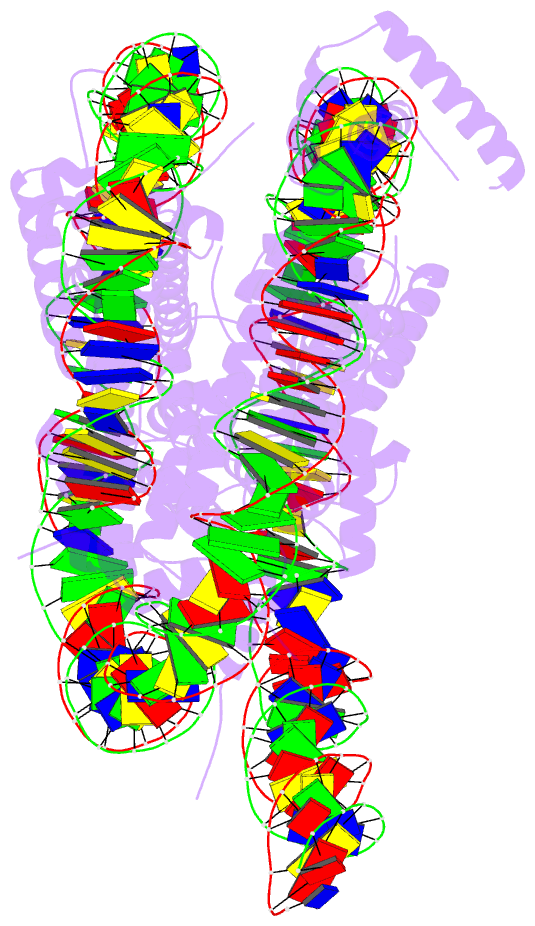
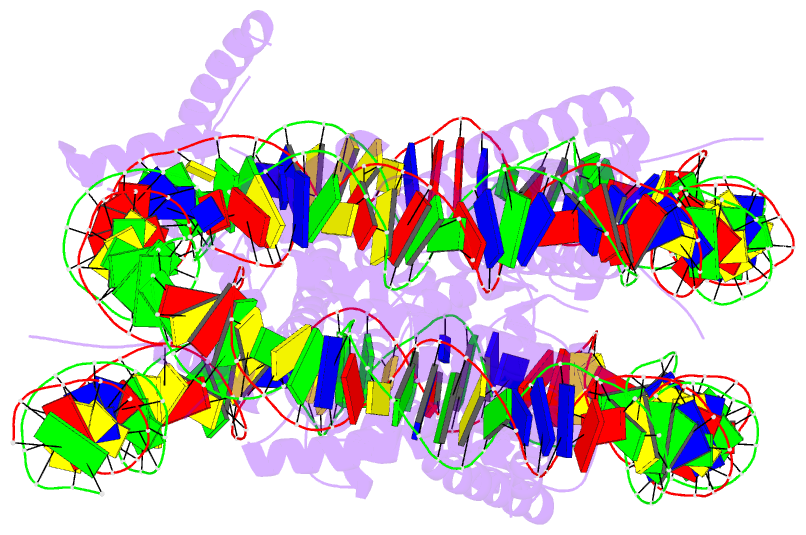
Summary information and primary citation
- PDB-id
-
9cg9;
DSSR-derived features in text and
JSON formats
- Class
- DNA binding protein-DNA
- Method
- cryo-EM (2.94 Å)
- Summary
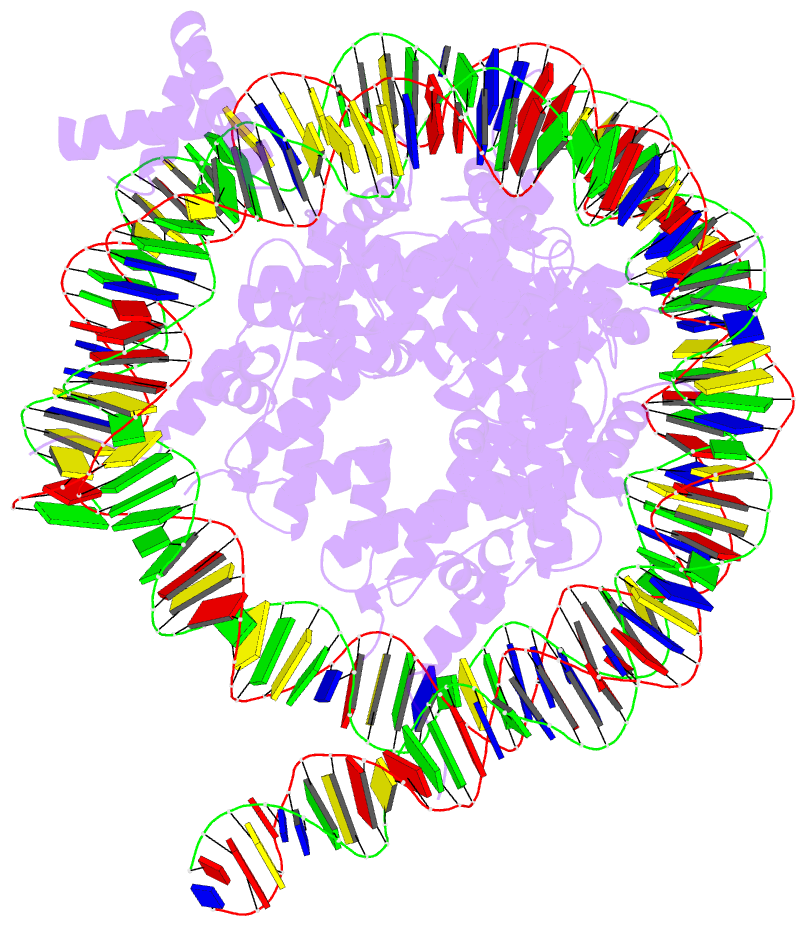
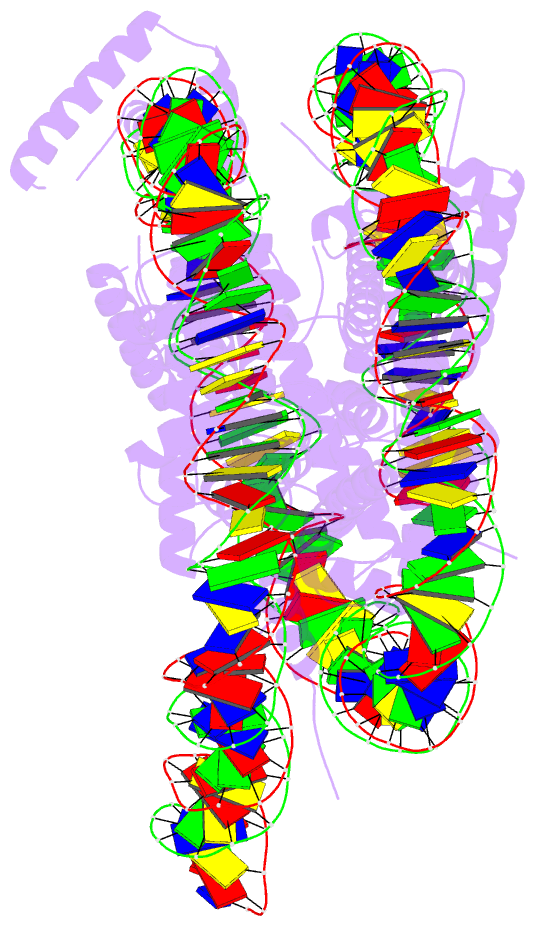
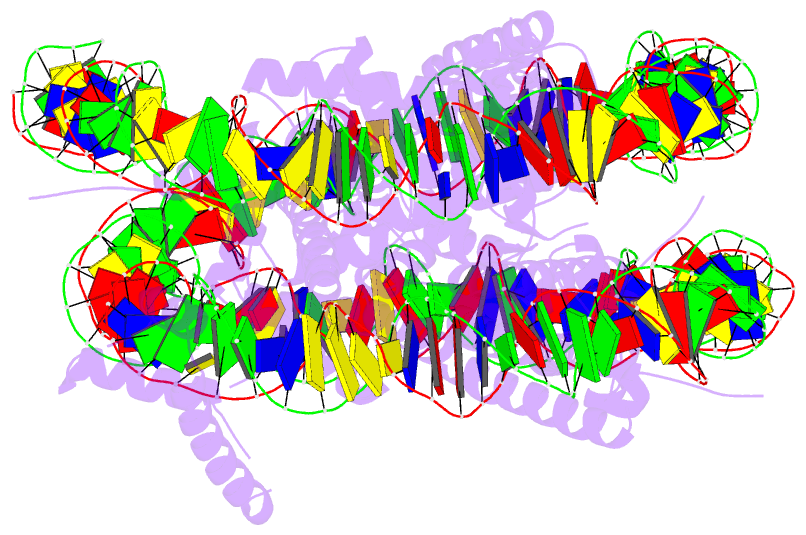
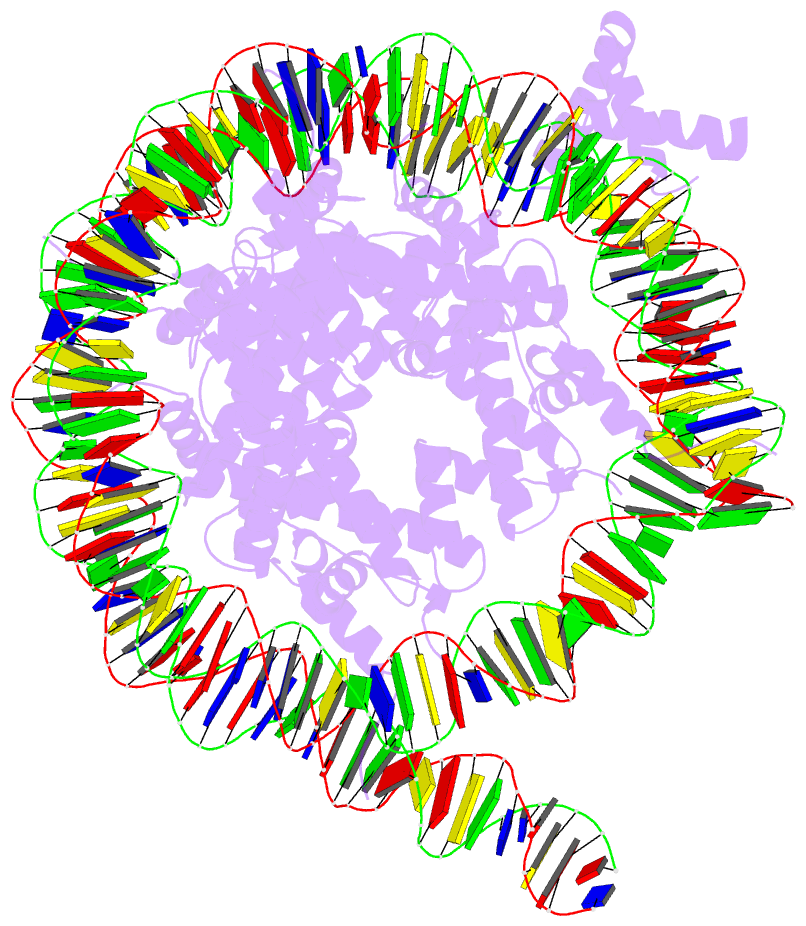
- cryo-EM structure of an hmgb1 box bound to nucleosome
at shl-2
- Reference
-
Saunders HS, Chio US, Moore CM, Ramani V, Cheng Y,
Narlikar GJ (2025): "HMGB1
deforms nucleosomal DNA to generate a dynamic chromatin
environment counteracting the effects of linker
histone." Sci Adv, 11,
eads4473. doi: 10.1126/sciadv.ads4473.
- Abstract
- The essential architectural protein HMGB1 increases
accessibility of nucleosomal DNA and counteracts the
effects of linker histone H1. However, HMGB1 is less
abundant than H1 and binds nucleosomes more weakly, raising
the question of how it competes with H1. Here, we find that
HMGB1 increases nucleosomal DNA accessibility without
displacing H1. HMGB1 also increases the dynamics of
condensed, H1-bound chromatin. Unexpectedly, cryo-electron
microscopy structures show HMGB1 bound at internal
locations on nucleosomes and local DNA distortion. These
sites are away from where H1 binds, explaining how HMGB1
and H1 can co-occupy a nucleosome. Our findings suggest a
model where HMGB1 counteracts the effects of H1 by
distorting nucleosomal DNA and disrupting interactions of
the H1 carboxyl-terminal tail with DNA. Compared to
mutually exclusive binding, co-occupancy by HMGB1 and H1
allows greater diversity in dynamic chromatin states. More
generally, these results explain how architectural proteins
acting at the nucleosome scale can have large effects on
chromatin dynamics at the mesoscale.