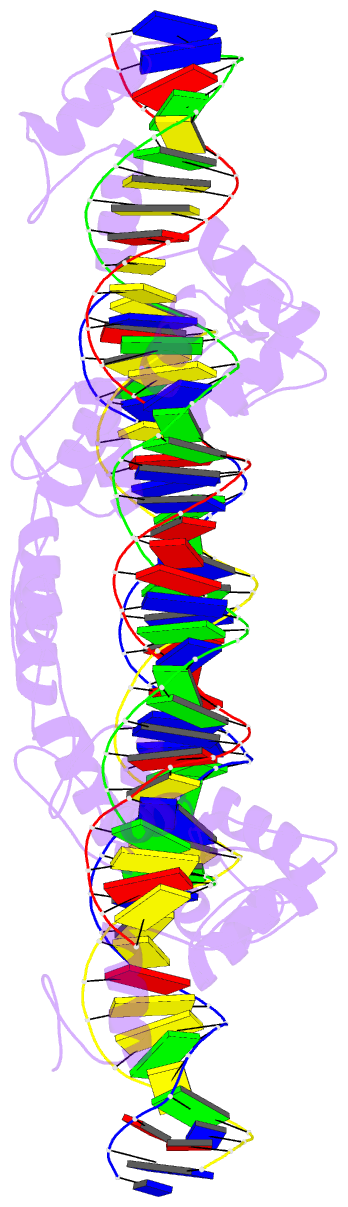
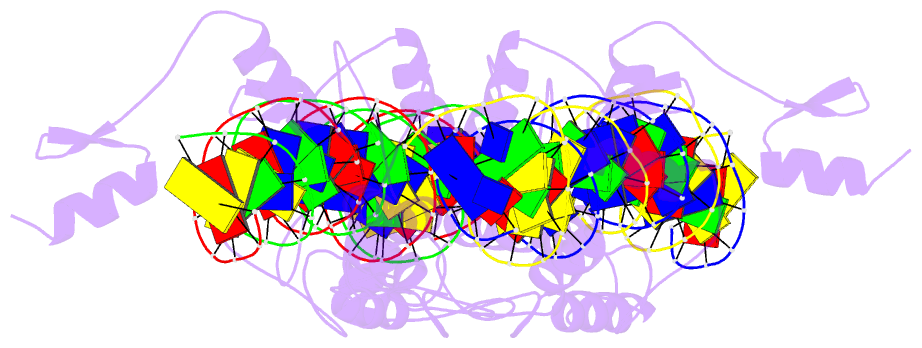
Summary information and primary citation
- PDB-id
-
8ssr;
DSSR-derived features in text and
JSON formats
- Class
- transcription-DNA
- Method
- X-ray (3.14 Å)
- Summary
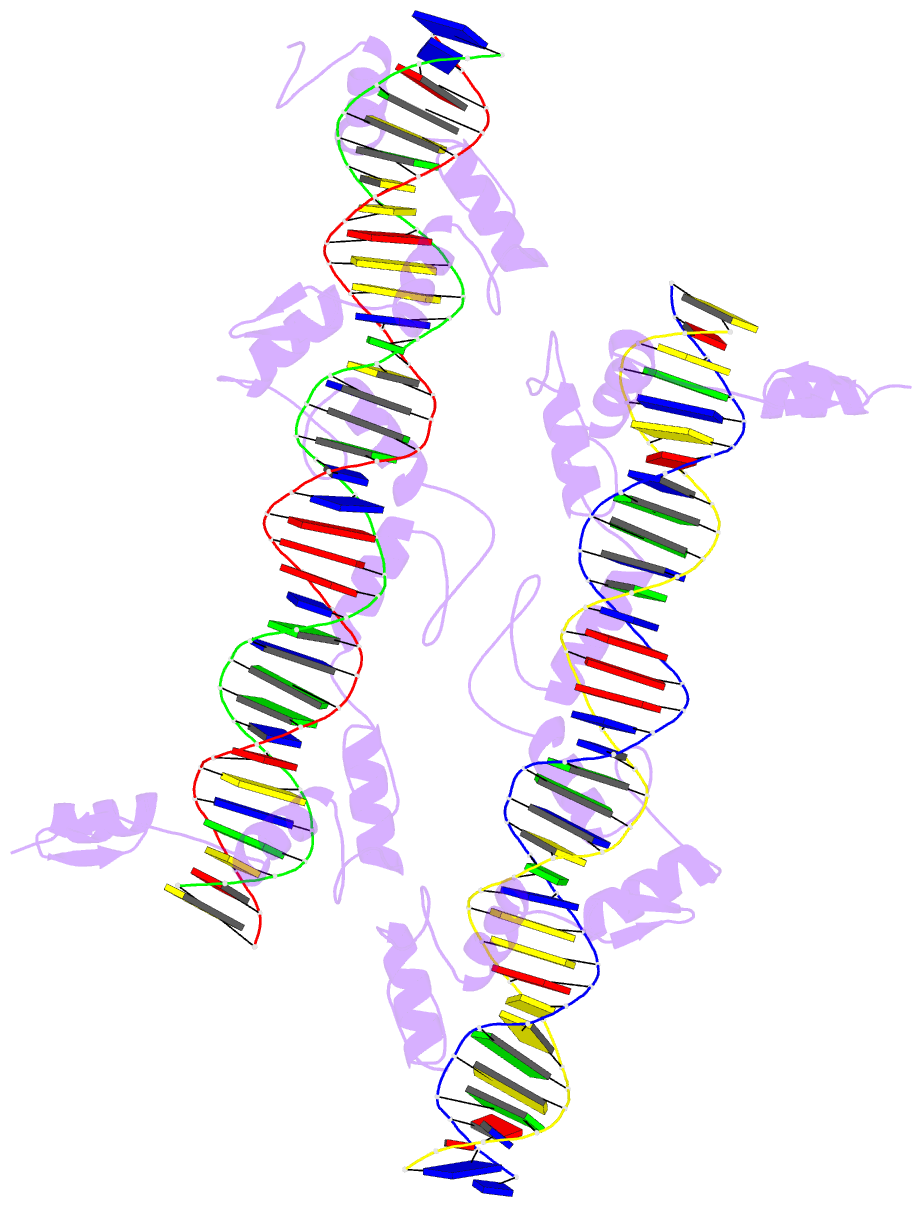
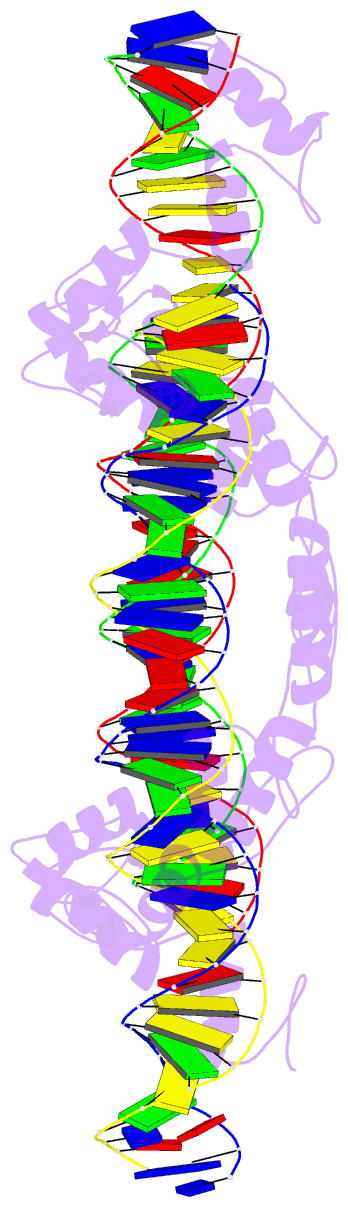
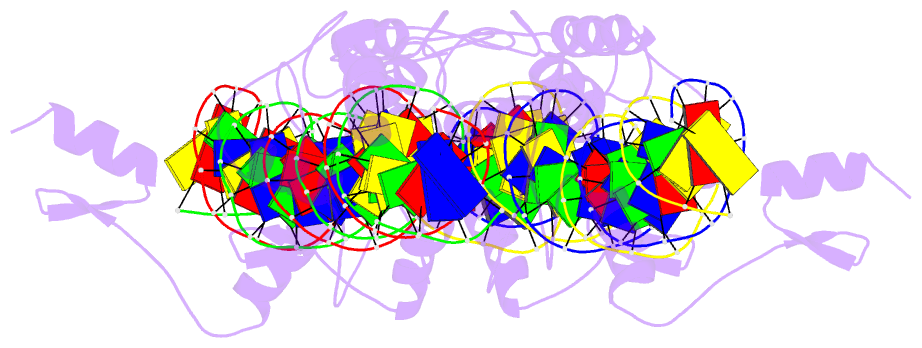
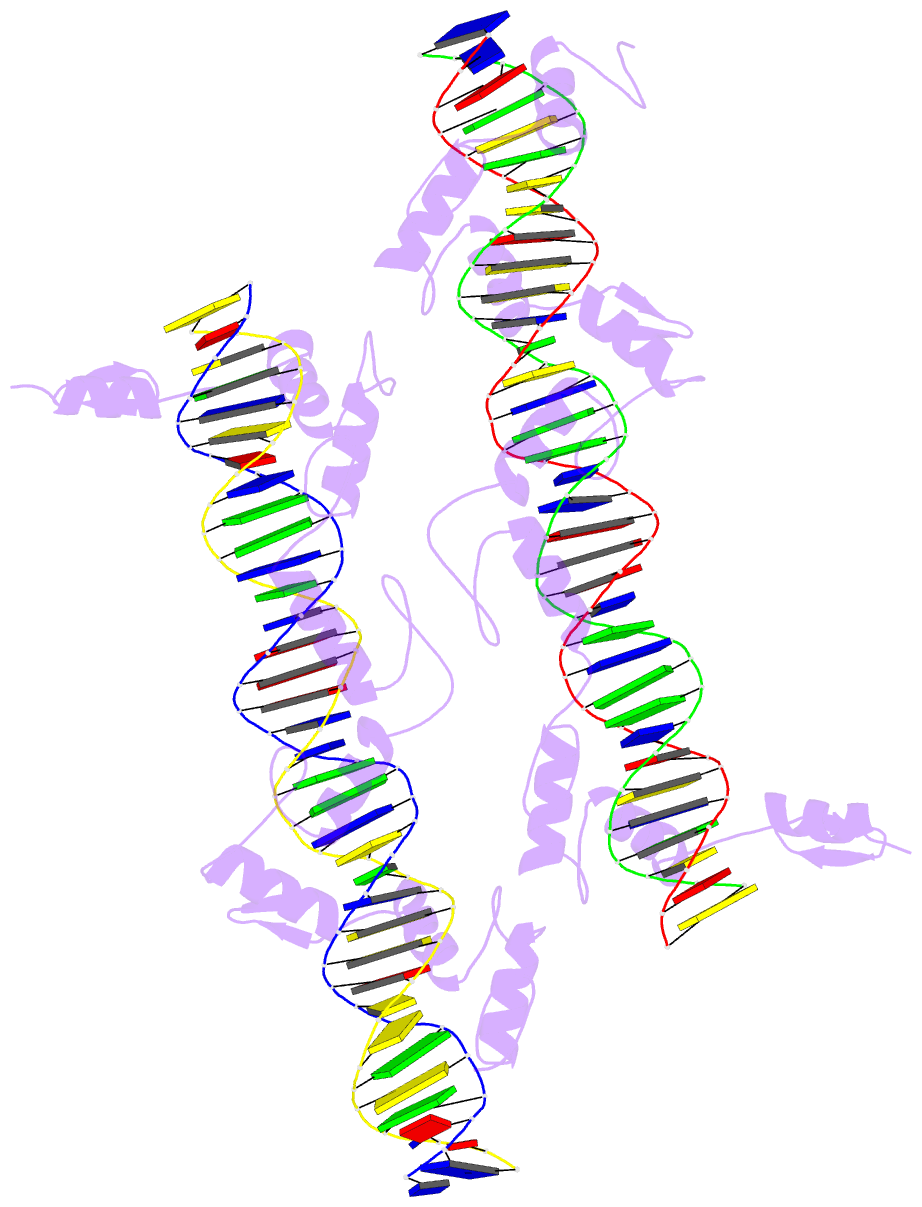
- Znfs 3-11 of ccctc-binding factor (ctcf) complexed with
35mer DNA 35-20
- Reference
-
Yang J, Horton JR, Liu B, Corces VG, Blumenthal RM, Zhang
X, Cheng X (2023): "Structures
of CTCF-DNA complexes including all 11 zinc fingers."
Nucleic Acids Res., 51,
8447-8462. doi: 10.1093/nar/gkad594.
- Abstract
- The CCCTC-binding factor (CTCF) binds tens of thousands
of enhancers and promoters on mammalian chromosomes by
means of its 11 tandem zinc finger (ZF) DNA-binding domain.
In addition to the 12-15-bp CORE sequence, some of the CTCF
binding sites contain 5' upstream and/or 3' downstream
motifs. Here, we describe two structures for overlapping
portions of human CTCF, respectively, including ZF1-ZF7 and
ZF3-ZF11 in complex with DNA that incorporates the
CORE sequence together with either 3' downstream or 5'
upstream motifs. Like conventional tandem ZF array
proteins, ZF1-ZF7 follow the right-handed twist of the
DNA, with each finger occupying and recognizing one triplet
of three base pairs in the DNA major groove. ZF8 plays
a unique role, acting as a spacer across the DNA minor
groove and positioning ZF9-ZF11 to make cross-strand
contacts with DNA. We ascribe the difference between the
two subgroups of ZF1-ZF7 and ZF8-ZF11 to residues at the
two positions -6 and -5 within each finger, with small
residues for ZF1-ZF7 and bulkier and polar/charged residues
for ZF8-ZF11. ZF8 is also uniquely rich in basic amino
acids, which allows salt bridges to DNA phosphates in the
minor groove. Highly specific arginine-guanine and
glutamine-adenine interactions, used to recognize G:C or
A:T base pairs at conventional base-interacting positions
of ZFs, also apply to the cross-strand interactions adopted
by ZF9-ZF11. The differences between ZF1-ZF7 and ZF8-ZF11
can be rationalized structurally and may contribute to
recognition of high-affinity CTCF binding sites.