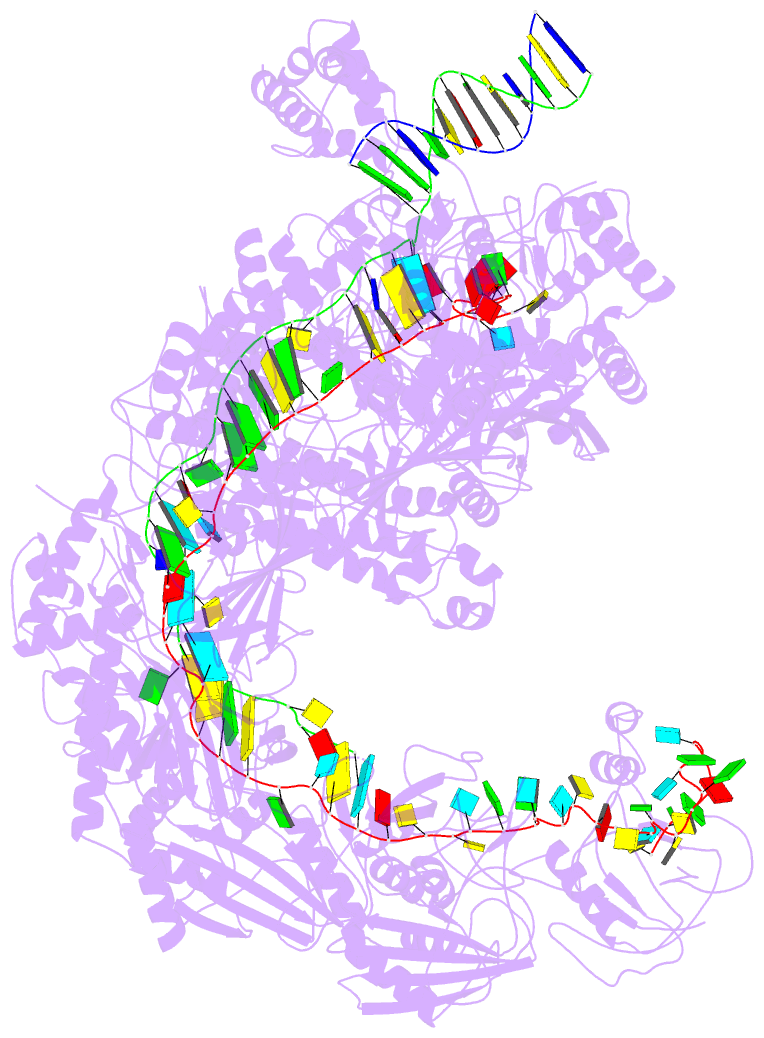
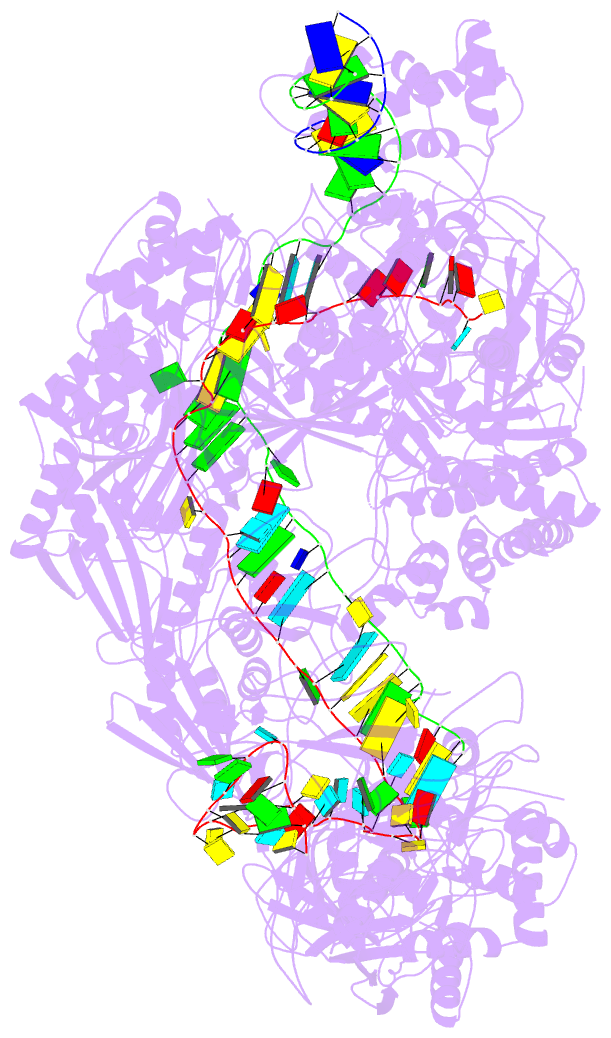
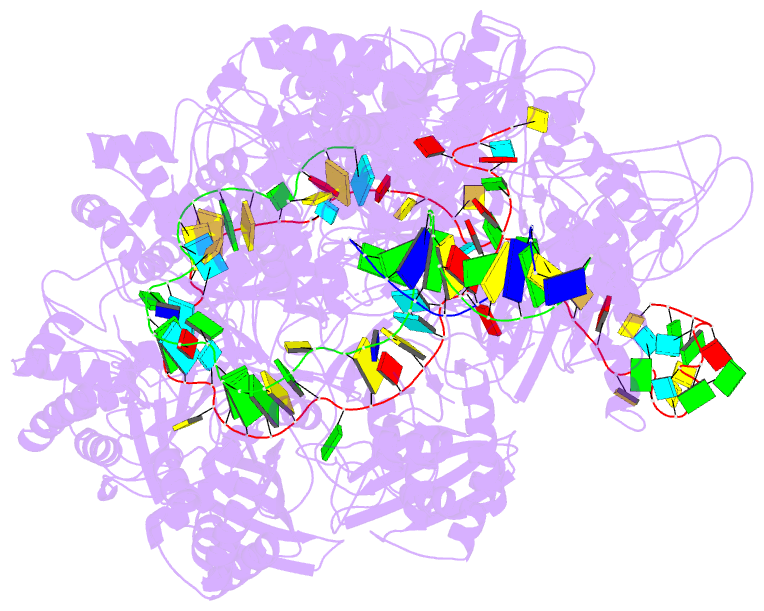
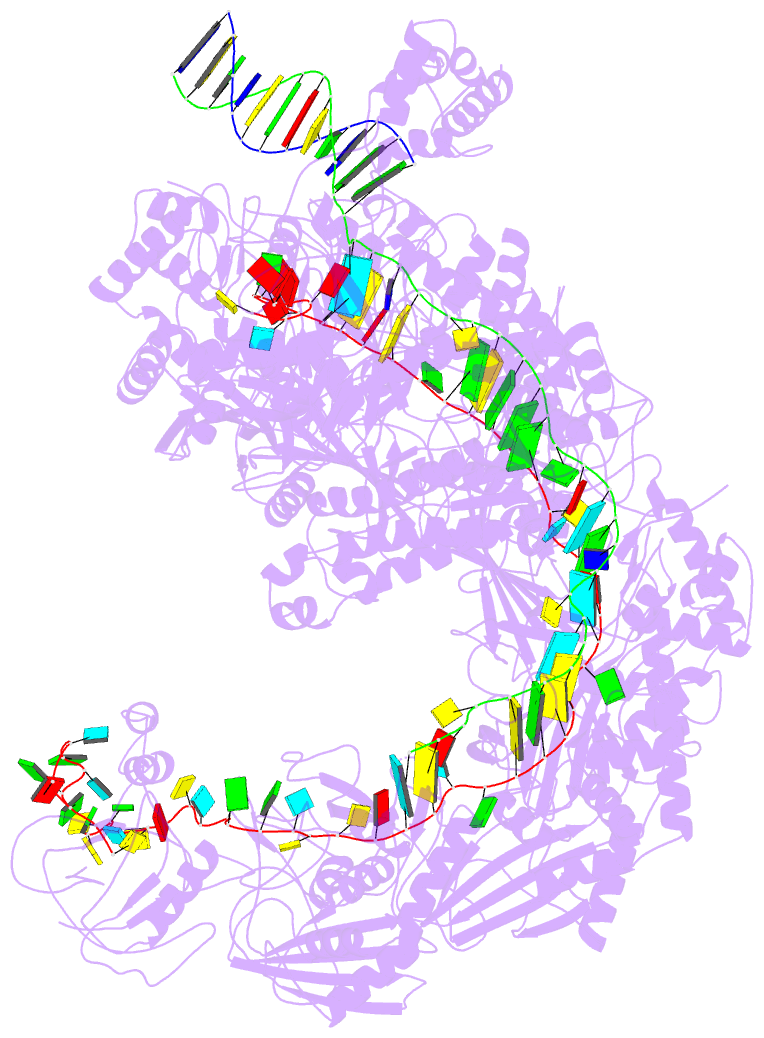
Summary information and primary citation
- PDB-id
-
7yhs;
DSSR-derived features in text and
JSON formats
- Class
- immune system-RNA-DNA
- Method
- cryo-EM (3.37 Å)
- Summary
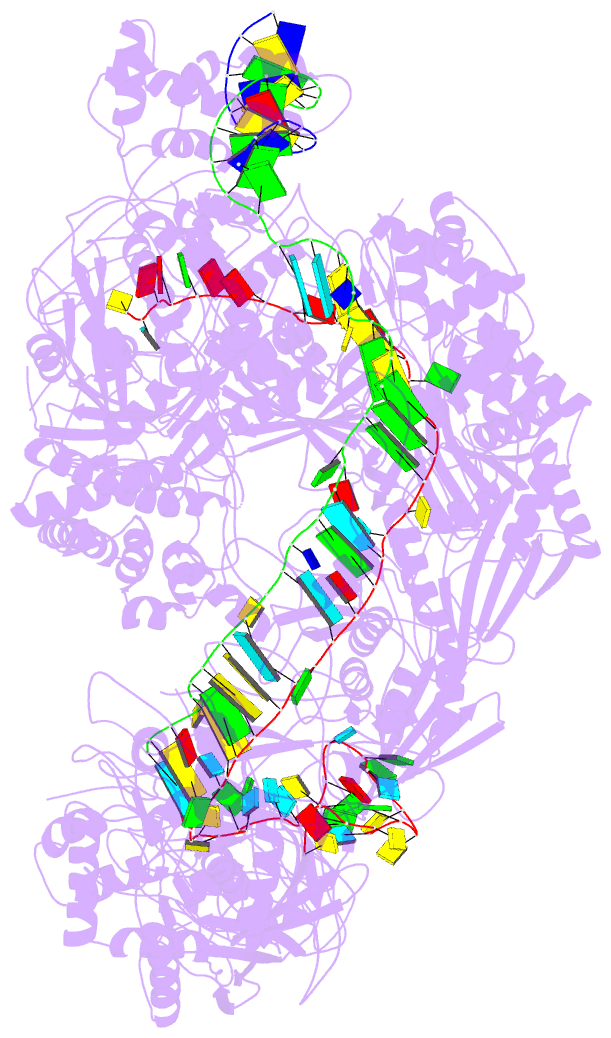
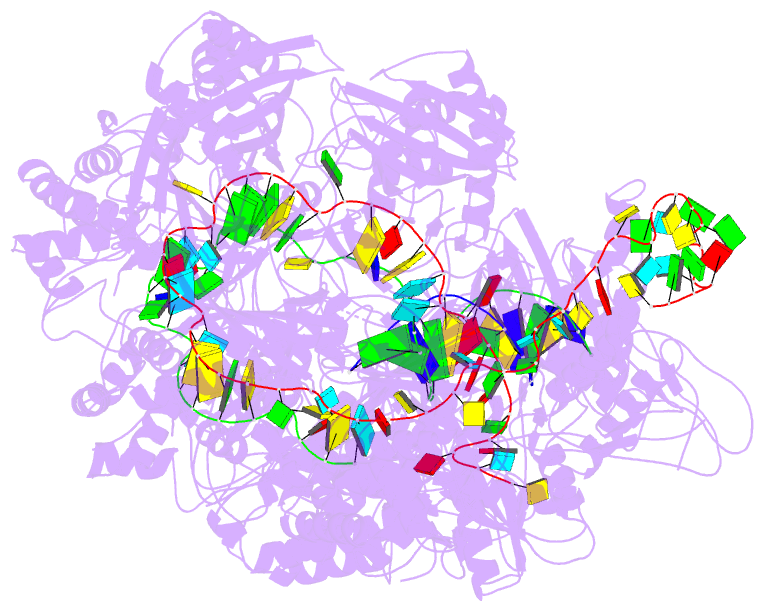
- Structure of csy-acrif4-dsDNA
- Reference
-
Gao Z, Zhang L, Ge Z, Wang H, Yue Y, Jiang Z, Wang X, Xu
C, Zhang Y, Yang M, Feng Y (2022): "Anti-CRISPR
protein AcrIF4 inhibits the type I-F CRISPR-Cas
surveillance complex by blocking nuclease recruitment and
DNA cleavage." J.Biol.Chem.,
298, 102575. doi: 10.1016/j.jbc.2022.102575.
- Abstract
- The clustered regularly interspaced short palindromic
repeats (CRISPR)-Cas system provides prokaryotes with
protection against mobile genetic elements such as phages.
In turn, phages deploy anti-CRISPR (Acr) proteins to evade
this immunity. AcrIF4, an Acr targeting the type I-F
CRISPR-Cas system, has been reported to bind the
crRNA-guided surveillance (Csy) complex. However, it
remains controversial whether AcrIF4 inhibits target DNA
binding to the Csy complex. Here, we present structural and
mechanistic studies into AcrIF4, exploring its unique
anti-CRISPR mechanism. While the Csy-AcrIF4 complex
displays decreased affinity for target DNA, it is still
able to bind the DNA. Our structural and functional
analyses of the Csy-AcrIF4-dsDNA complex revealed that
AcrIF4 binding prevents rotation of the helical bundle of
the Cas8f subunit induced by dsDNA binding, therefore
resulting in failure of nuclease Cas2/3 recruitment and DNA
cleavage. Overall, our study provides an interesting
example of attack on the nuclease recruitment event by an
Acr, but not conventional mechanisms of blocking binding of
target DNA.