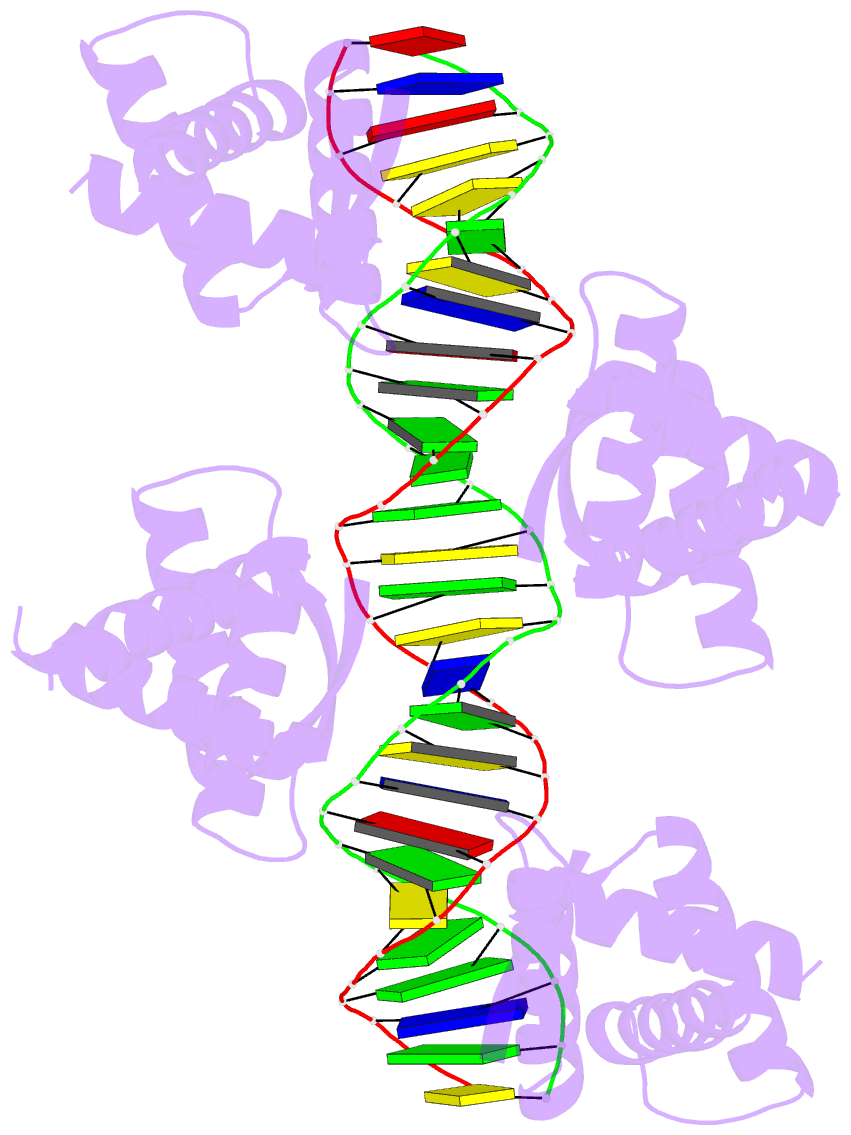
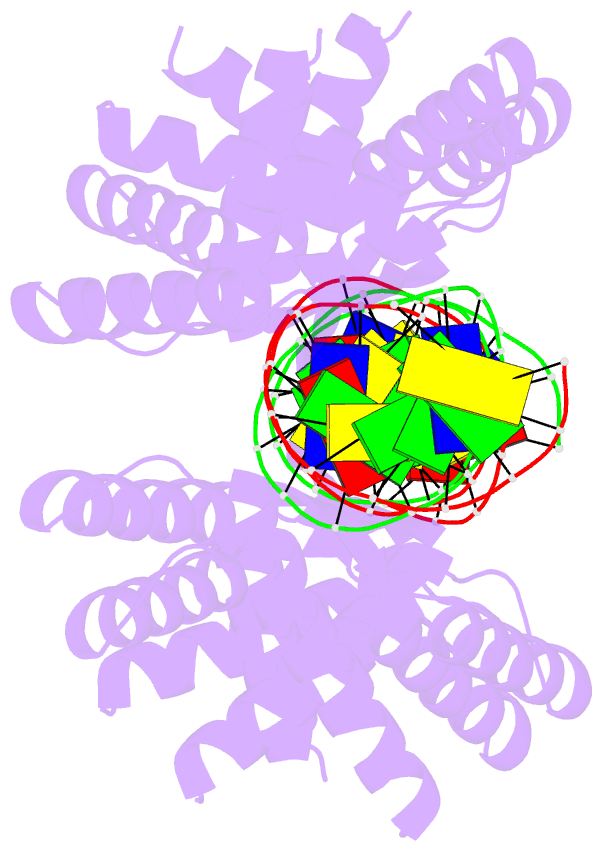
Summary information and primary citation
- PDB-id
-
4qpq;
DSSR-derived features in text and
JSON formats
- Class
- transcription-DNA
- Method
- X-ray (3.106 Å)
- Summary
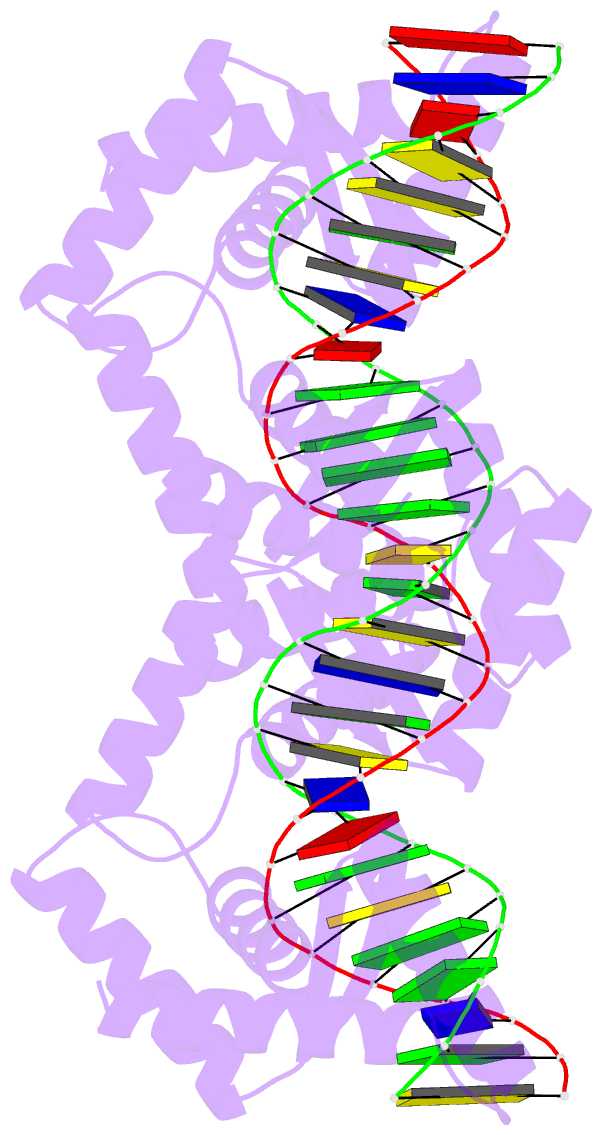
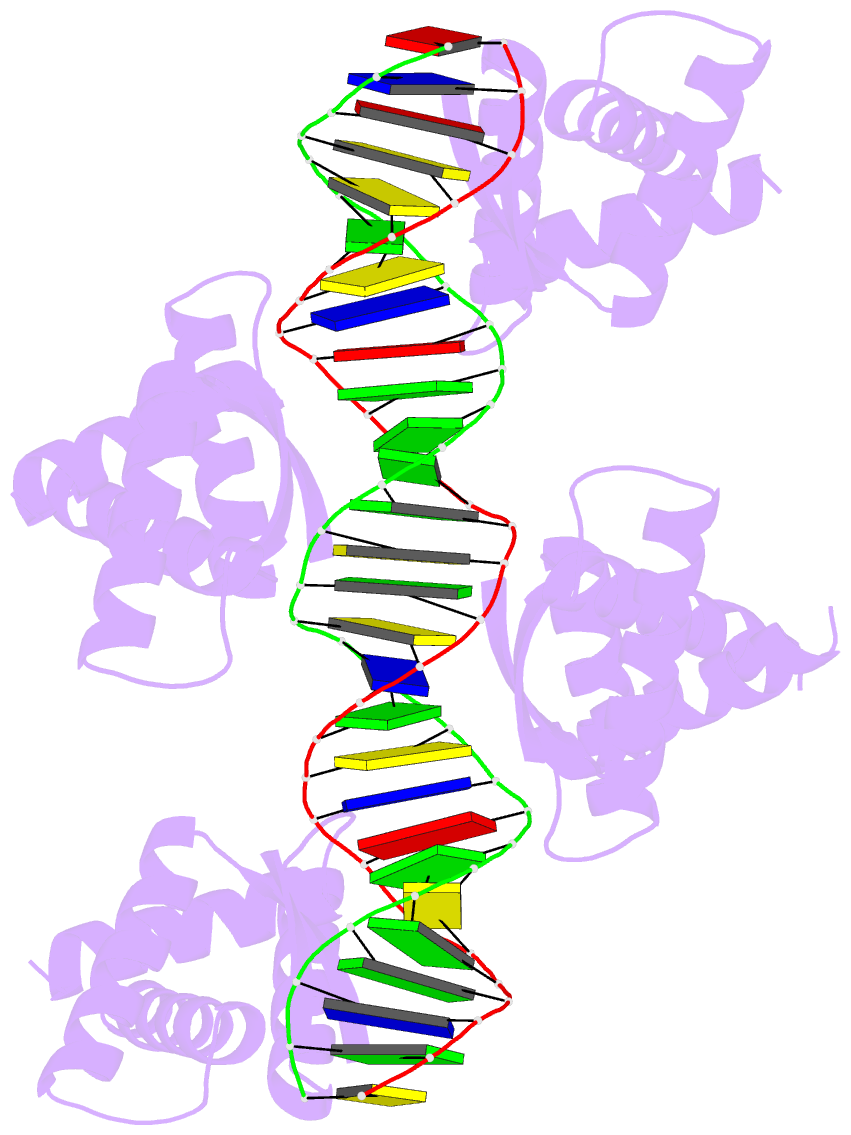
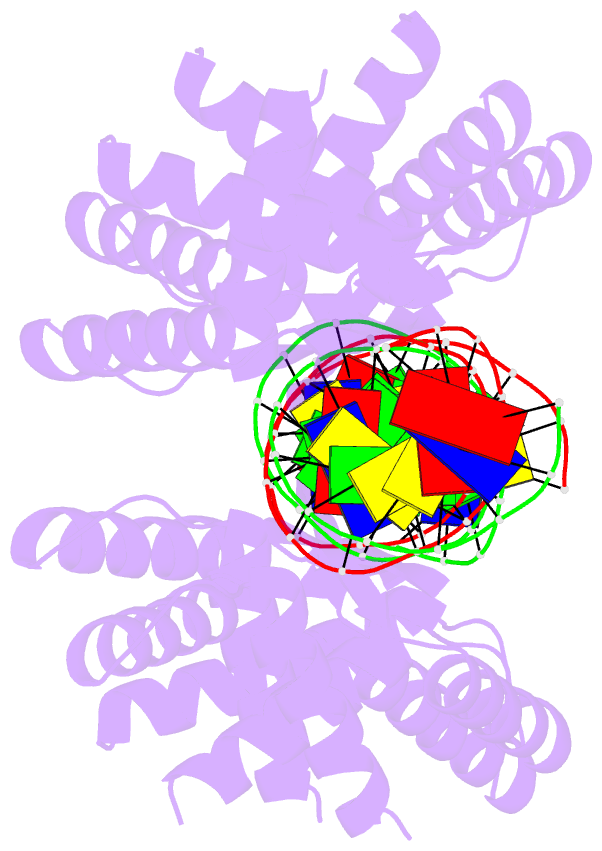
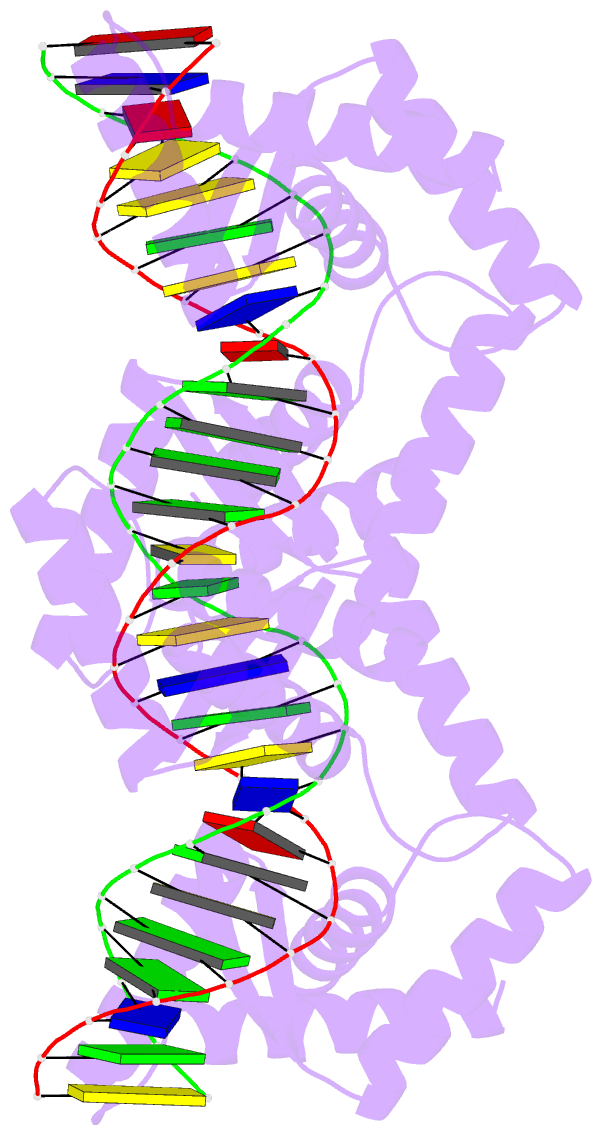
- Mechanistic basis of plasmid-specific DNA binding of
the f plasmid regulatory protein, tram
- Reference
-
Peng Y, Lu J, Wong JJ, Edwards RA, Frost LS, Mark Glover
JN (2014): "Mechanistic
Basis of Plasmid-Specific DNA Binding of the F Plasmid
Regulatory Protein, TraM." J.Mol.Biol.,
426, 3783-3795. doi: 10.1016/j.jmb.2014.09.018.
- Abstract
- The conjugative transfer of bacterial F plasmids relies
on TraM, a plasmid-encoded protein that recognizes multiple
DNA sites to recruit the plasmid to the conjugative pore.
In spite of the high degree of amino acid sequence
conservation between TraM proteins, many of these proteins
have markedly different DNA binding specificities that
ensure the selective recruitment of a plasmid to its
cognate pore. Here we present the structure of F TraM RHH
(ribbon-helix-helix) domain bound to its sbmA site. The
structure indicates that a pair of TraM tetramers
cooperatively binds an underwound sbmA site containing 12
base pairs per turn. The sbmA is composed of 4 copies of a
5-base-pair motif, each of which is recognized by an RHH
domain. The structure reveals that a single conservative
amino acid difference in the RHH β-ribbon between F and
pED208 TraM changes its specificity for its cognate
5-base-pair sequence motif. Specificity is also dictated by
the positioning of 2-base-pair spacer elements within sbmA;
in F sbmA, the spacers are positioned between motifs 1 and
2 and between motifs 3 and 4, whereas in pED208 sbmA, there
is a single spacer between motifs 2 and 3. We also
demonstrate that a pair of F TraM tetramers can
cooperatively bind its sbmC site with an affinity similar
to that of sbmA in spite of a lack of sequence similarity
between these DNA elements. These results provide a basis
for the prediction of the DNA binding properties of the
family of TraM proteins.