Summary information and primary citation
- PDB-id
-
4plx;
DSSR-derived features in text and
JSON formats
- Class
- RNA
- Method
- X-ray (3.1 Å)
- Summary
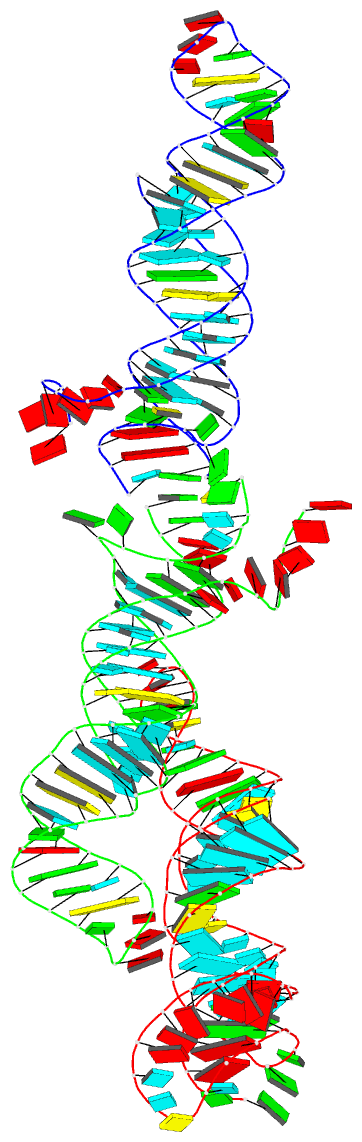
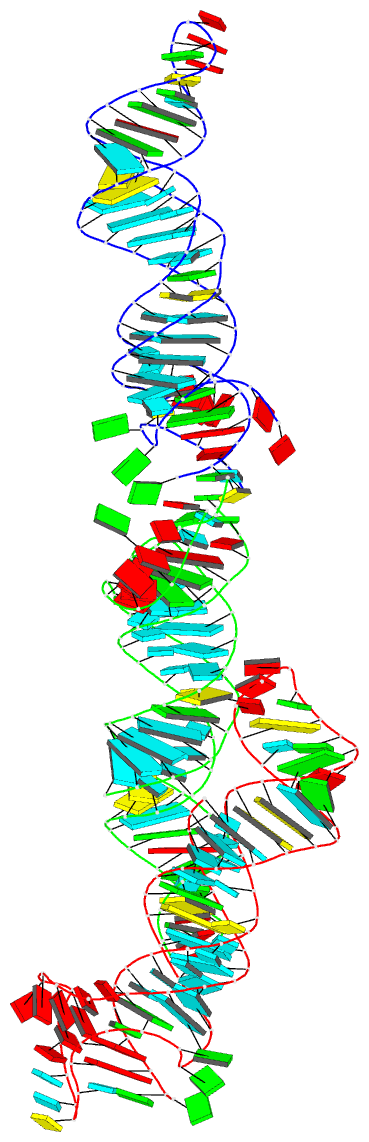
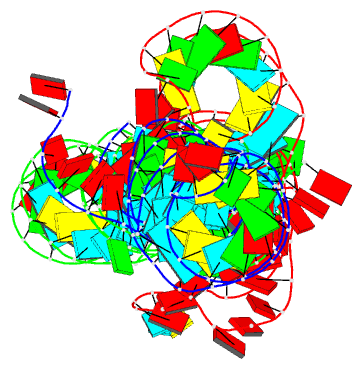
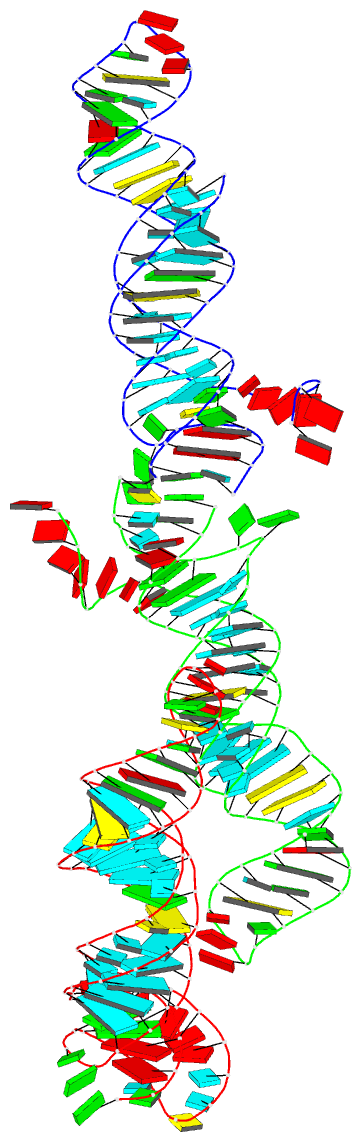
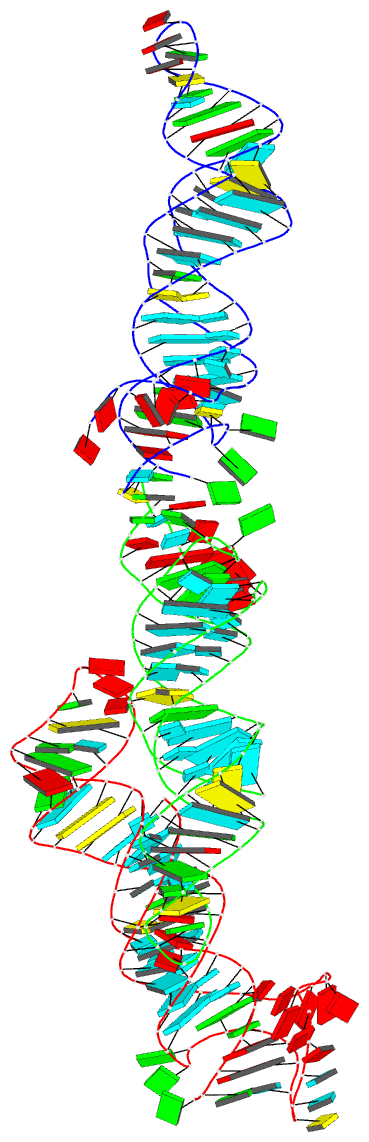
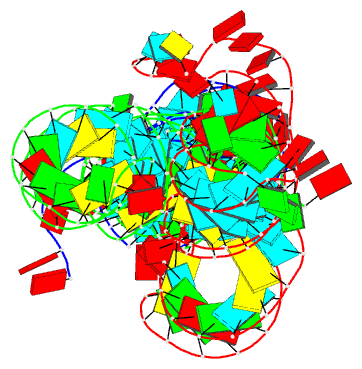
- Crystal structure of the triple-helical stability
element at the 3' end of malat1
- Reference
-
Brown JA, Bulkley D, Wang J, Valenstein ML, Yario TA,
Steitz TA, Steitz JA (2014): "Structural
insights into the stabilization of MALAT1 noncoding RNA
by a bipartite triple helix."
Nat.Struct.Mol.Biol., 21,
633-640. doi: 10.1038/nsmb.2844.
- Abstract
- Metastasis-associated lung adenocarcinoma transcript 1
(MALAT1) is a highly abundant nuclear long noncoding RNA
that promotes malignancy. A 3'-stem-loop structure is
predicted to confer stability by engaging a downstream
A-rich tract in a triple helix, similar to the expression
and nuclear retention element (ENE) from the KSHV
polyadenylated nuclear RNA. The 3.1-Å-resolution crystal
structure of the human MALAT1 ENE and A-rich tract reveals
a bipartite triple helix containing stacks of five and four
U•A-U triples separated by a C+•G-C triplet and C-G
doublet, extended by two A-minor interactions. In vivo
decay assays indicate that this blunt-ended triple helix,
with the 3' nucleotide in a U•A-U triple, inhibits rapid
nuclear RNA decay. Interruption of the triple helix by the
C-G doublet induces a 'helical reset' that explains why
triple-helical stacks longer than six do not occur in
nature.