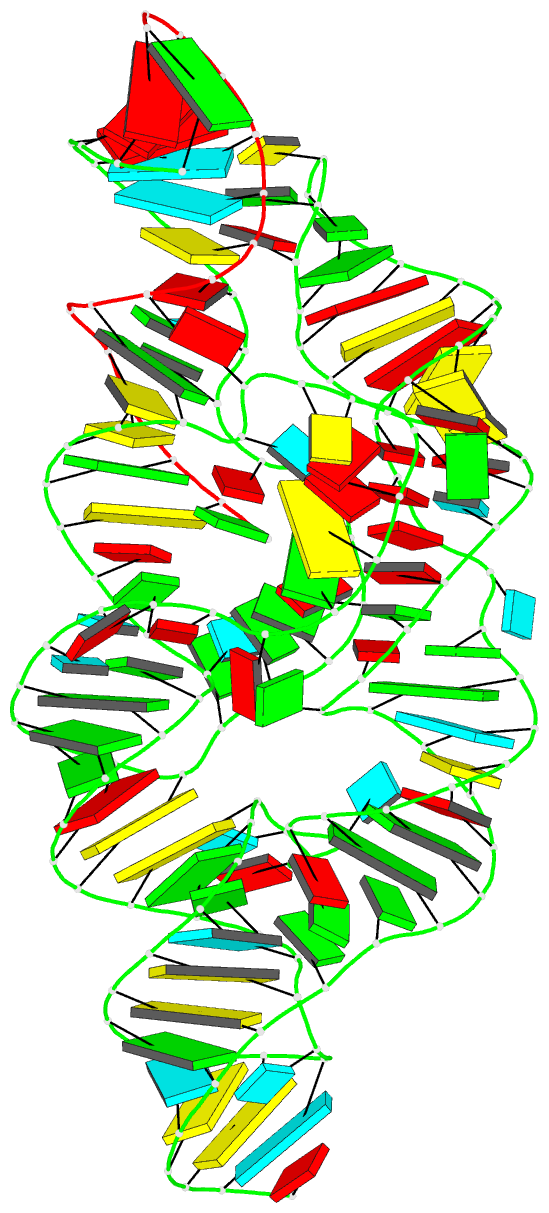
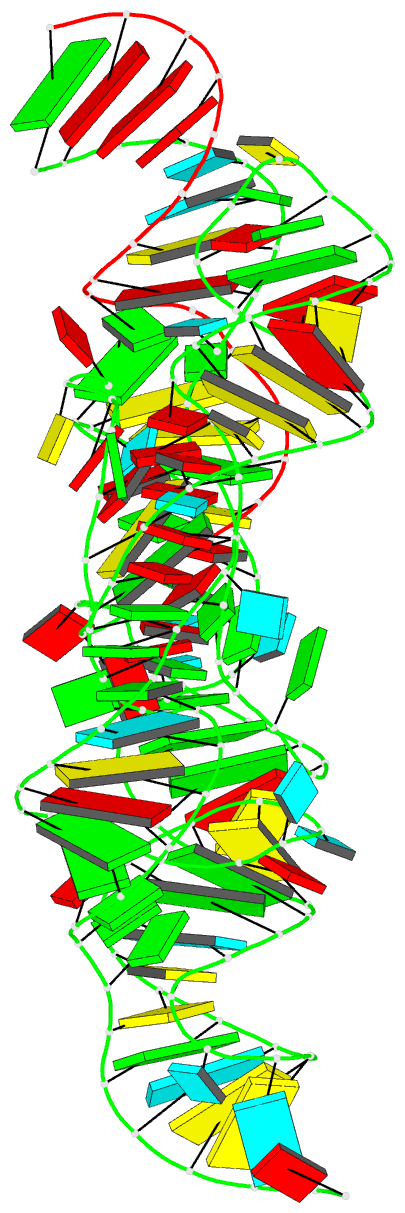
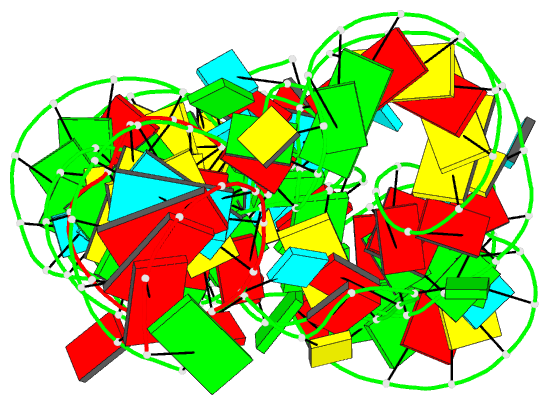
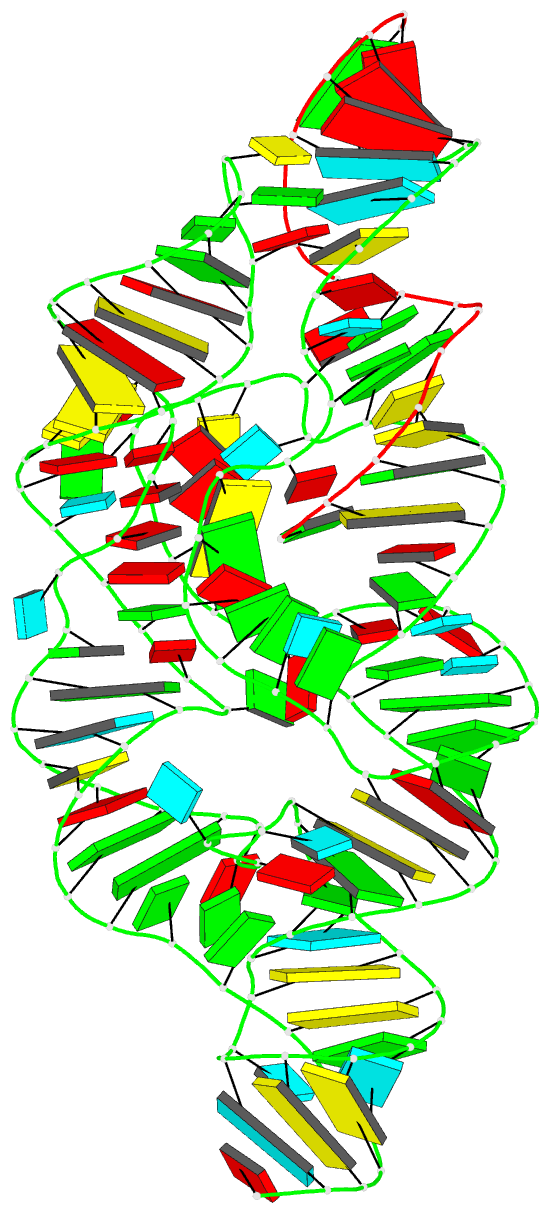
Summary information and primary citation
- PDB-id
-
4meg;
DSSR-derived features in text and
JSON formats
- Class
- RNA
- Method
- X-ray (3.1 Å)
- Summary
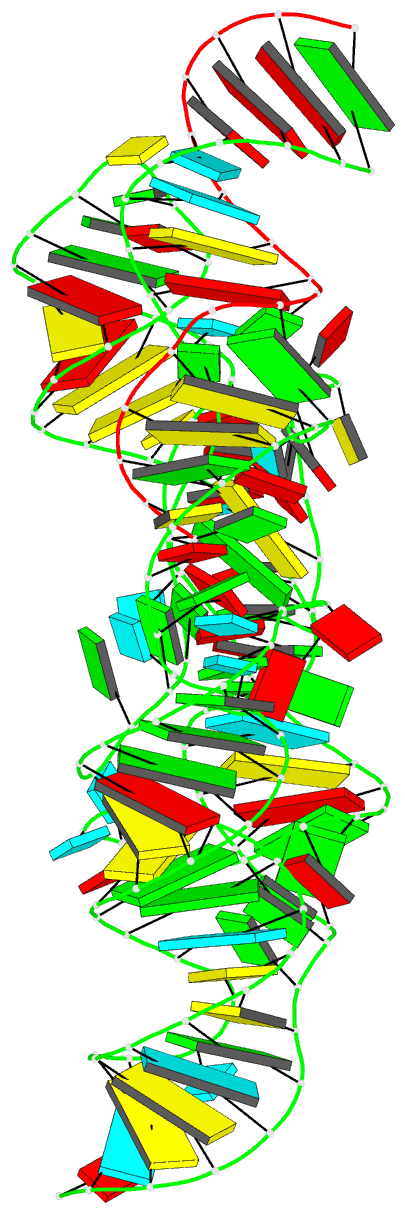
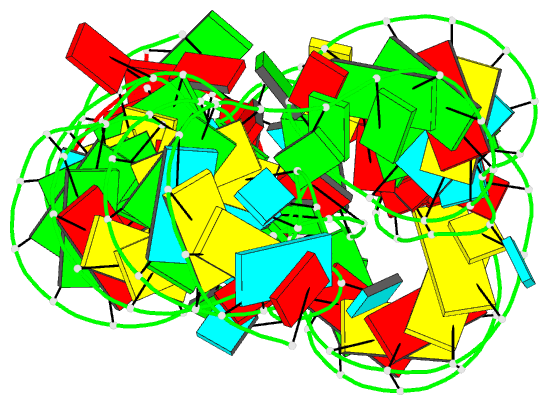
- In vitro evolved glms ribozyme triple mutant, magnesium
ion complex
- Reference
-
Lau MW, Ferre-D'Amare AR (2013): "An in
vitro evolved glmS ribozyme has the wild-type fold but
loses coenzyme dependence." Nat.Chem.Biol.,
9, 805-810. doi: 10.1038/nchembio.1360.
- Abstract
- Uniquely among known ribozymes, the glmS
ribozyme-riboswitch requires a small-molecule coenzyme,
glucosamine-6-phosphate (GlcN6P). Although consistent with
its gene-regulatory function, the use of GlcN6P is
unexpected because all of the other characterized
self-cleaving ribozymes use RNA functional groups or
divalent cations for catalysis. To determine what active
site features make this ribozyme reliant on GlcN6P and to
evaluate whether it might have evolved from a
coenzyme-independent ancestor, we isolated a
GlcN6P-independent variant through in vitro selection.
Three active site mutations suffice to generate a highly
reactive RNA that adopts the wild-type fold but uses
divalent cations for catalysis and is insensitive to
GlcN6P. Biochemical and crystallographic comparisons of
wild-type and mutant ribozymes show that a handful of
functional groups fine-tune the RNA to be either coenzyme
or cation dependent. These results indicate that a few
mutations can confer new biochemical activities on
structured RNAs. Thus, families of structurally related
ribozymes with divergent function may exist.