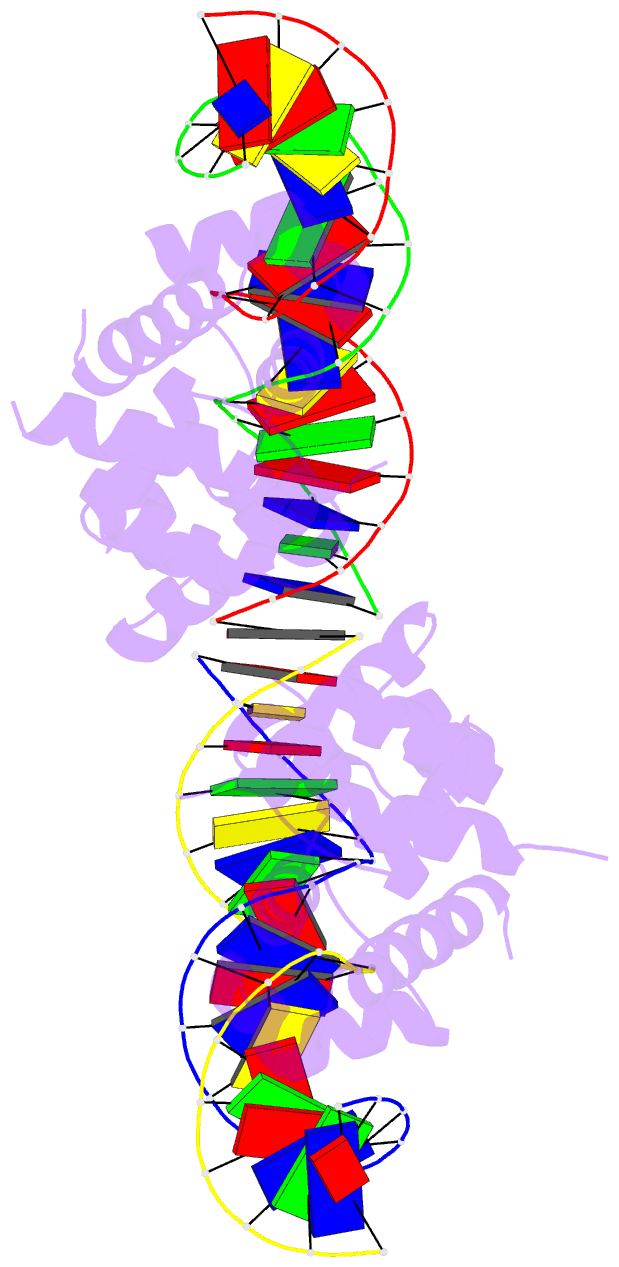
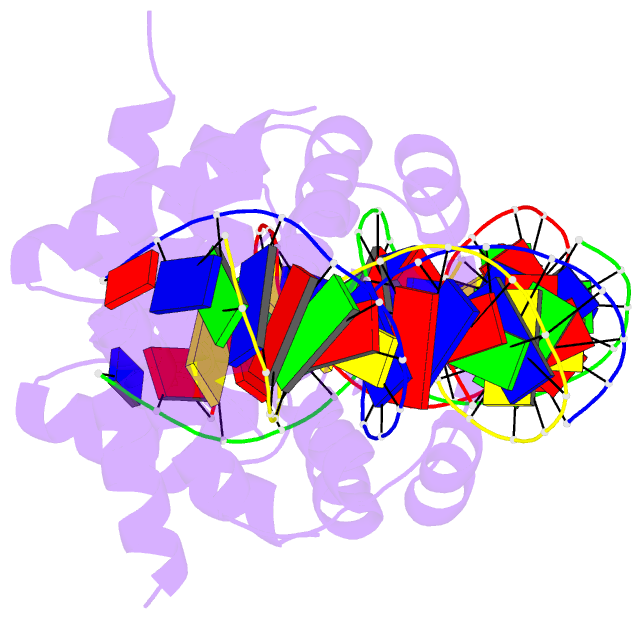
Summary information and primary citation
- PDB-id
-
4ivz;
DSSR-derived features in text and
JSON formats
- Class
- transcription-DNA
- Method
- X-ray (3.1 Å)
- Summary
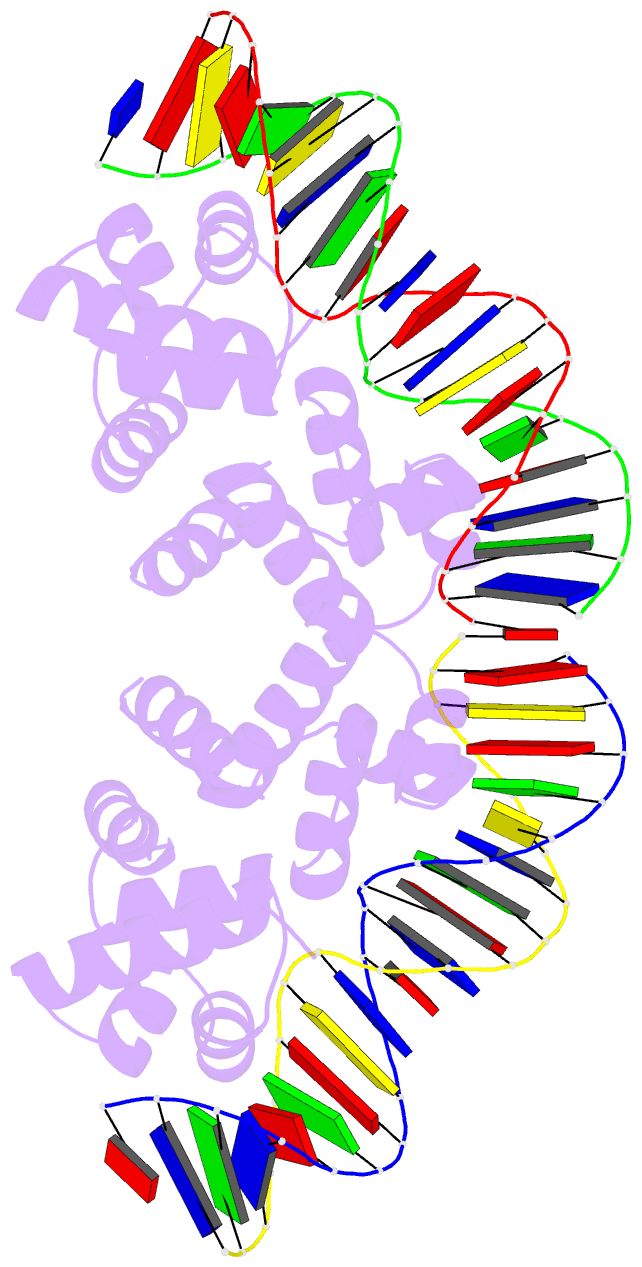
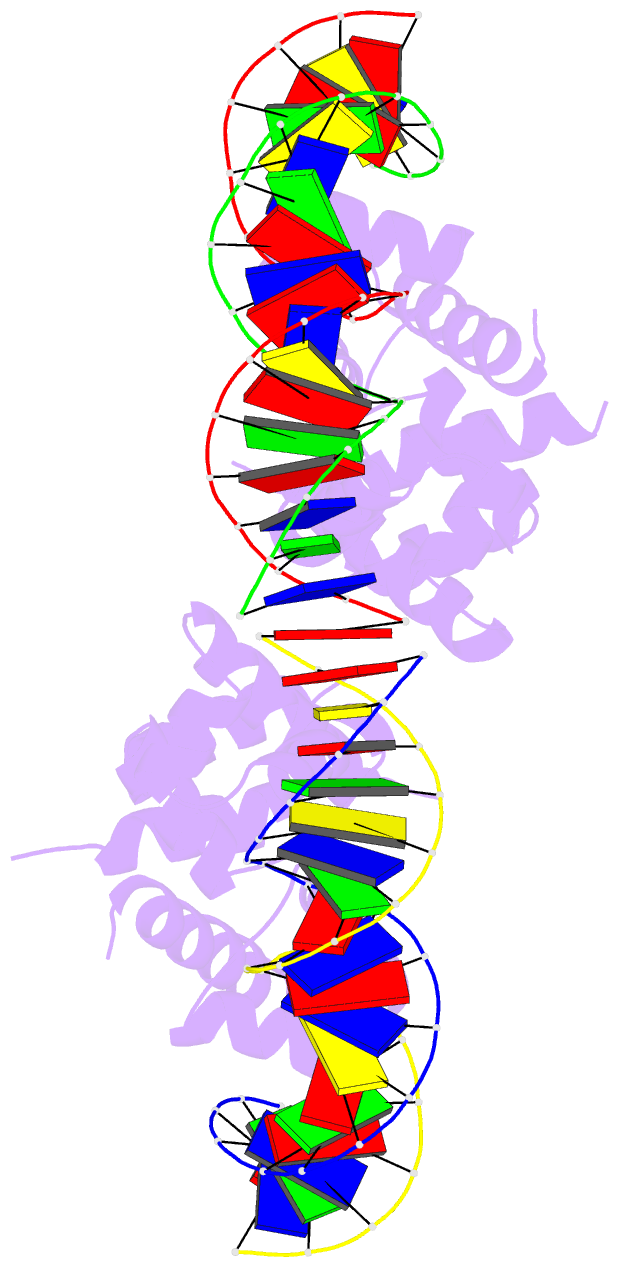
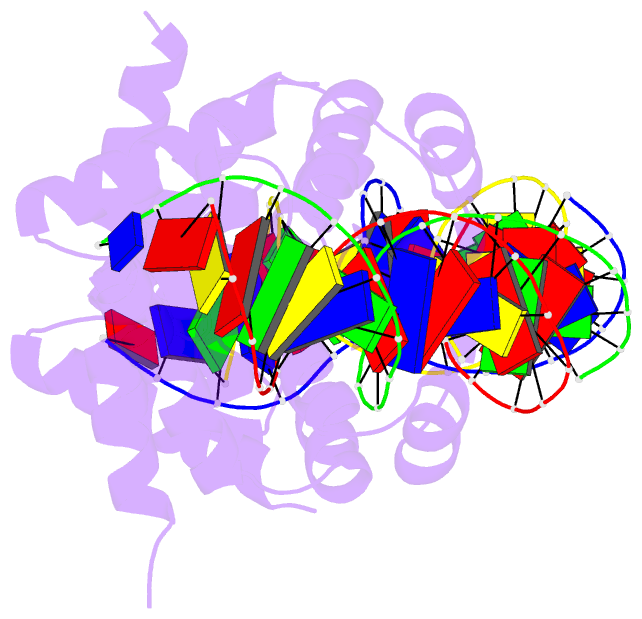
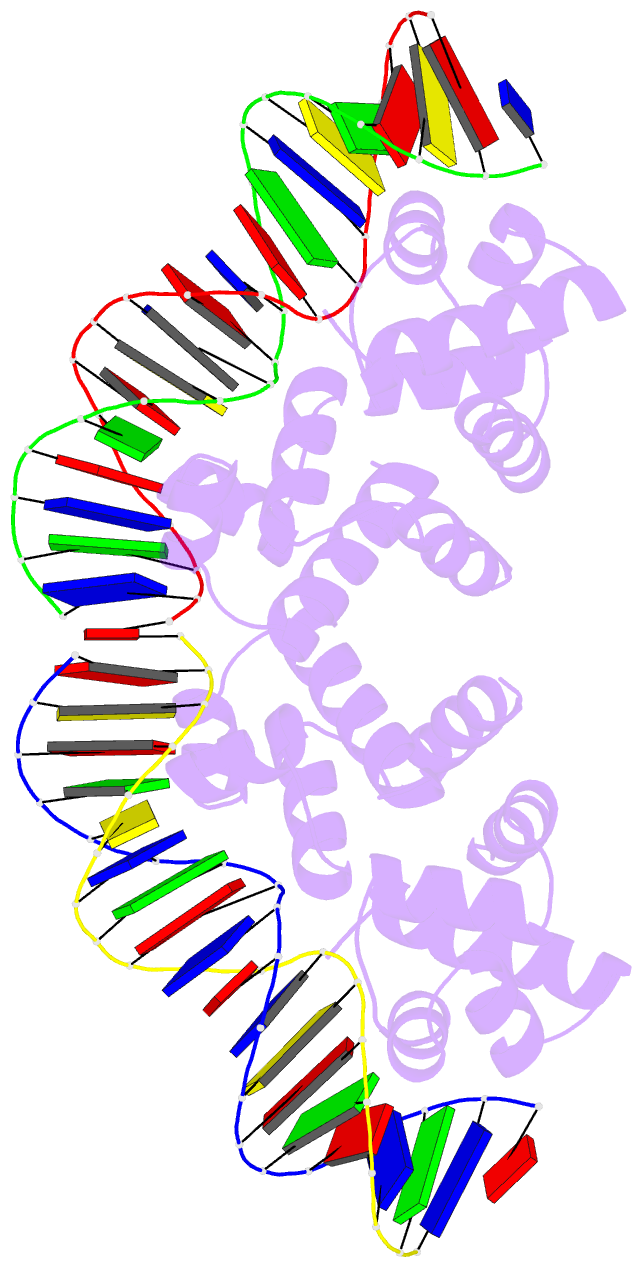
- A y37f mutant of c.esp1396i bound to its highest
affinity operator site om
- Reference
-
Martin RN, McGeehan JE, Kneale G (2014): "Structural
and Mutagenic Analysis of the RM Controller Protein
C.Esp1396I." Plos One, 9,
e98365. doi: 10.1371/journal.pone.0098365.
- Abstract
- Bacterial restriction-modification (RM) systems are
comprised of two complementary enzymatic activities that
prevent the establishment of foreign DNA in a bacterial
cell: DNA methylation and DNA restriction. These two
activities are tightly regulated to prevent
over-methylation or auto-restriction. Many Type II RM
systems employ a controller (C) protein as a
transcriptional regulator for the endonuclease gene (and in
some cases, the methyltransferase gene also). All
high-resolution structures of C-protein/DNA-protein
complexes solved to date relate to C.Esp1396I, from which
the interactions of specific amino acid residues with DNA
bases and/or the phosphate backbone could be observed. Here
we present both structural and DNA binding data for a
series of mutations to the key DNA binding residues of
C.Esp1396I. Our results indicate that mutations to the
backbone binding residues (Y37, S52) had a lesser affect on
DNA binding affinity than mutations to those residues that
bind directly to the bases (T36, R46), and the
contributions of each side chain to the binding energies
are compared. High-resolution X-ray crystal structures of
the mutant and native proteins showed that the fold of the
proteins was unaffected by the mutations, but also revealed
variation in the flexible loop conformations associated
with DNA sequence recognition. Since the tyrosine residue
Y37 contributes to DNA bending in the native complex, we
have solved the structure of the Y37F mutant protein/DNA
complex by X-ray crystallography to allow us to directly
compare the structure of the DNA in the mutant and native
complexes.