Summary information and primary citation
- PDB-id
-
4hiv;
DSSR-derived features in text and
JSON formats
- Class
- DNA-antibiotic
- Method
- X-ray (2.6 Å)
- Summary
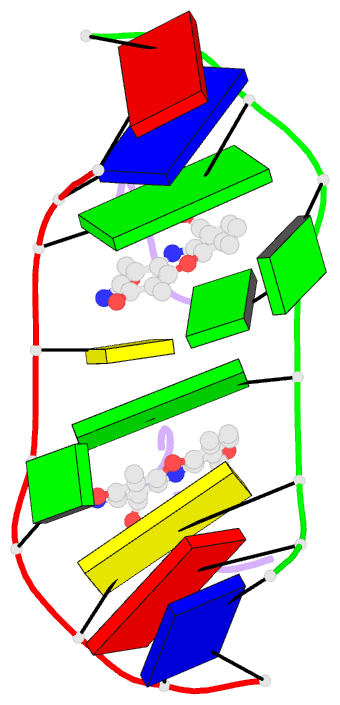
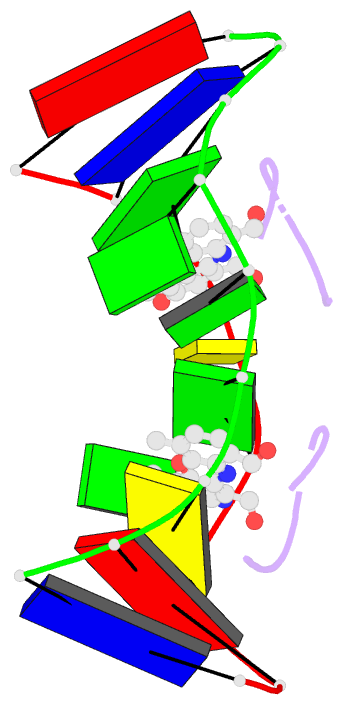
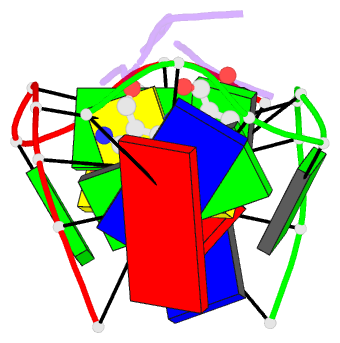
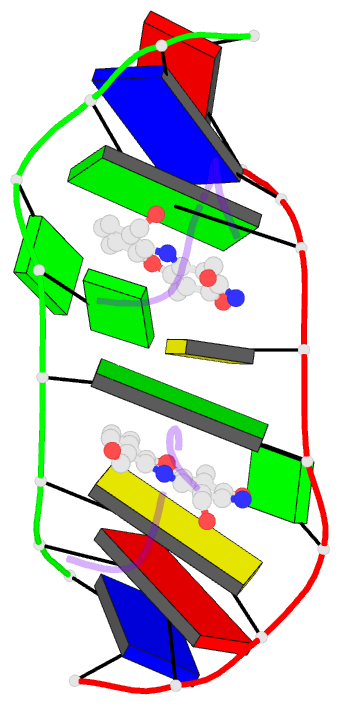
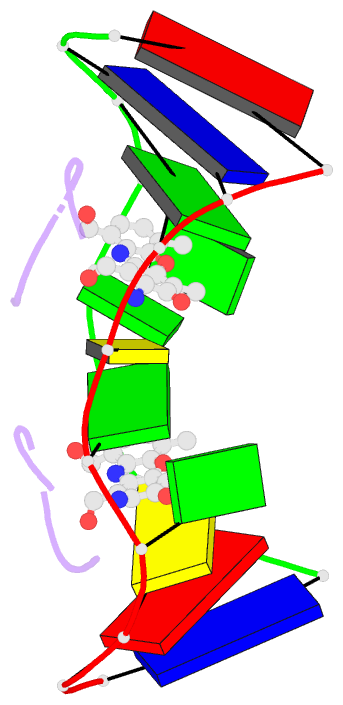
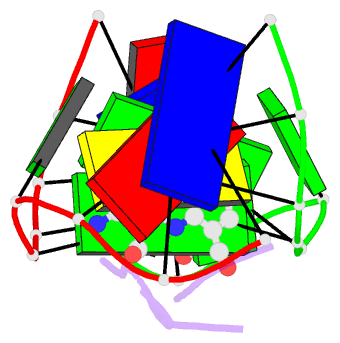
- Structure of actinomycin d d(atgcggcat) complex
- Reference
-
Lo YS, Tseng WH, Chuang CY, Hou MH (2013): "The
structural basis of actinomycin D-binding induces
nucleotide flipping out, a sharp bend and a left-handed
twist in CGG triplet repeats." Nucleic Acids
Res., 41, 4284-4294. doi: 10.1093/nar/gkt084.
- Abstract
- The potent anticancer drug actinomycin D (ActD)
functions by intercalating into DNA at GpC sites, thereby
interrupting essential biological processes including
replication and transcription. Certain neurological
diseases are correlated with the expansion of (CGG)n
trinucleotide sequences, which contain many contiguous GpC
sites separated by a single G:G mispair. To characterize
the binding of ActD to CGG triplet repeat sequences, the
structural basis for the strong binding of ActD to
neighbouring GpC sites flanking a G:G mismatch has been
determined based on the crystal structure of ActD bound to
ATGCGGCAT, which contains a CGG triplet sequence. The
binding of ActD molecules to GCGGC causes many unexpected
conformational changes including nucleotide flipping out, a
sharp bend and a left-handed twist in the DNA helix via a
two site-binding model. Heat denaturation, circular
dichroism and surface plasmon resonance analyses showed
that adjacent GpC sequences flanking a G:G mismatch are
preferred ActD-binding sites. In addition, ActD was shown
to bind the hairpin conformation of (CGG)16 in a pairwise
combination and with greater stability than that of other
DNA intercalators. Our results provide evidence of a
possible biological consequence of ActD binding to CGG
triplet repeat sequences.