Summary information and primary citation
- PDB-id
-
3rrg;
DSSR-derived features in text and
JSON formats
- Class
- transferase-DNA
- Method
- X-ray (2.3 Å)
- Summary
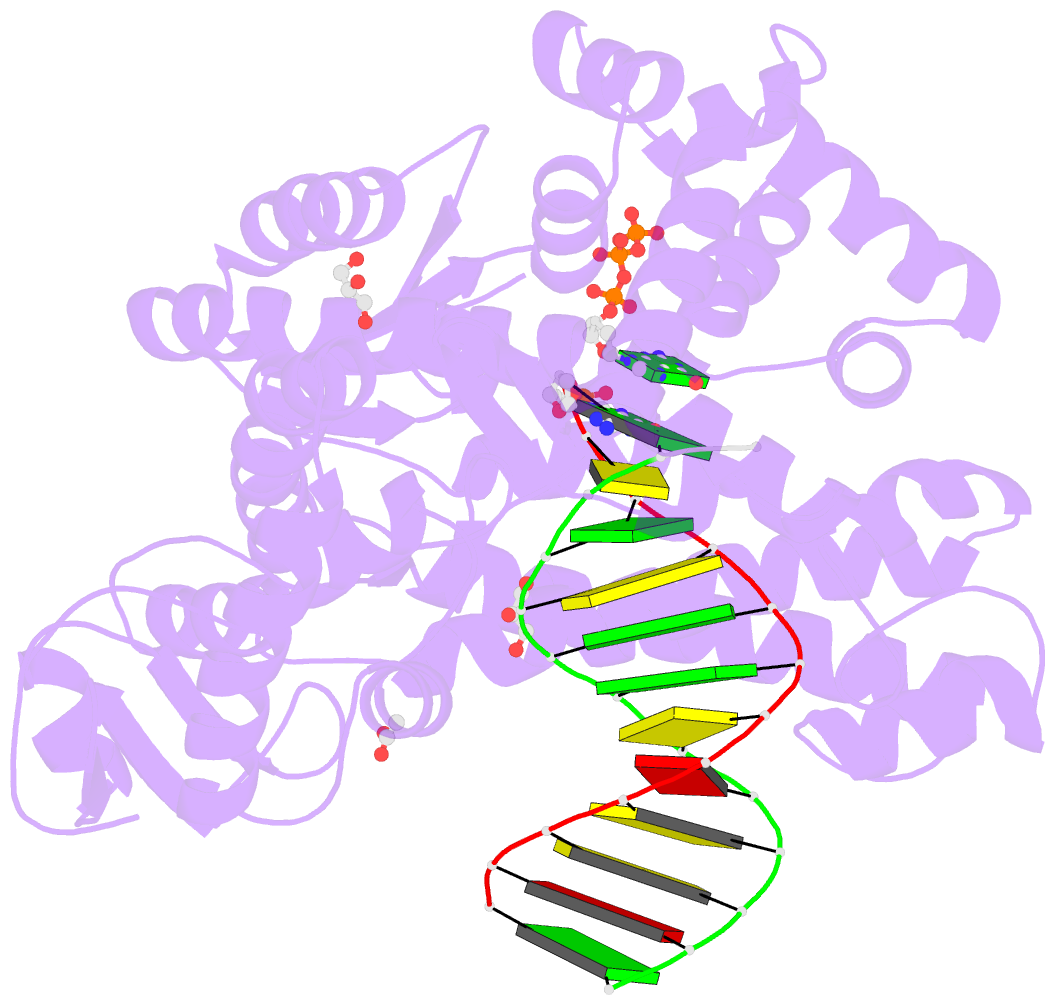
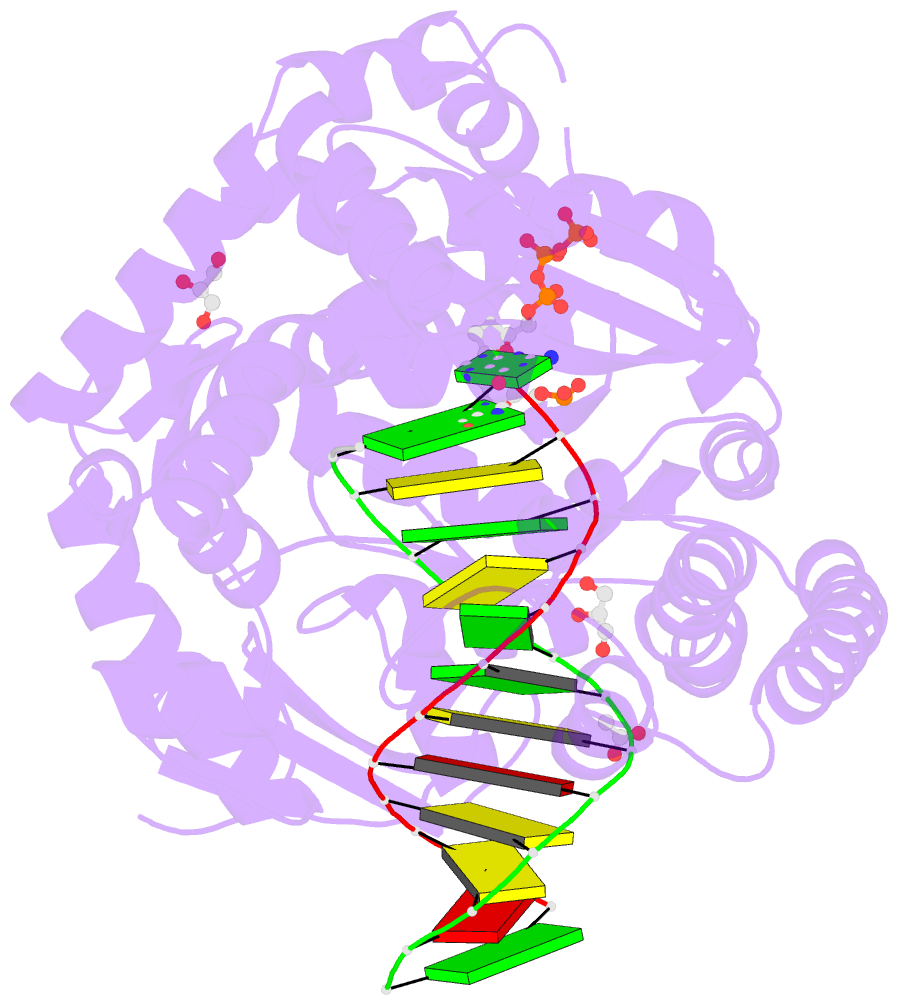
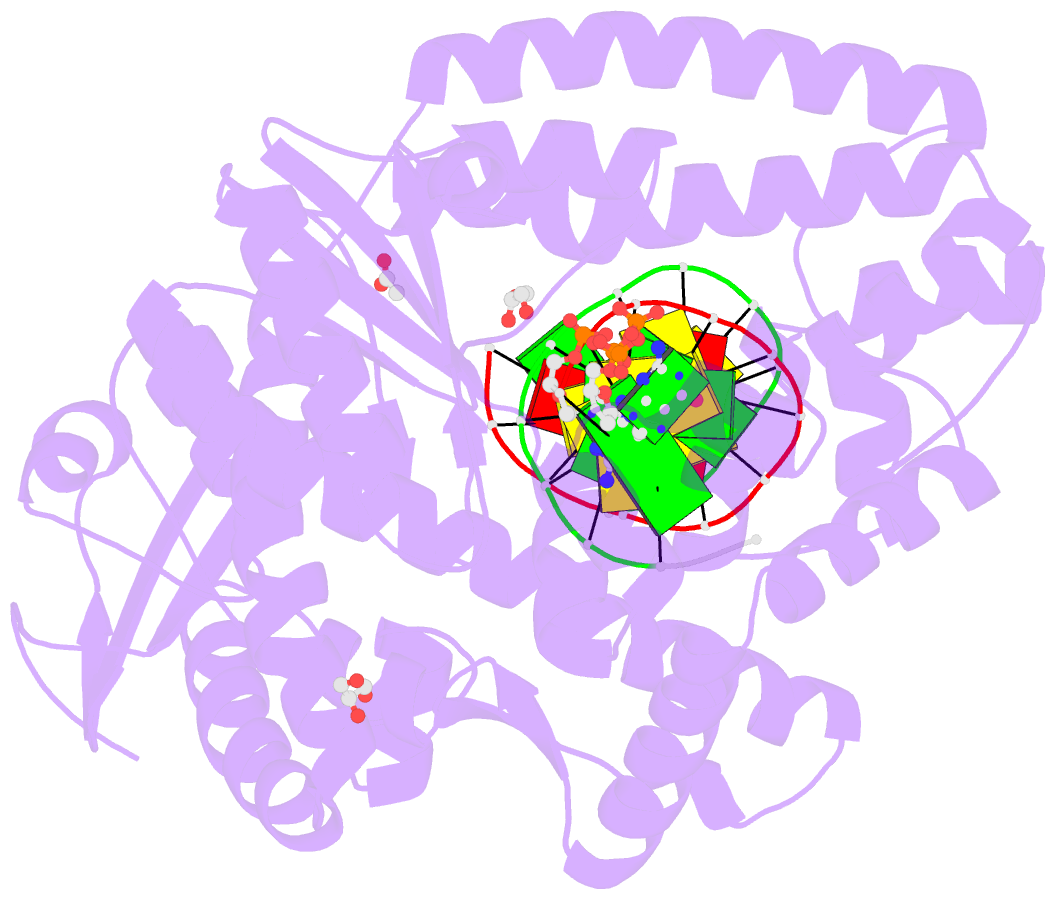
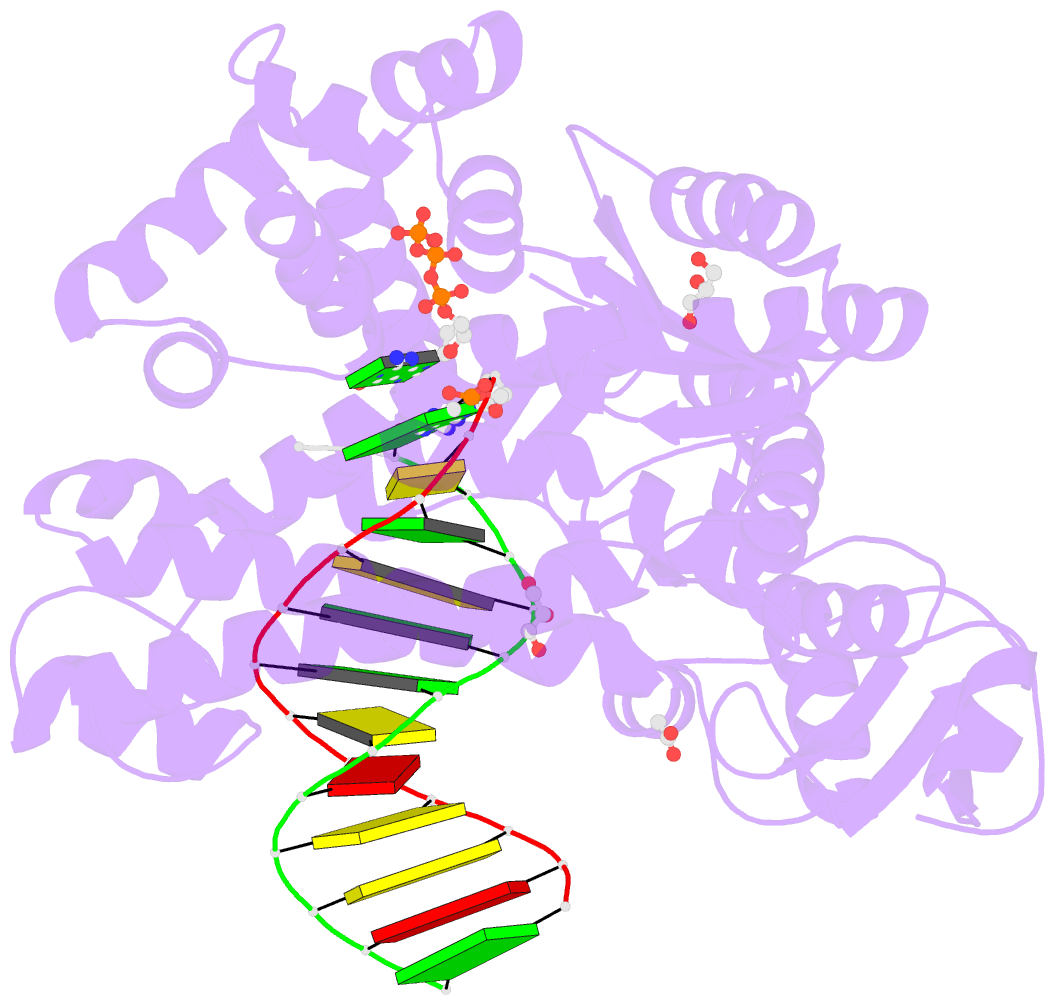
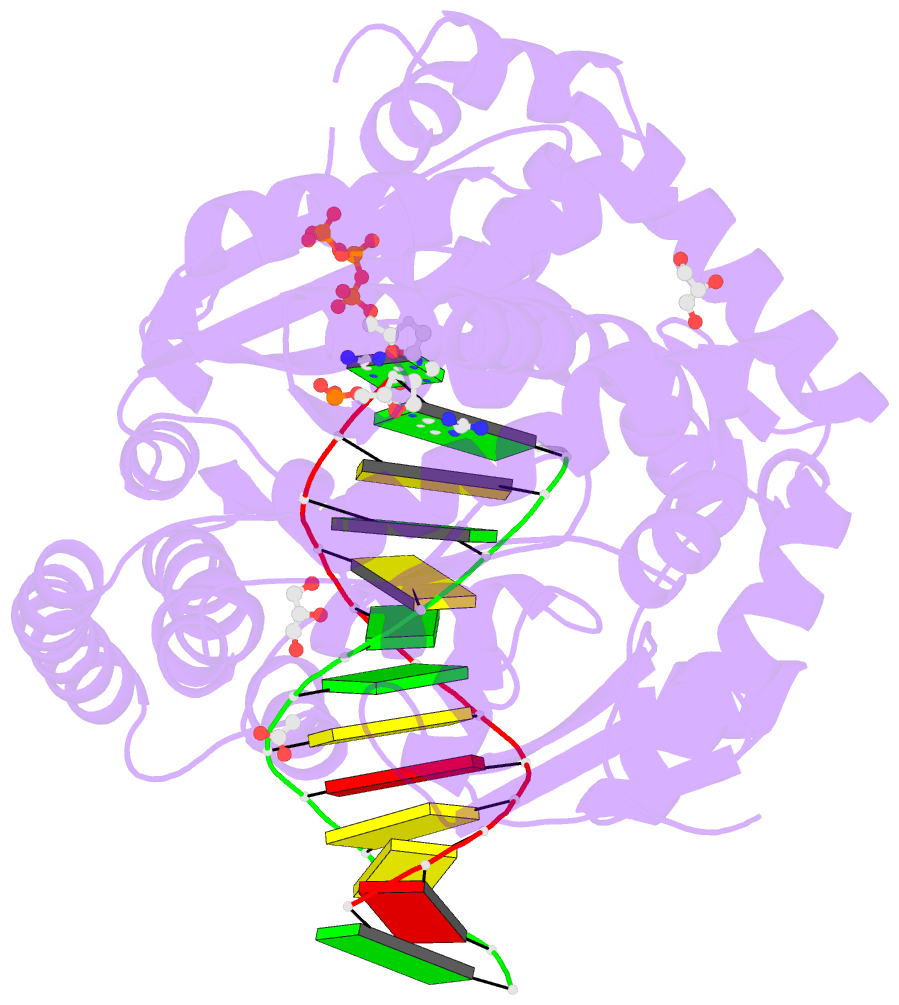
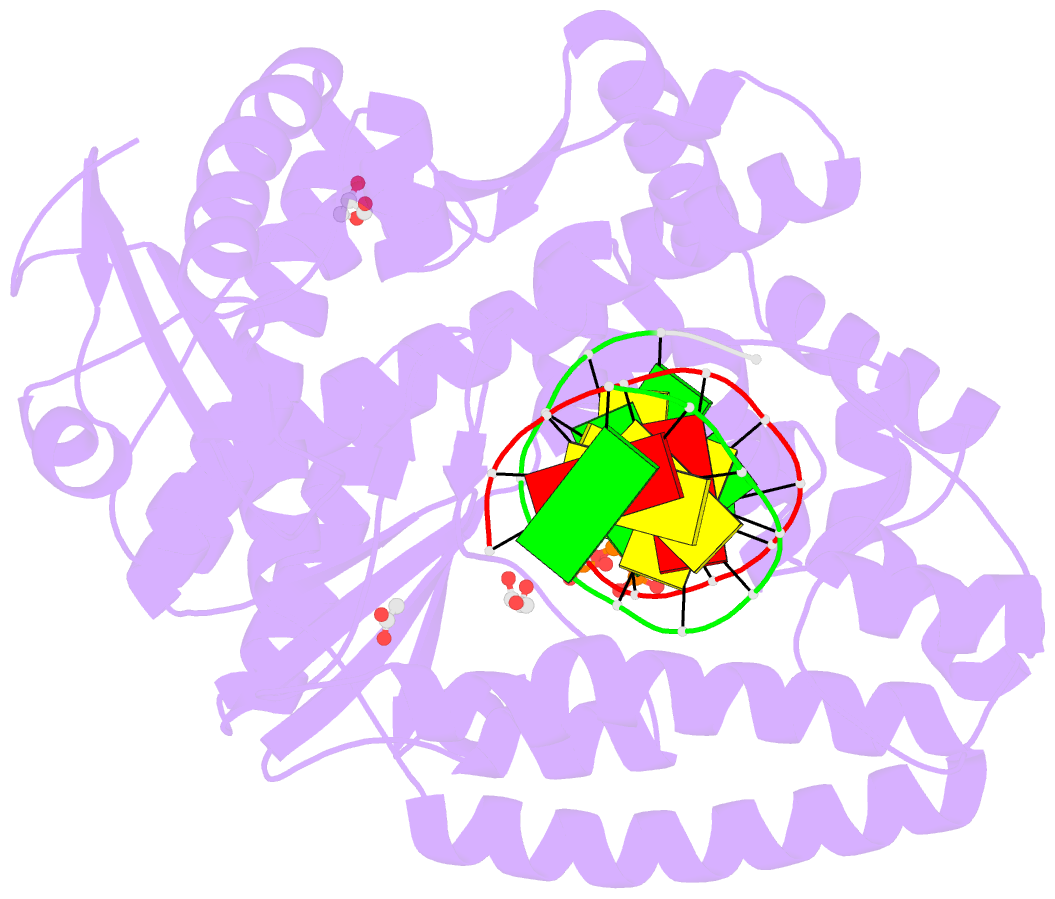
- Ternary structure of the large fragment of taq DNA
polymerase bound to an abasic site and a ddgtp
- Reference
-
Obeid S, Welte W, Diederichs K, Marx A (2012): "Amino Acid
templating mechanisms in selection of nucleotides
opposite abasic sites by a family a DNA polymerase."
J.Biol.Chem., 287, 14099-14108.
doi: 10.1074/jbc.M111.334904.
- Abstract
- Cleavage of the N-glycosidic bond that connects the
nucleobase to the backbone in DNA leads to abasic sites,
the most frequent lesion under physiological conditions.
Several DNA polymerases preferentially incorporate an A
opposite this lesion, a phenomenon termed "A-rule."
Accordingly, KlenTaq, the large fragment of Thermus
aquaticus DNA polymerase I, incorporates a nucleotide
opposite an abasic site with efficiencies of A > G >
T > C. Here we provide structural insights into
constraints of the active site during nucleotide selection
opposite an abasic site. It appears that these confines
govern the nucleotide selection mainly by interaction of
the incoming nucleotide with Tyr-671. Depending on the
nucleobase, the nucleotides are differently positioned
opposite Tyr-671 resulting in different alignments of the
functional groups that are required for bond formation. The
distances between the α-phosphate and the 3'-primer
terminus increases in the order A < G < T, which
follows the order of incorporation efficiency.
Additionally, a binary KlenTaq structure bound to DNA
containing an abasic site indicates that binding of the
nucleotide triggers a remarkable rearrangement of enzyme
and DNA template. The ability to resolve the stacking
arrangement might be dependent on the intrinsic properties
of the respective nucleotide contributing to nucleotide
selection. Furthermore, we studied the incorporation of a
non-natural nucleotide opposite an abasic site. The
nucleotide was often used in studying stacking effects in
DNA polymerization. Here, no interaction with Tyr-761 as
found for the natural nucleotides is observed, indicating a
different reaction path for this non-natural
nucleotide.