Summary information and primary citation
- PDB-id
-
3ecp;
DSSR-derived features in text and
JSON formats
- Class
- DNA recombination-DNA
- Method
- X-ray (2.5 Å)
- Summary
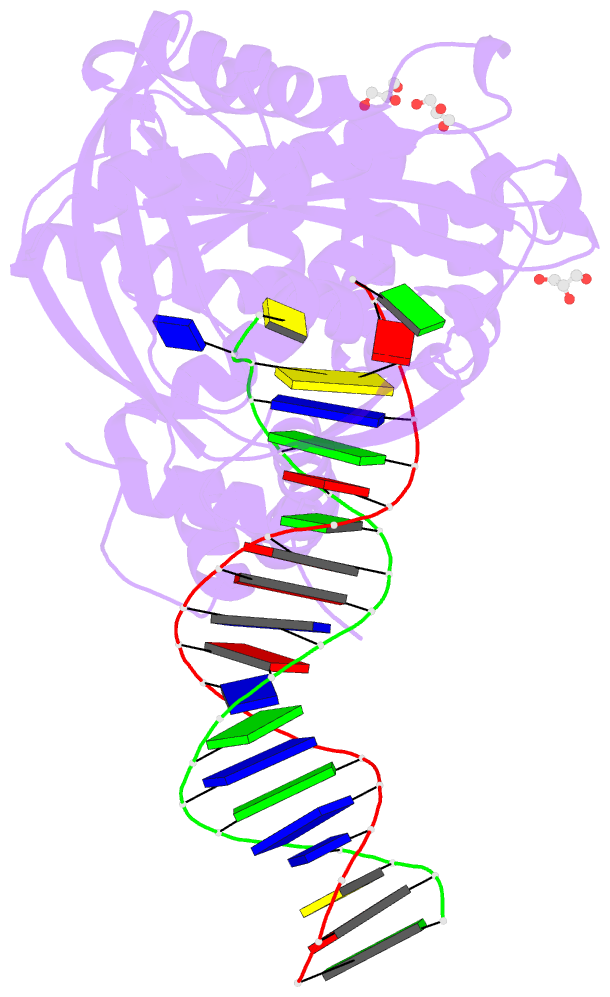
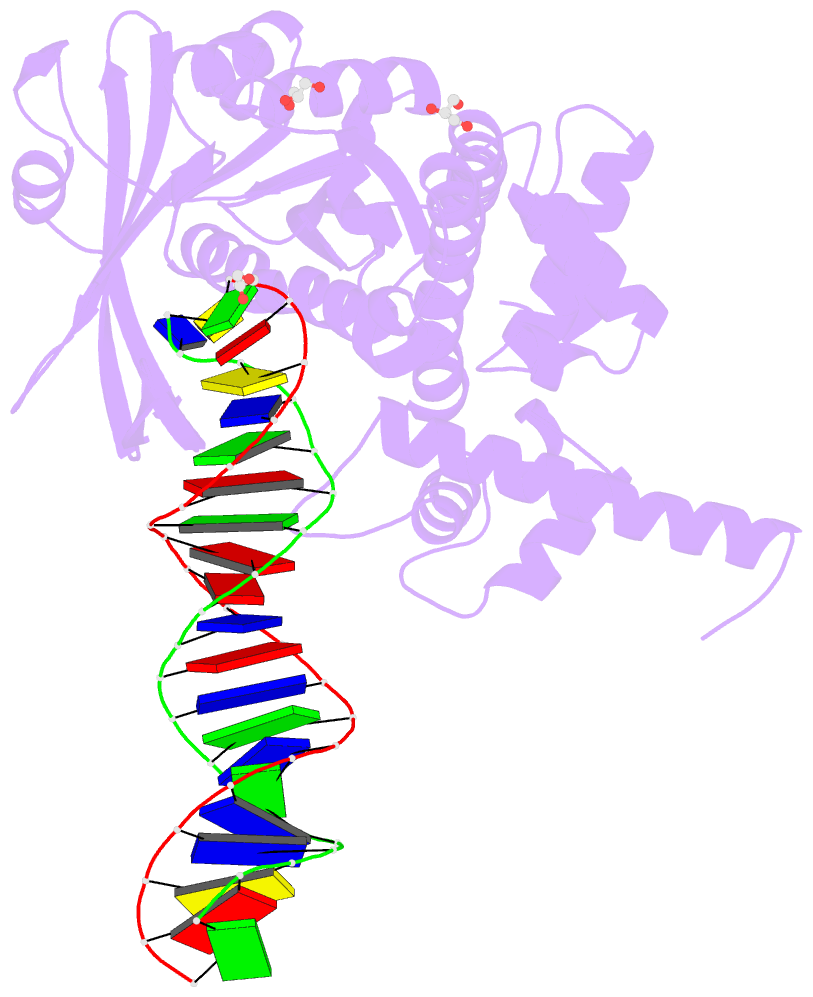
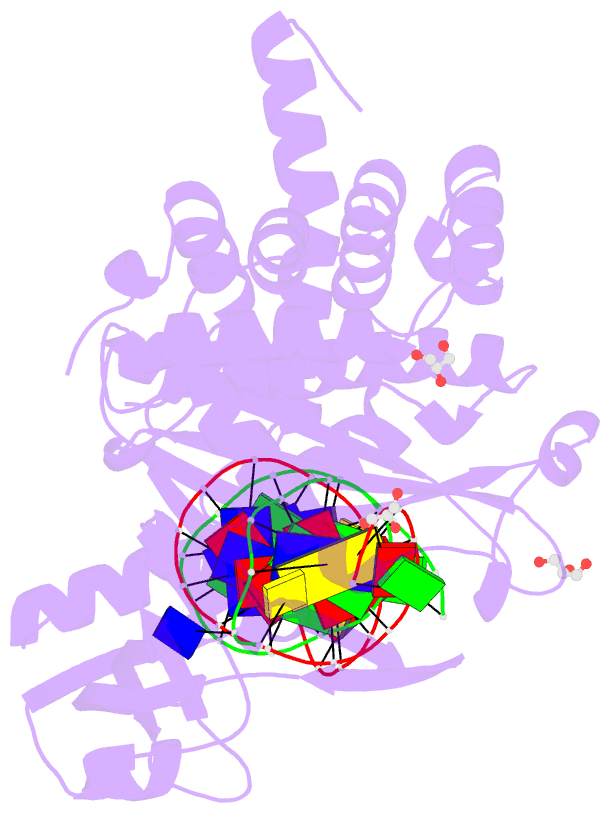
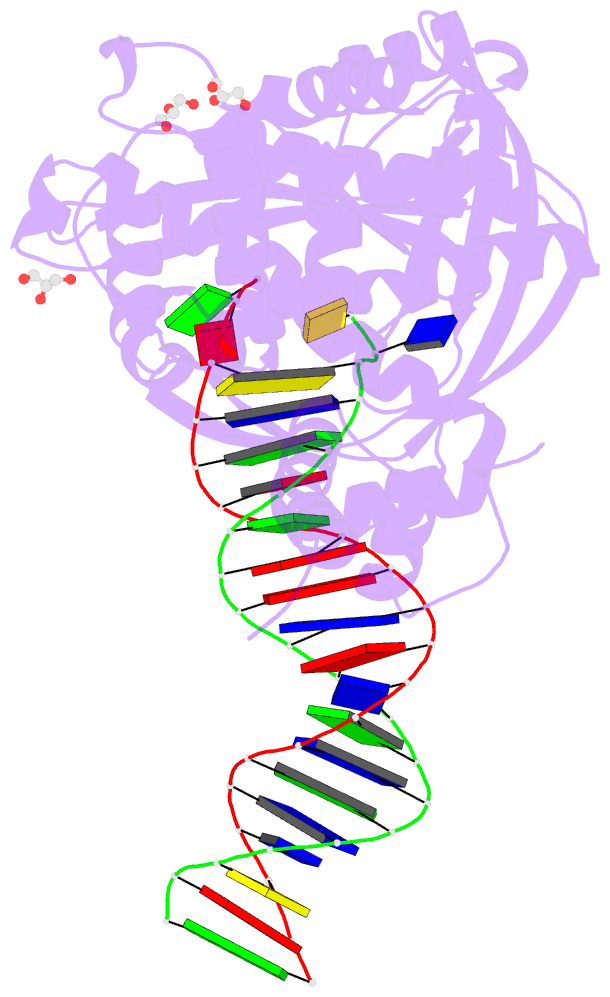
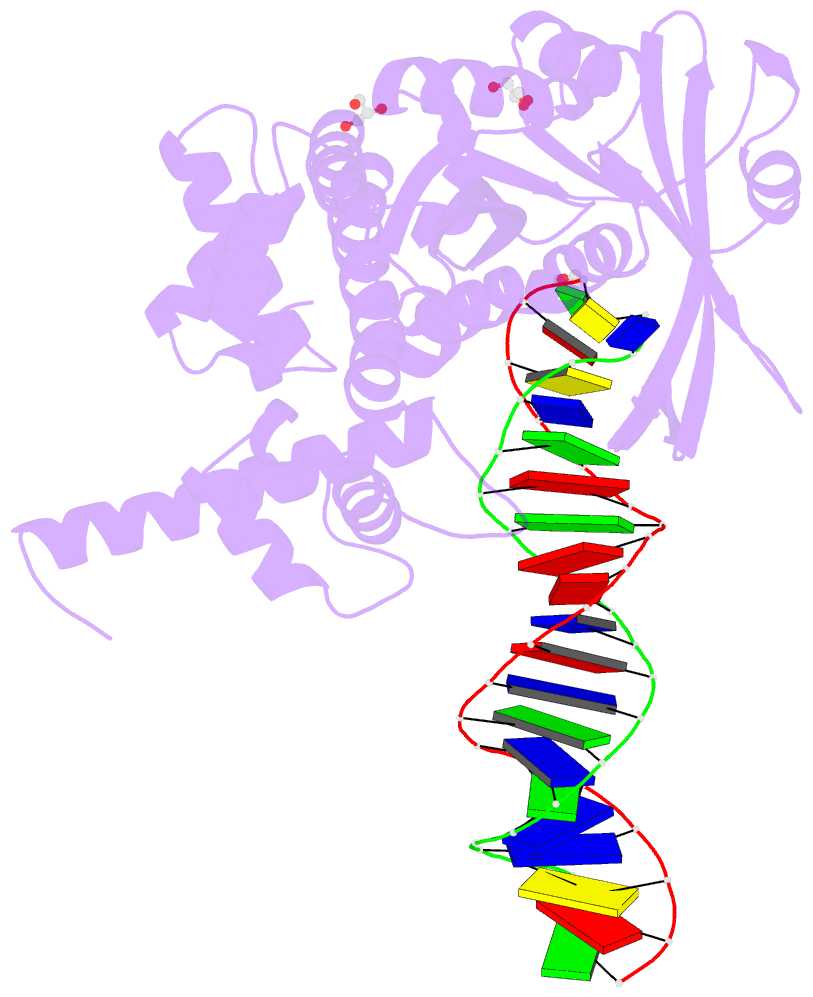
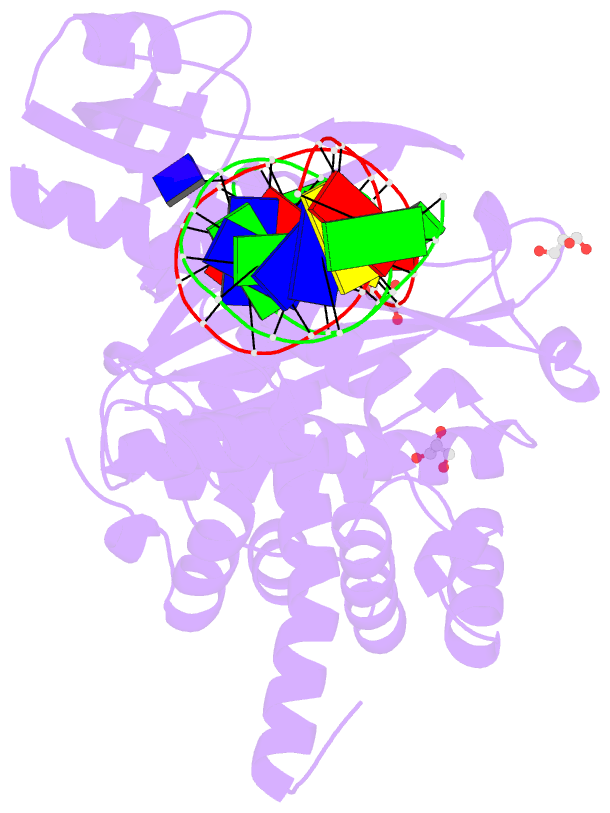
- Crystal structure of tn5 transposase complexed with 5'
phosphorylated transposon end DNA
- Reference
-
Klenchin VA, Czyz A, Goryshin IY, Gradman R, Lovell S,
Rayment I, Reznikoff WS (2008): "Phosphate
coordination and movement of DNA in the Tn5 synaptic
complex: role of the (R)YREK motif." Nucleic
Acids Res., 36, 5855-5862. doi:
10.1093/nar/gkn577.
- Abstract
- Bacterial DNA transposition is an important model
system for studying DNA recombination events such as HIV-1
DNA integration and RAG-1-mediated V(D)J recombination.
This communication focuses on the role of protein-phosphate
contacts in manipulating DNA structure as a requirement for
transposition catalysis. In particular, the participation
of the nontransferred strand (NTS) 5' phosphate in Tn5
transposition strand transfer is analyzed. The 5' phosphate
plays no direct catalytic role, nonetheless its presence
stimulates strand transfer approximately 30-fold. X-ray
crystallography indicates that transposase-DNA complexes
formed with NTS 5' phosphorylated DNA have two properties
that contrast with structures formed with complexes lacking
the 5' phosphate or complexes generated from in-crystal
hairpin cleavage. Transposase residues R210, Y319 and R322
of the (R)YREK motif coordinate the 5' phosphate rather
than the subterminal NTS phosphate, and the 5' NTS end is
moved away from the 3' transferred strand end. Mutation
R210A impairs the 5' phosphate stimulation. It is posited
that DNA phosphate coordination by R210, Y319 and R322
results in movement of the 5' NTS DNA away from the 3'-end
thus allowing efficient target DNA binding. It is likely
that this role for the newly identified RYR triad is
utilized by other transposase-related proteins.