Summary information and primary citation
- PDB-id
-
3aoh;
DSSR-derived features in text and
JSON formats
- Class
- transcription, transferase-DNA-RNA
- Method
- X-ray (4.1 Å)
- Summary
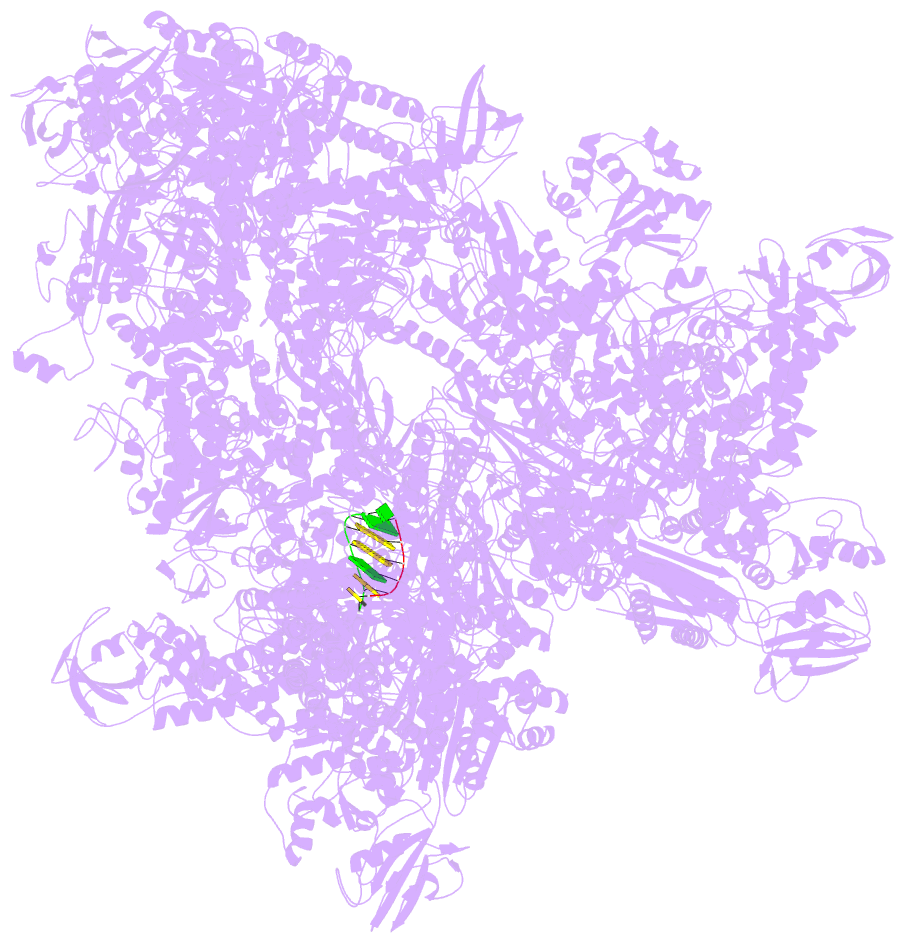
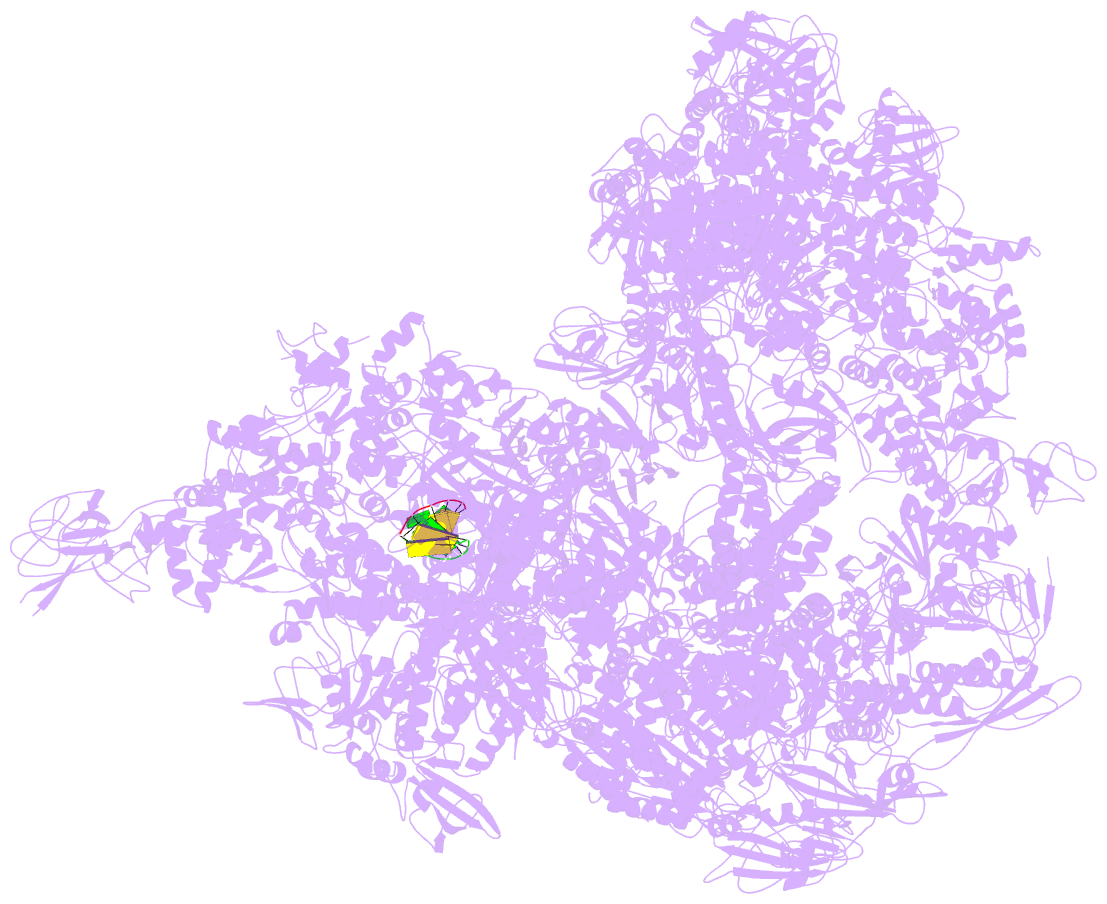
- RNA polymerase-gfh1 complex (crystal type 1)
- Reference
-
Tagami S, Sekine SI, Kumarevel T, Hino N, Murayama Y,
Kamegamori S, Yamamoto M, Sakamoto K, Yokoyama S (2010):
"Crystal
structure of bacterial RNA polymerase bound with a
transcription inhibitor protein." Nature,
468, 978-982. doi: 10.1038/nature09573.
- Abstract
- The multi-subunit DNA-dependent RNA polymerase (RNAP)
is the principal enzyme of transcription for gene
expression. Transcription is regulated by various
transcription factors. Gre factor homologue 1 (Gfh1), found
in the Thermus genus, is a close homologue of the
well-conserved bacterial transcription factor GreA, and
inhibits transcription initiation and elongation by binding
directly to RNAP. The structural basis of transcription
inhibition by Gfh1 has remained elusive, although the
crystal structures of RNAP and Gfh1 have been determined
separately. Here we report the crystal structure of Thermus
thermophilus RNAP complexed with Gfh1. The amino-terminal
coiled-coil domain of Gfh1 fully occludes the channel
formed between the two central modules of RNAP; this
channel would normally be used for nucleotide triphosphate
(NTP) entry into the catalytic site. Furthermore, the tip
of the coiled-coil domain occupies the NTP β-γ
phosphate-binding site. The NTP-entry channel is expanded,
because the central modules are 'ratcheted' relative to
each other by ∼7°, as compared with the previously reported
elongation complexes. This 'ratcheted state' is an
alternative structural state, defined by a newly acquired
contact between the central modules. Therefore, the shape
of Gfh1 is appropriate to maintain RNAP in the ratcheted
state. Simultaneously, the ratcheting expands the
nucleic-acid-binding channel, and kinks the bridge helix,
which connects the central modules. Taken together, the
present results reveal that Gfh1 inhibits transcription by
preventing NTP binding and freezing RNAP in the alternative
structural state. The ratcheted state might also be
associated with other aspects of transcription, such as
RNAP translocation and transcription termination.