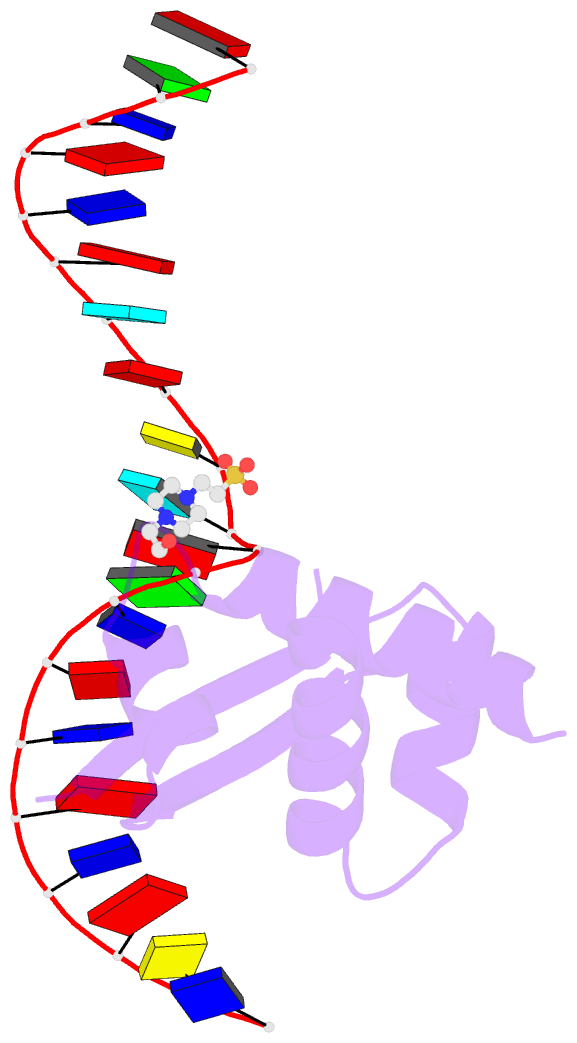
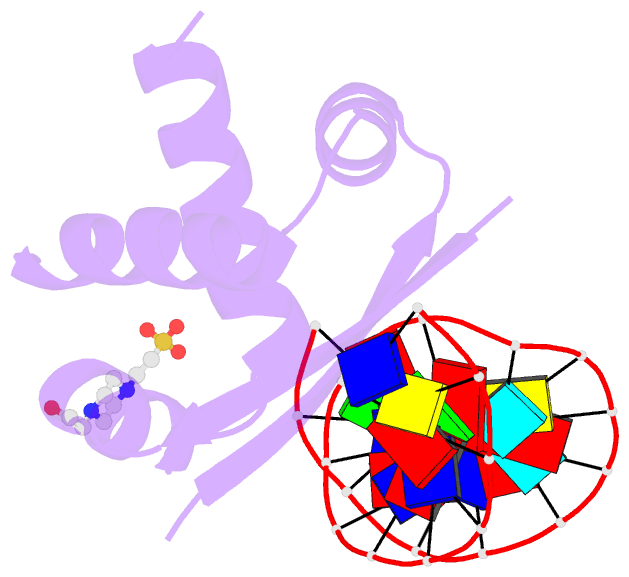
Summary information and primary citation
- PDB-id
-
2q2k;
DSSR-derived features in text and
JSON formats
- Class
- DNA binding protein-DNA
- Method
- X-ray (3.0 Å)
- Summary
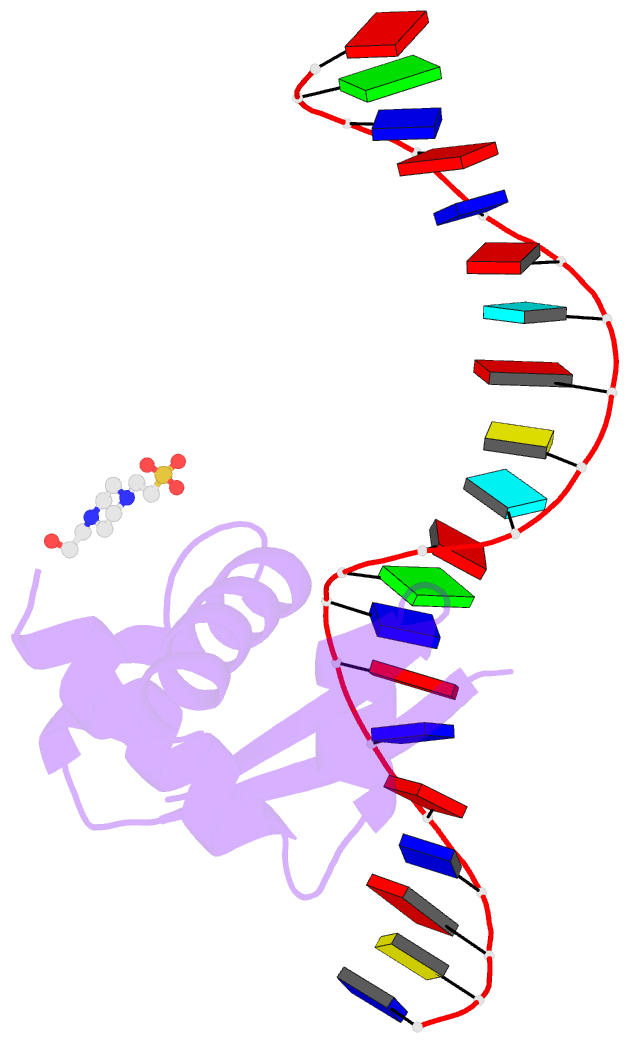
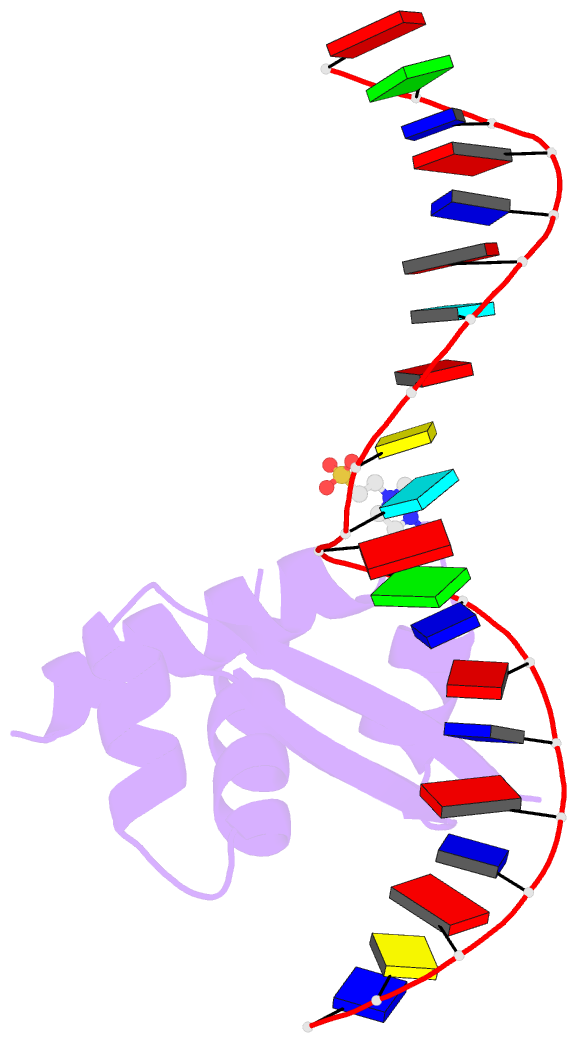
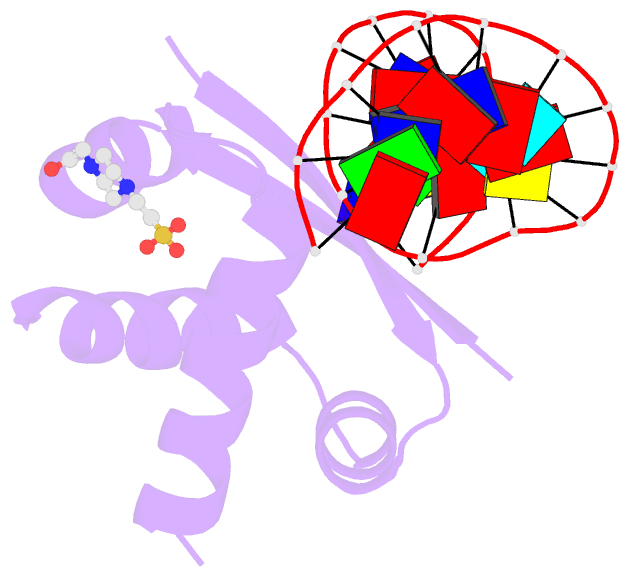
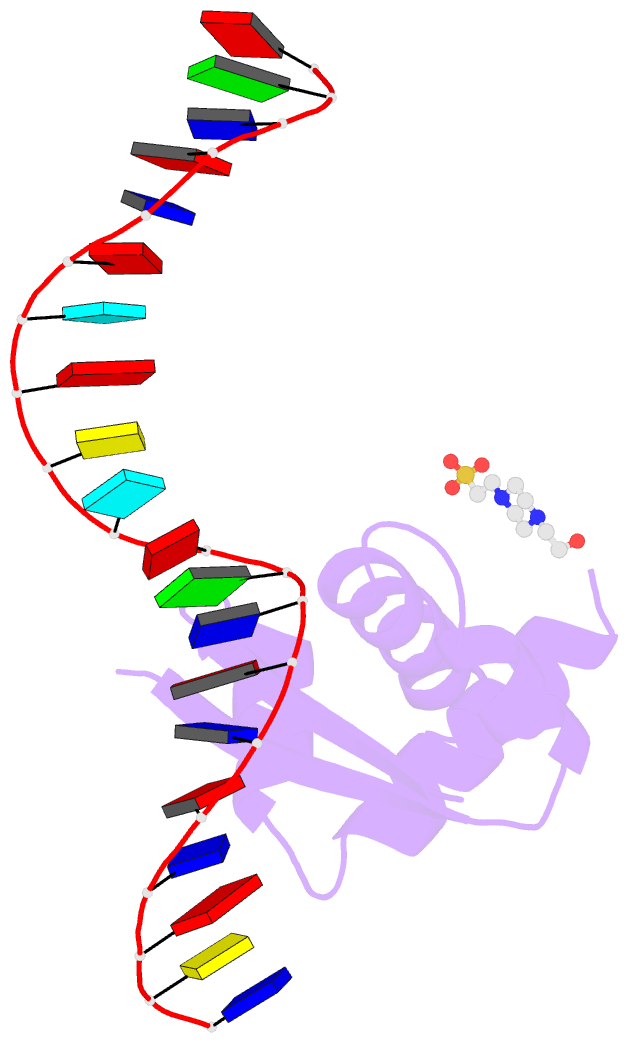
- Structure of nucleic-acid binding protein
- Reference
-
Schumacher MA, Glover TC, Brzoska AJ, Jensen SO, Dunham
TD, Skurray RA, Firth N (2007): "Segrosome
structure revealed by a complex of ParR with centromere
DNA." Nature, 450,
1268-1271. doi: 10.1038/nature06392.
- Abstract
- The stable inheritance of genetic material depends on
accurate DNA partition. Plasmids serve as tractable model
systems to study DNA segregation because they require only
a DNA centromere, a centromere-binding protein and a
force-generating ATPase. The centromeres of partition (par)
systems typically consist of a tandem arrangement of direct
repeats. The best-characterized par system contains a
centromere-binding protein called ParR and an ATPase called
ParM. In the first step of segregation, multiple ParR
proteins interact with the centromere repeats to form a
large nucleoprotein complex of unknown structure called the
segrosome, which binds ParM filaments. pSK41 ParR binds a
centromere consisting of multiple 20-base-pair (bp) tandem
repeats to mediate both transcription autoregulation and
segregation. Here we report the structure of the pSK41
segrosome revealed in the crystal structure of a ParR-DNA
complex. In the crystals, the 20-mer tandem repeats stack
pseudo-continuously to generate the full-length centromere
with the ribbon-helix-helix (RHH) fold of ParR binding
successive DNA repeats as dimer-of-dimers. Remarkably, the
dimer-of-dimers assemble in a continuous protein
super-helical array, wrapping the DNA about its positive
convex surface to form a large segrosome with an open,
solenoid-shaped structure, suggesting a mechanism for ParM
capture and subsequent plasmid segregation.