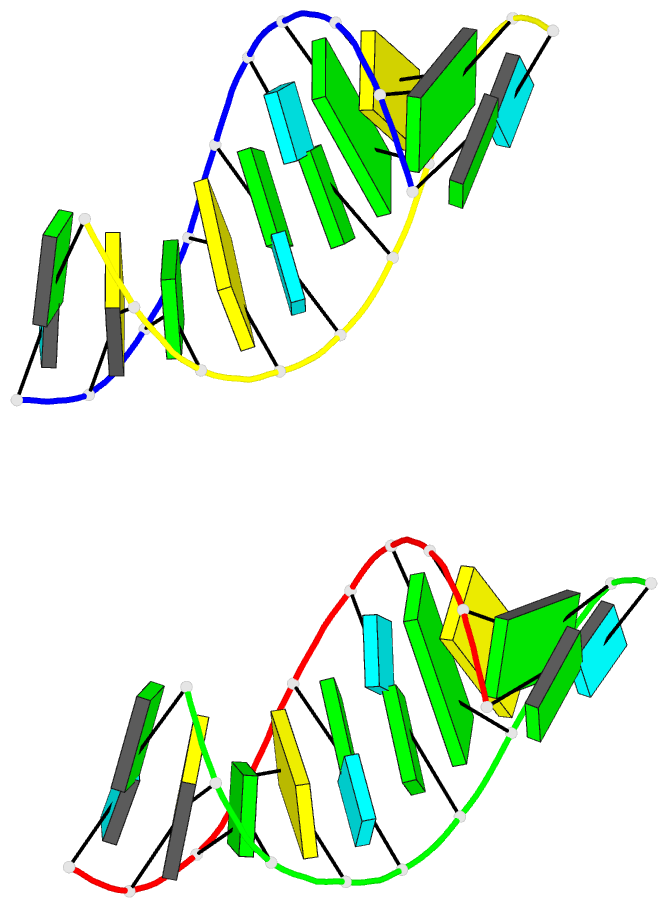
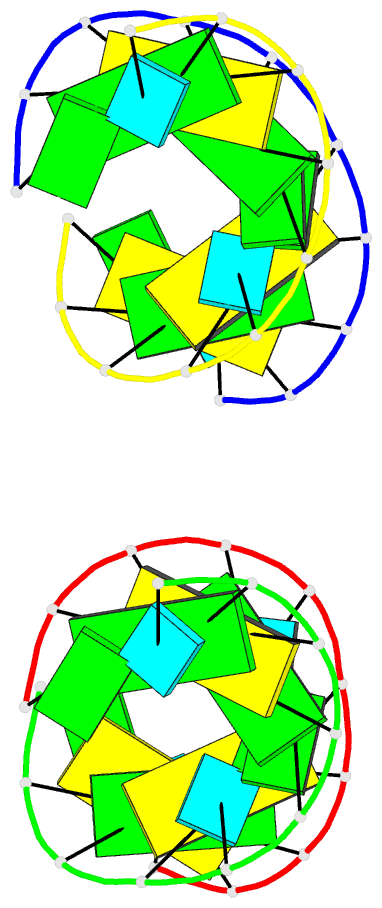
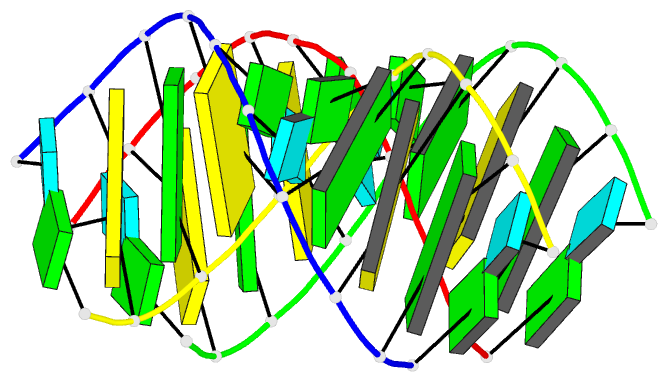
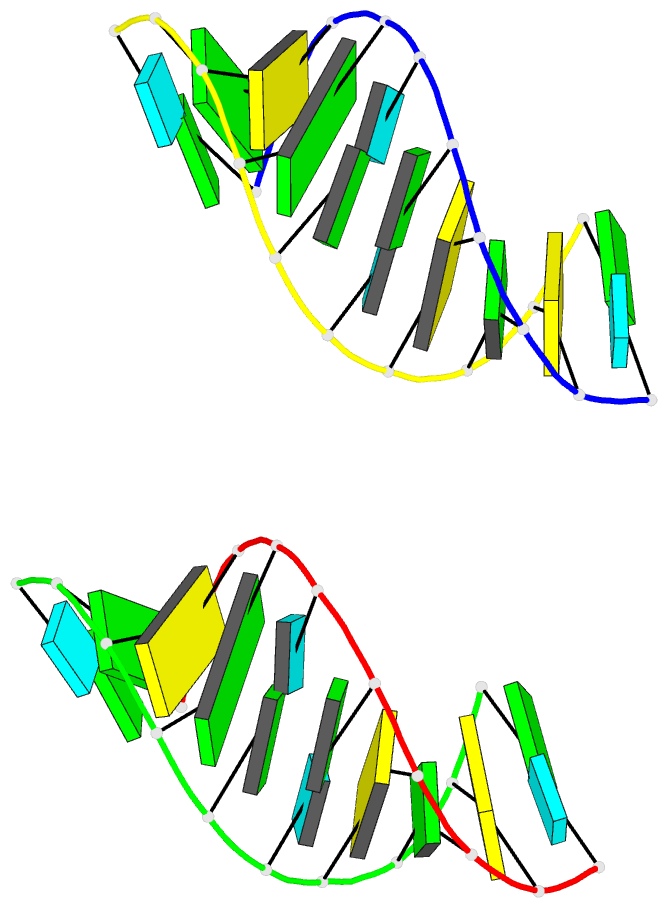
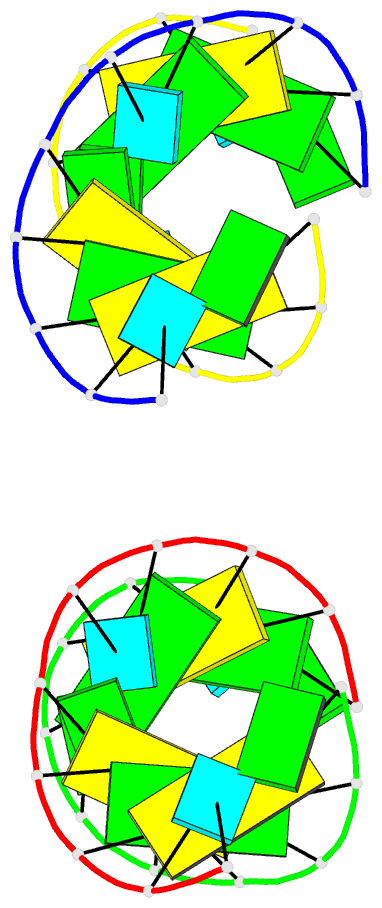
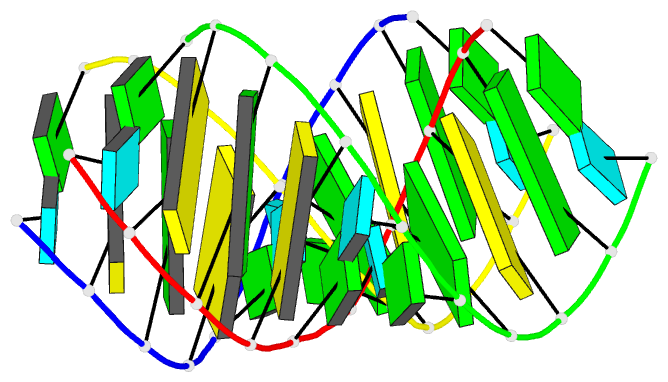
Summary information and primary citation
- PDB-id
-
2ao5;
DSSR-derived features in text and
JSON formats
- Class
- RNA
- Method
- X-ray (2.1 Å)
- Summary
- Crystal structure of an RNA duplex r(ggcgbrugcgcu)2
with terminal and internal tandem g-u base pairs
- Reference
-
Utsunomiya R, Suto K, Balasundaresan D, Fukamizu A, Kumar
PK, Mizuno H (2006): "Structure
of an RNA duplex r(GGCGBrUGCGCU)2 with terminal and
internal tandem G.U base pairs." Acta
Crystallogr.,Sect.D, 62, 331-338.
doi: 10.1107/S0907444905043210.
- Abstract
- The crystal structure of a self-complementary RNA
duplex r(GGCG(Br)UGCGCU)(2) with terminal G.U and internal
tandem G.U base pairs has been determined at 2.1 Angstroms
resolution. The crystals belong to the tetragonal space
group P4(3), with unit-cell parameters a = b = 37.69, c =
96.28 Angstroms and two duplexes in the asymmetric unit.
The two strands of each duplex are related by a pseudodyad
axis. The structure was refined to final R(work) and
R(free) values of 20.9 and 25.3%, respectively. The
duplexes stack in an end-to-end manner, forming infinite
columns along the c axis. This is the first structural
study of an RNA duplex containing G.U pairs at the termini.
The stacking overlaps of the terminal G.U base pairs with
their adjacent Watson-Crick base pairs are larger than
those of Watson-Crick base pairs of the 5'-YR-3'/3'-RY-5'
type. The terminal G.U base pairs of neighbouring duplexes
are also stacked with each other. An alternating
underwound-overwound pattern of the twist angles is seen at
each step along the duplex. This observation is typical for
internal tandem G.U pairs, while the terminal G.U base
pairs exhibit high twist angles with the adjacent
Watson-Crick pairs. The 3'-side of U of the internal G.U
base pair, which is unstacked, appears to be stabilized by
pi-cation interaction with an Mg(2+) ion.