Summary information and primary citation
- PDB-id
-
1y9s;
DSSR-derived features in text and
JSON formats
- Class
- DNA
- Method
- X-ray (1.55 Å)
- Summary
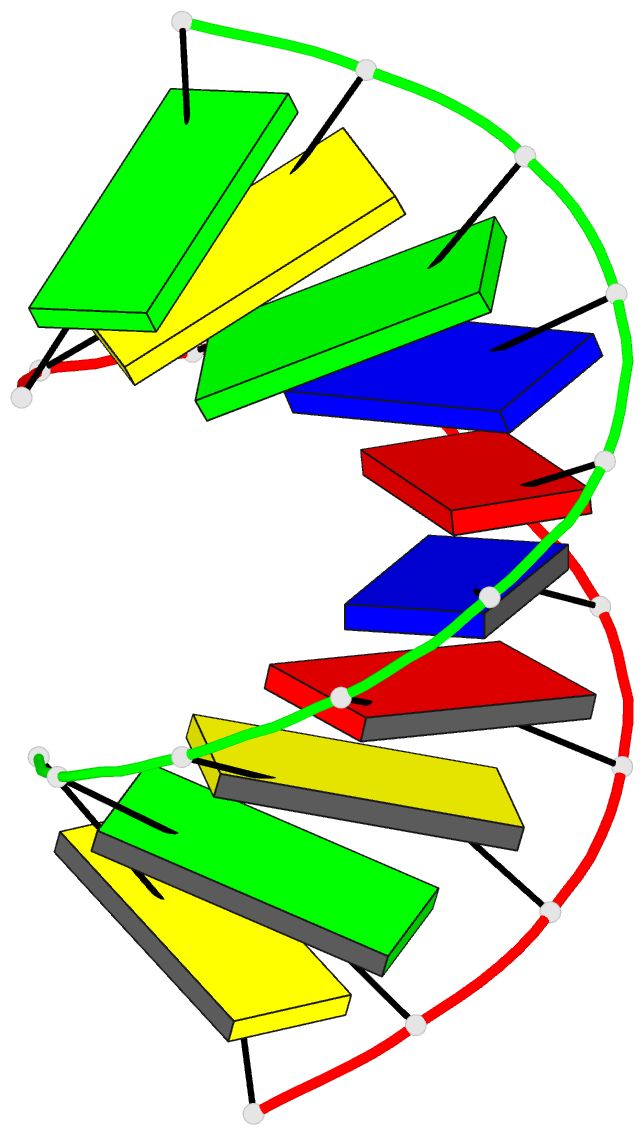
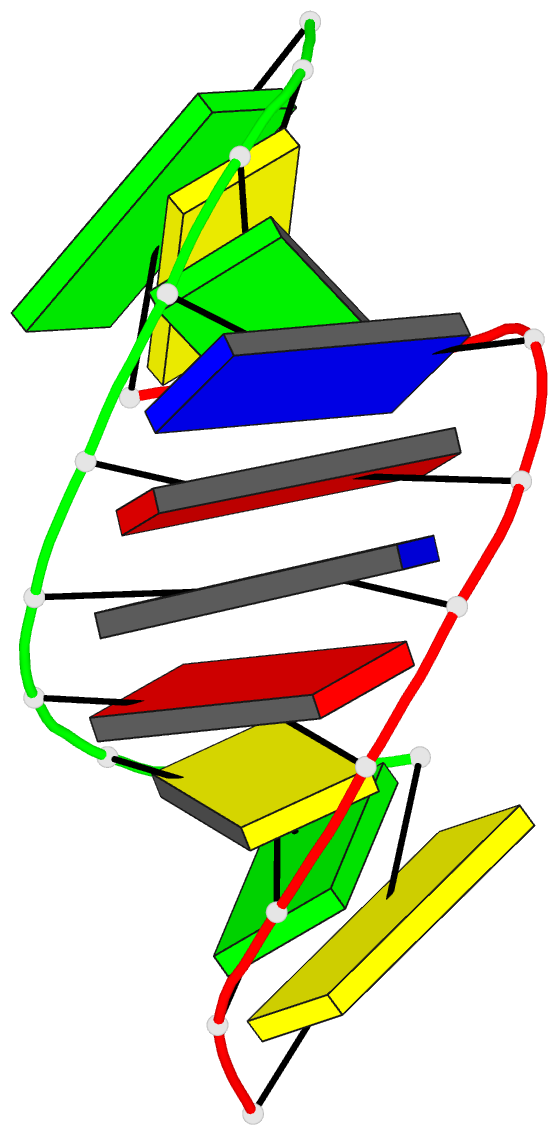
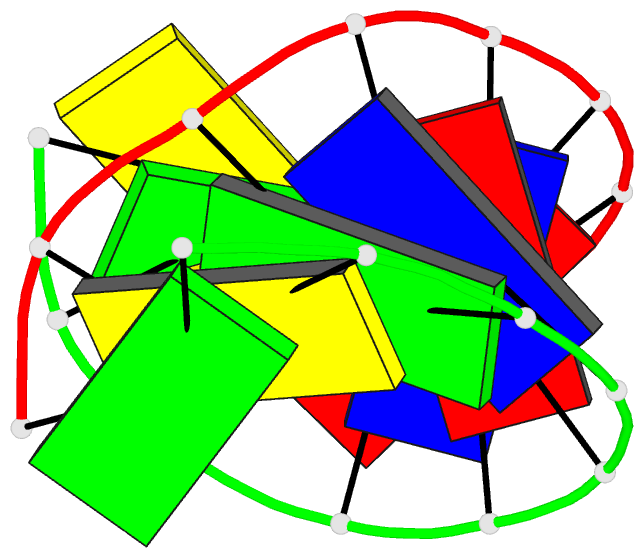
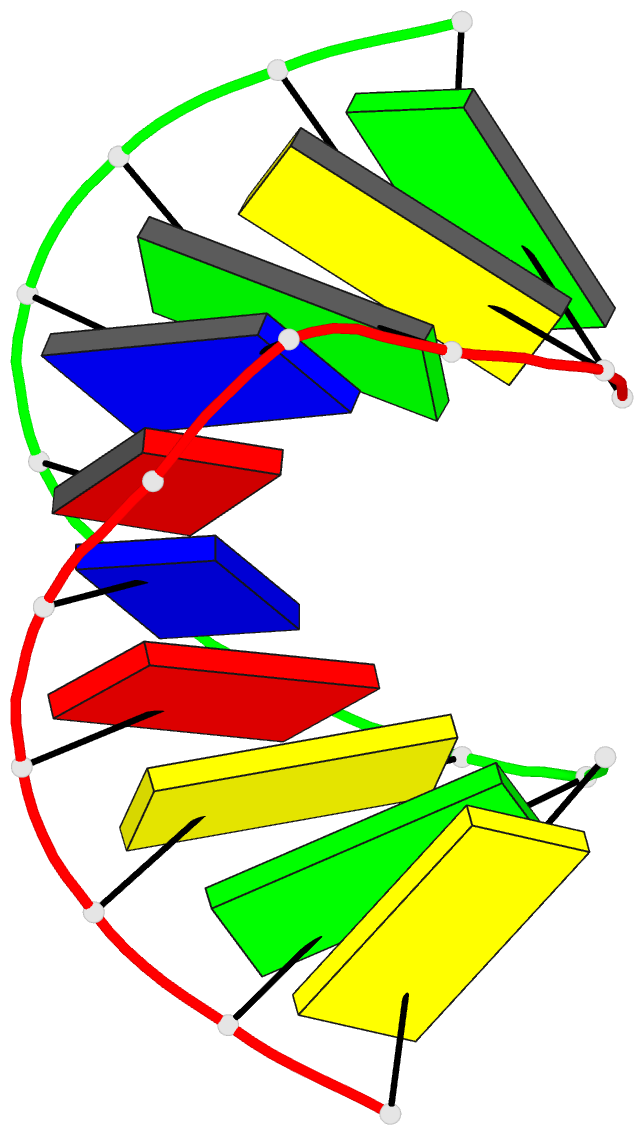
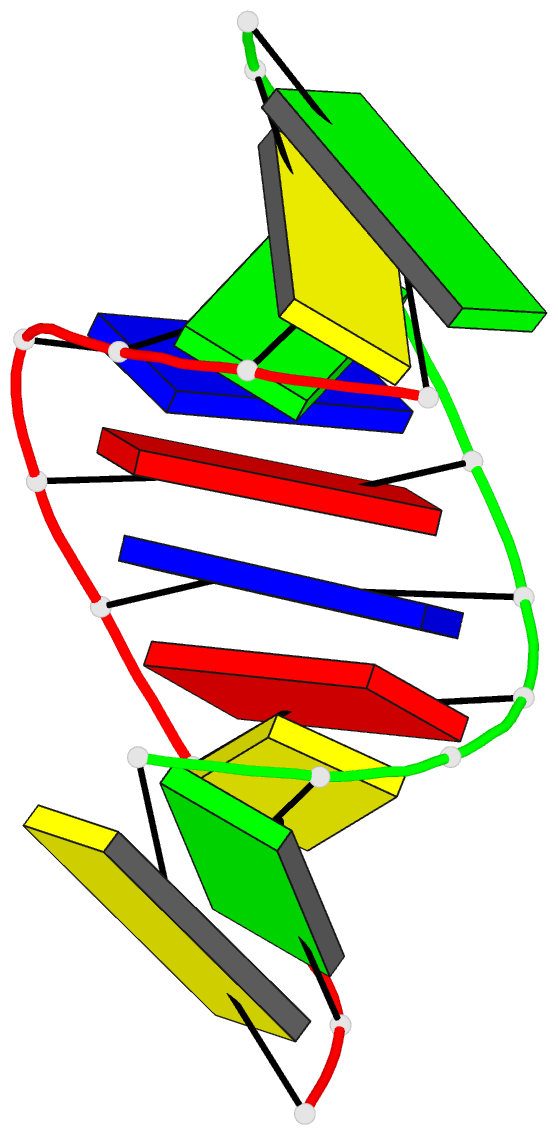
- Crystal structure of the a-DNA gcgtat*cgc with a
2'-o-propargyl thymidine (t*)
- Reference
-
Egli M, Minasov G, Tereshko V, Pallan PS, Teplova M,
Inamati GB, Lesnik EA, Owens SR, Ross BS, Prakash TP,
Manoharan M (2005): "Probing
the Influence of Stereoelectronic Effects on the
Biophysical Properties of Oligonucleotides: Comprehensive
Analysis of the RNA Affinity, Nuclease Resistance, and
Crystal Structure of Ten 2'-O-Ribonucleic Acid
Modifications." Biochemistry,
44, 9045-9057. doi: 10.1021/bi050574m.
- Abstract
- The syntheses of 10 new RNA 2'-O-modifications, their
incorporation into oligonucleotides, and an evaluation of
their properties such as RNA affinity and nuclease
resistance relevant to antisense activity are presented.
All modifications combined with the natural phosphate
backbone lead to significant gains in terms of the
stability of hybridization to RNA relative to the
first-generation DNA phosphorothioates (PS-DNA). The
nuclease resistance afforded in particular by the
2'-O-modifications carrying a positive charge surpasses
that of PS-DNA. However, small electronegative
2'-O-substituents, while enhancing the RNA affinity, do not
sufficiently protect against degradation by nucleases.
Similarly, oligonucleotides containing 3'-terminal residues
modified with the relatively large
2'-O-[2-(benzyloxy)ethyl] substituent are rapidly degraded
by exonucleases, proving wrong the assumption that steric
bulk will generally improve protection against nuclease
digestion. To analyze the factors that contribute to the
enhanced RNA affinity and nuclease resistance we determined
crystal structures of self-complementary A-form DNA decamer
duplexes containing single 2'-O-modified thymidines per
strand. Conformational preorganization of substituents,
favorable electrostatic interactions between substituent
and sugar-phosphate backbone, and a stable water structure
in the vicinity of the 2'-O-modification all appear to
contribute to the improved RNA affinity. Close association
of positively charged substituents and phosphate groups was
observed in the structures with modifications that protect
most effectively against nucleases. The promising
properties exhibited by some of the analyzed
2'-O-modifications may warrant a more detailed evaluation
of their potential for in vivo antisense applications.
Chemical modification of RNA can also be expected to
significantly improve the efficacy of small interfering
RNAs (siRNA). Therefore, the 2'-O-modifications introduced
here may benefit the development of RNAi therapeutics.