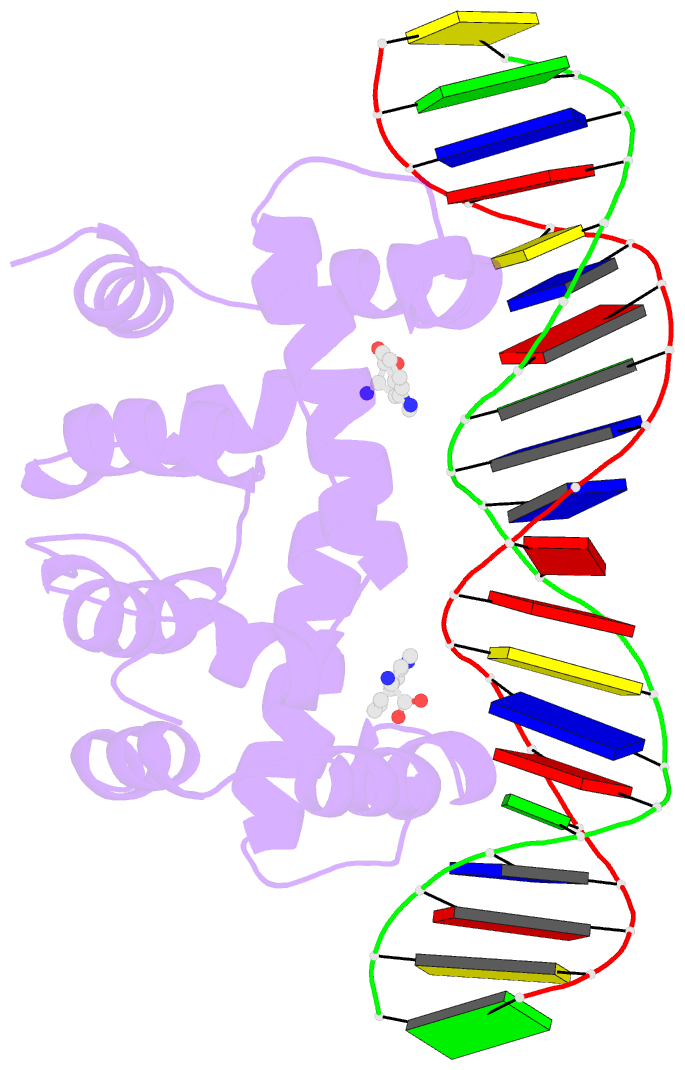
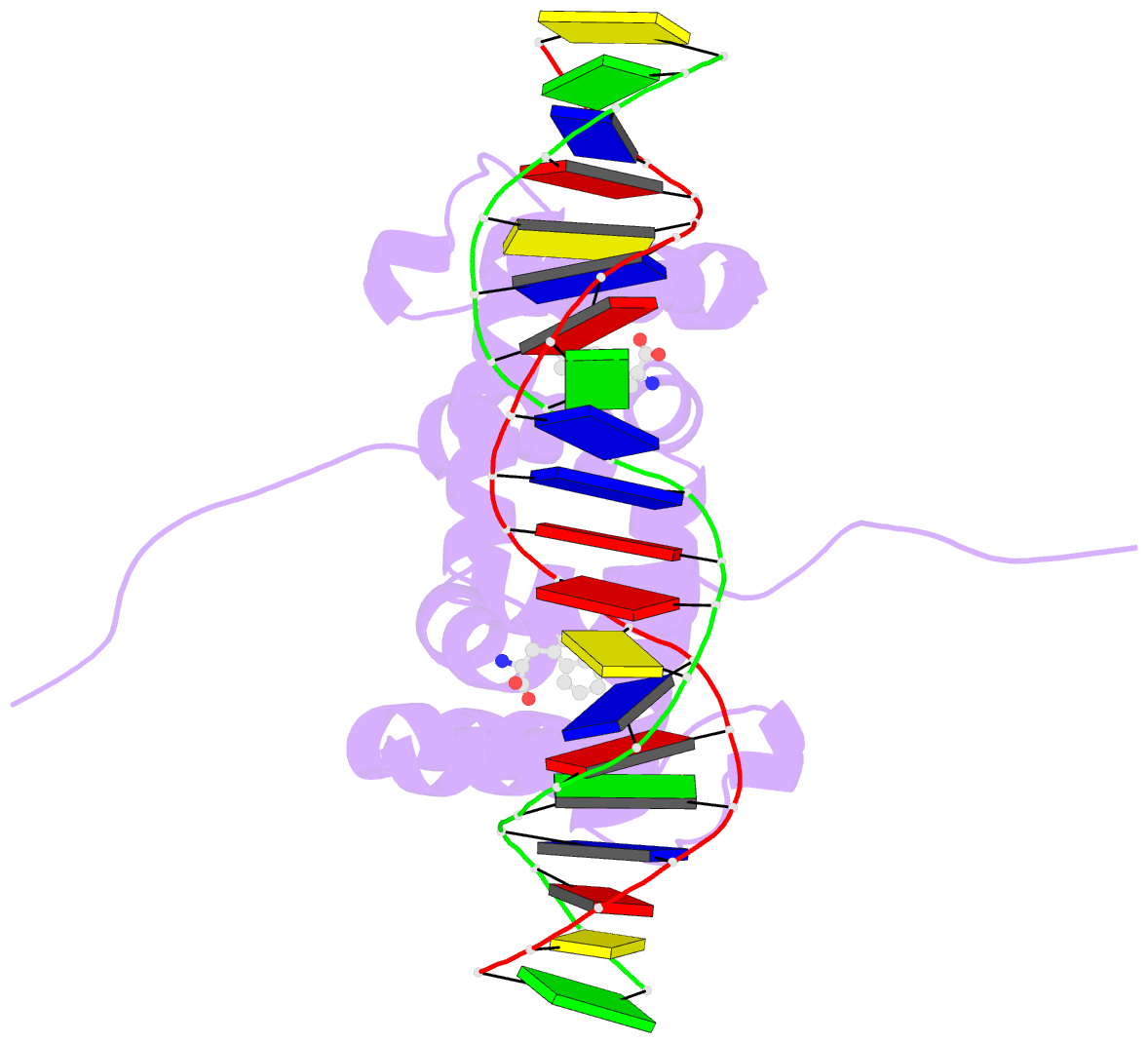
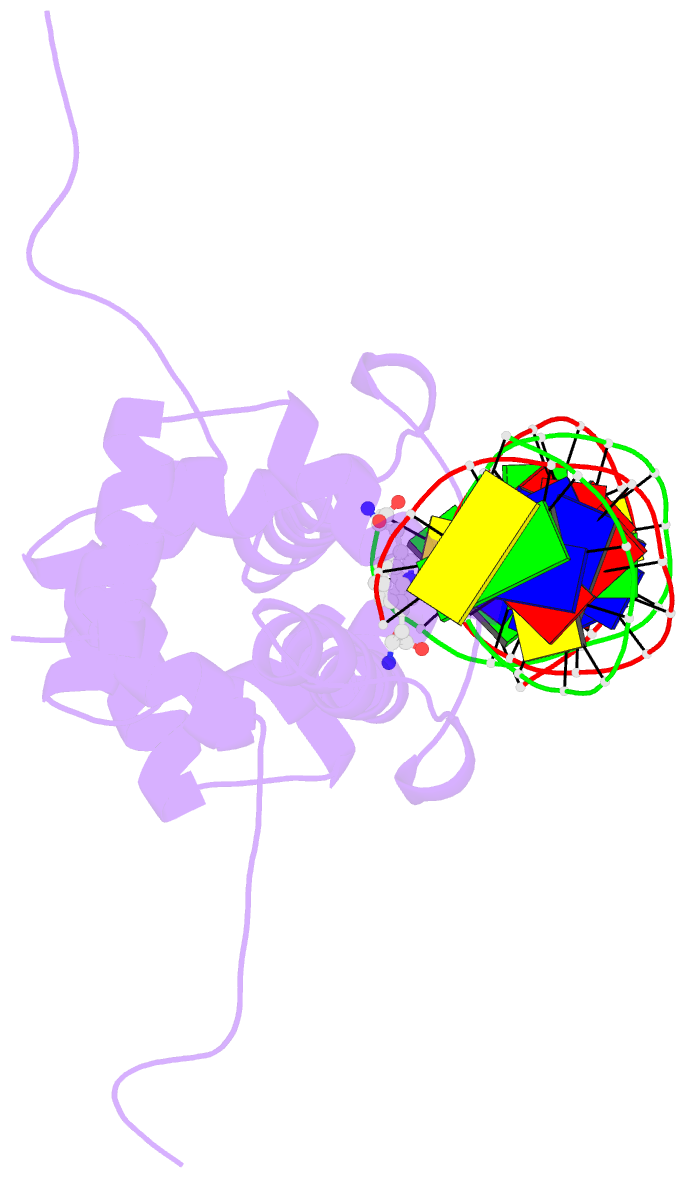
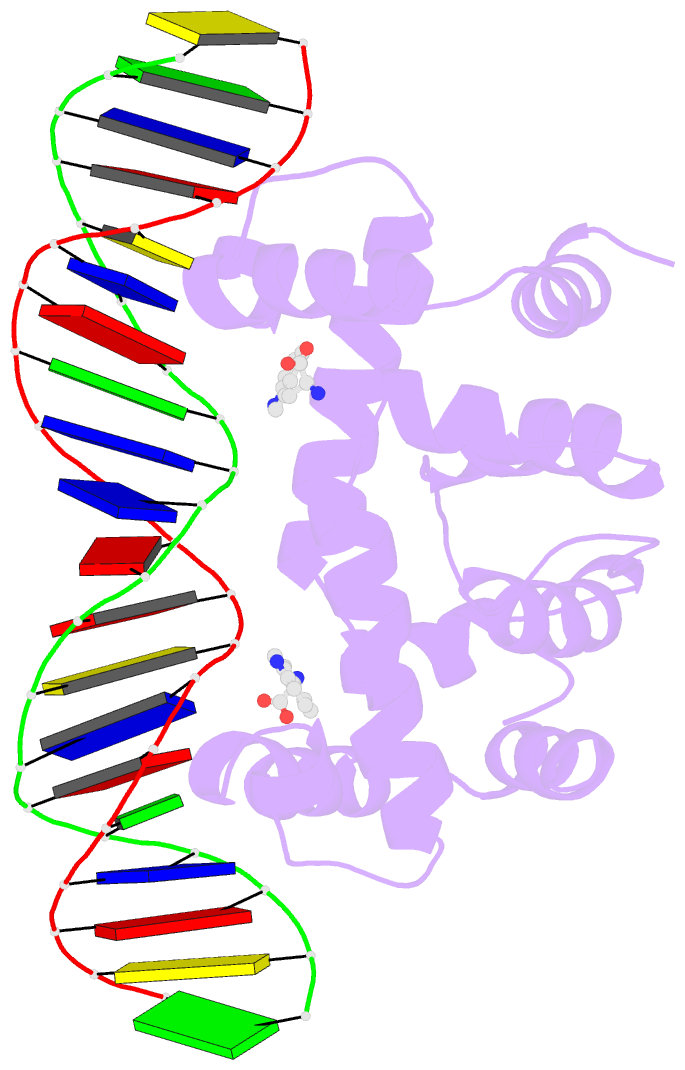
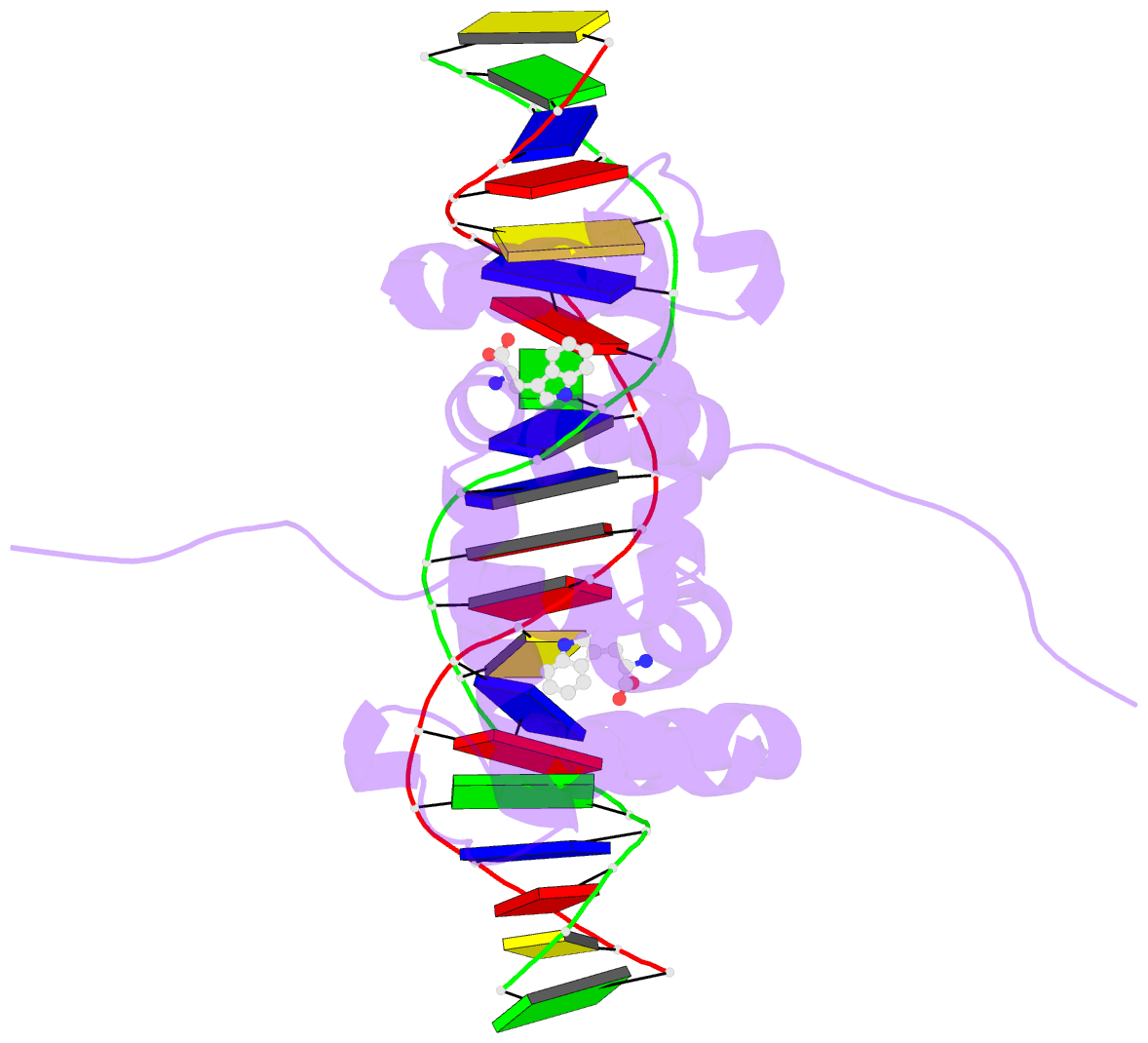
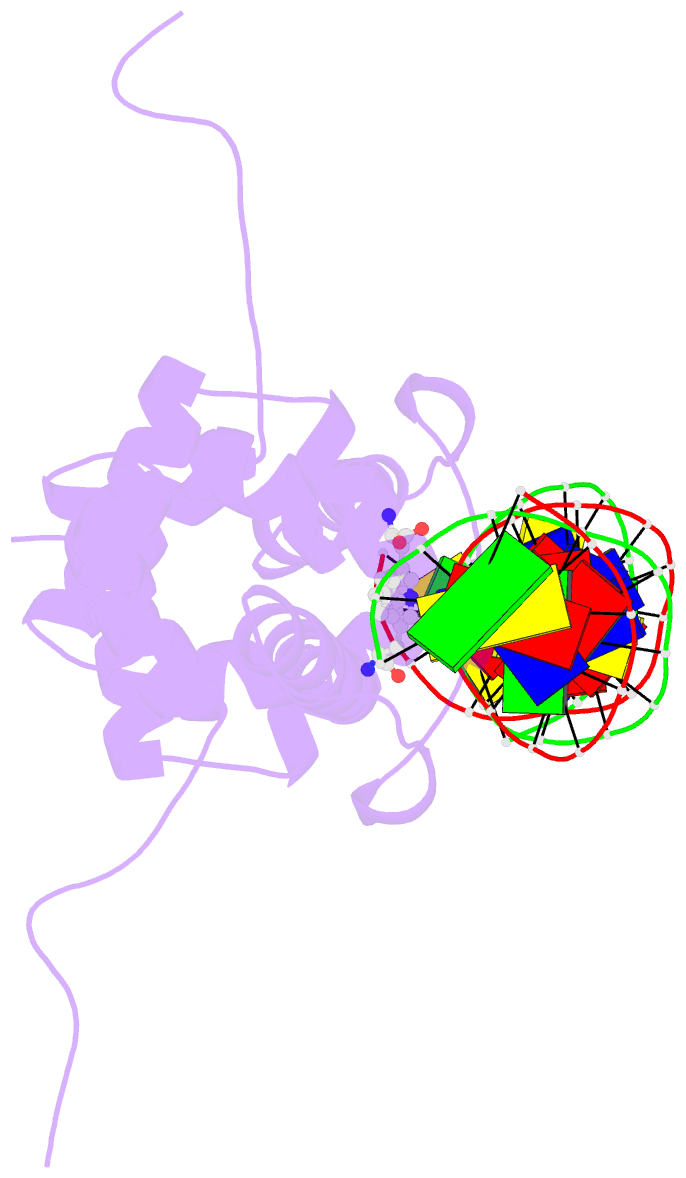
Summary information and primary citation
- PDB-id
-
1rcs;
DSSR-derived features in text and
JSON formats
- Class
- transcription-DNA
- Method
- NMR
- Summary
- NMR study of trp repressor-operator DNA complex
- Reference
-
Zhang H, Zhao D, Revington M, Lee W, Jia X, Arrowsmith C,
Jardetzky O (1994): "The
solution structures of the trp repressor-operator DNA
complex." J.Mol.Biol., 238,
592-614. doi: 10.1006/jmbi.1994.1317.
- Abstract
- The solution structures of the complex between
Escherichia coli trp holorepressor and a 20 base-pair
consensus operator DNA were determined. The majority of
proton chemical shifts of the trp holorepressor and
operator DNA were assigned from homonuclear 2D NOESY
spectra of selectively deuterated analog-operator DNA
complexes and the 3D NOESY-HMQC spectrum of a uniformly
15N-labeled repressor-operator DNA complex. The structures
were calculated using restrained molecular dynamics and
sequential simulated annealing with 4086 NOE and other
experimental constraints. The root-mean-squared deviation
(RMSD) among the calculated structures and their mean is
0.9(+/- 0.3)A for the repressor backbone, 1.1(+/- 0.5)A for
the DNA backbone, and 1.3(+/- 0.3)A for all heavy atoms.
The DNA is deformed to a significant extent from the
standard B DNA structure to fit the helix-turn-helix (HTH)
segment of the repressor (helices D and E) into its major
grooves. Little change is found in the ABCF core of the
repressor on complexation in comparison to the free
repressor, but changes in the cofactor L-tryptophan binding
pocket and the HTH segment are observed. The N-terminal
residues (2 to 17) are found to be disordered and do not
form stable interactions with DNA. Direct H-bonding to the
bases of the operator DNA is consistent with all of our
observed NOE constraints. Hydrogen bonds from NH eta 1 and
NH eta 2 of Arg69 to O-6 and N-7 of G2 are compatible with
the solution structure, as they are with the crystal
structure. Other direct H-bonds from Lys72, Ala80, Ile79,
Thr83 and Arg84 to base-pair functional groups can also be
formed in our solution structures.