Summary information and primary citation
- PDB-id
-
1qv4;
DSSR-derived features in text and
JSON formats
- Class
- DNA
- Method
- X-ray (2.5 Å)
- Summary
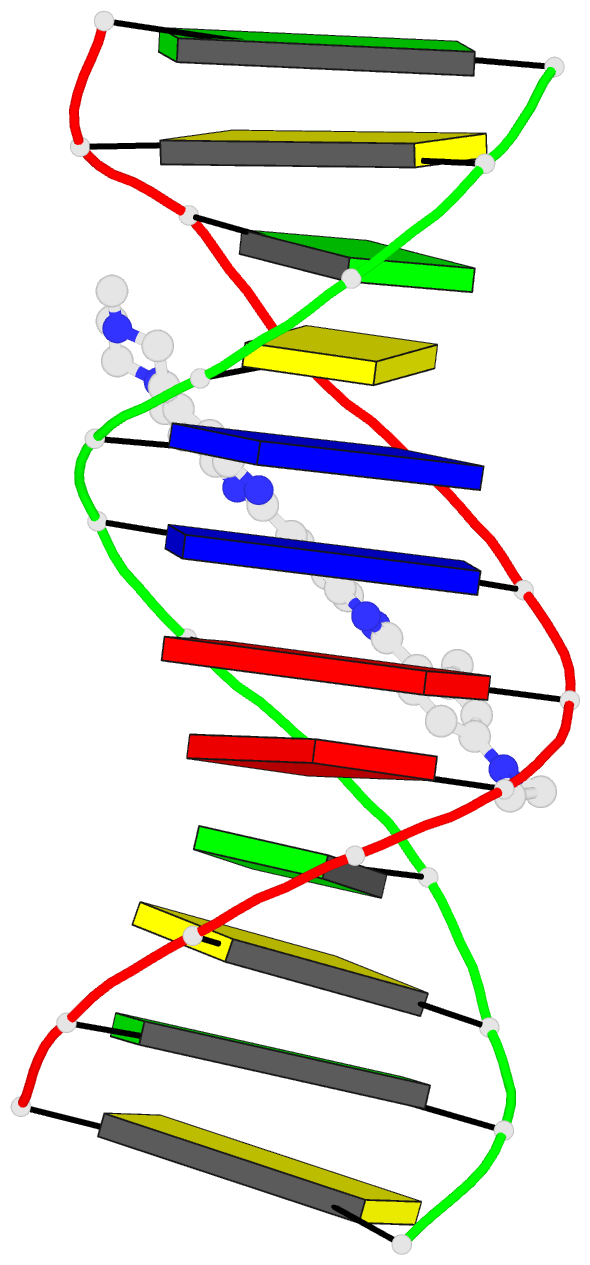
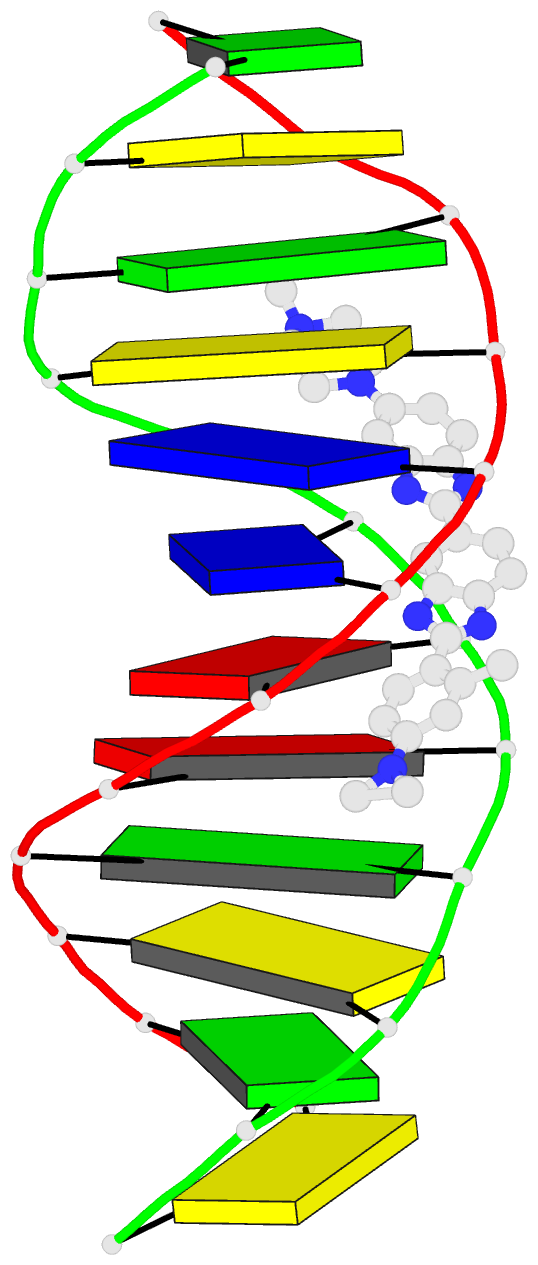
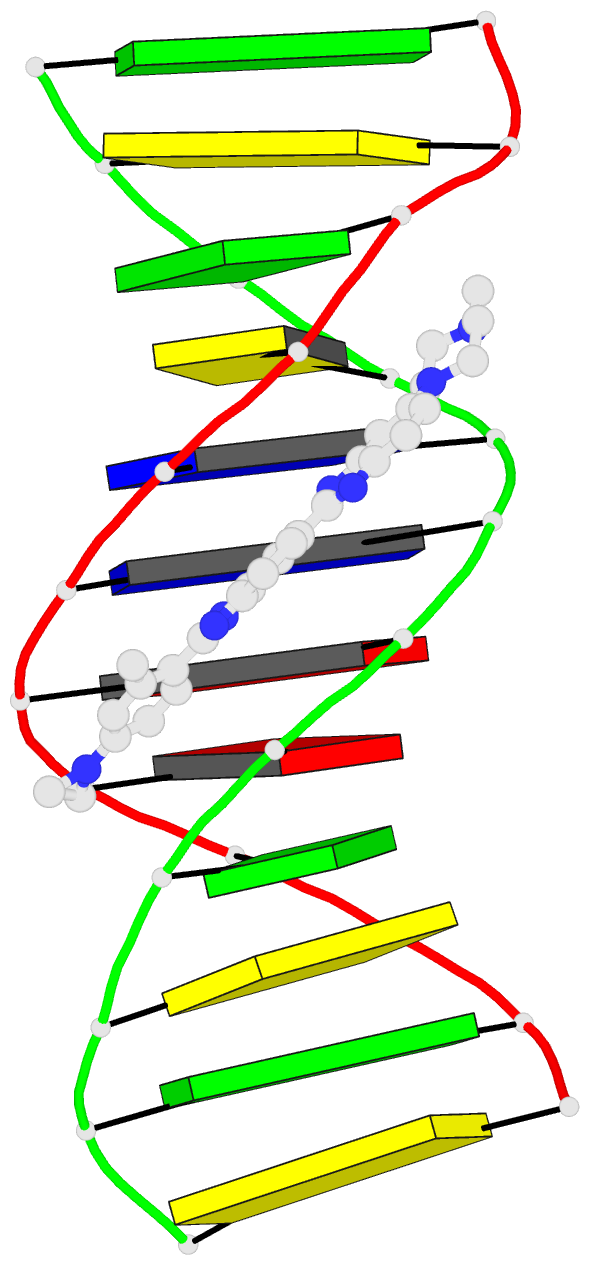
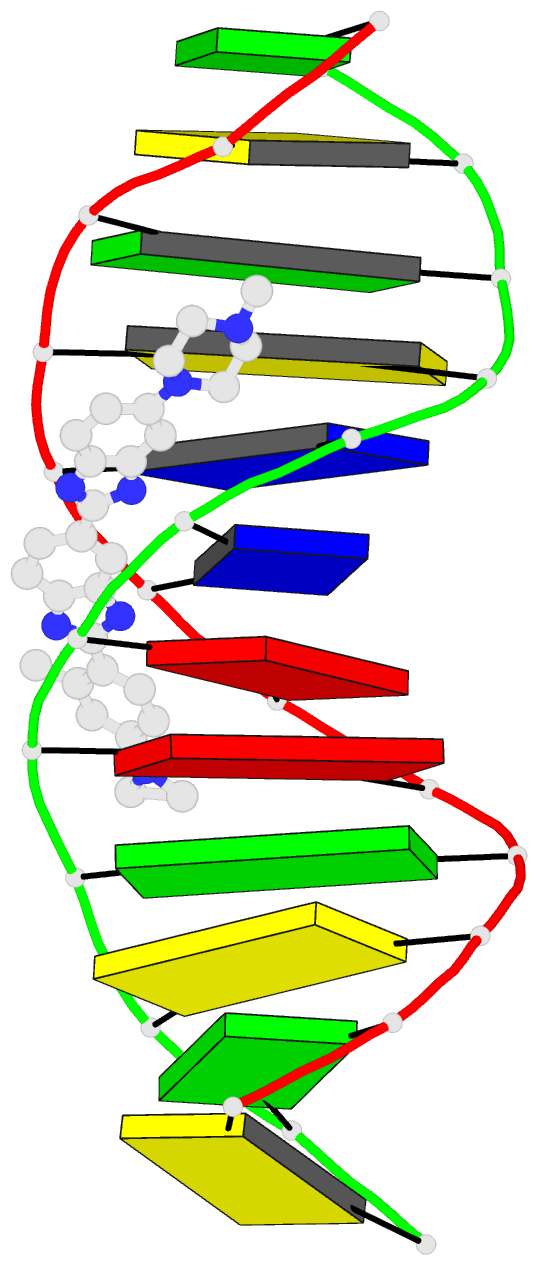
- B-DNA dodecamer cgtgaattcacg complexed with minor
groove binder methylproamine
- Reference
-
Martin RF, Broadhurst S, Reum ME, Squire CJ, Clark GR,
Lobachevsky PN, White JM, Clark C, Sy D,
Spotheim-Maurizot M, Kelly DP (2004): "In vitro
studies with methylproamine: a potent new
radioprotector." Cancer Res.,
64, 1067-1070. doi: 10.1158/0008-5472.CAN-03-2423.
- Abstract
- New analogues of the minor groove binding ligand
Hoechst 33342 have been investigated in an attempt to
improve radioprotective activity. The synthesis, DNA
binding, and in vitro radioprotective properties of
methylproamine, the most potent derivative, are reported.
Experiments with V79 cells have shown that methylproamine
is approximately 100-fold more potent than the classical
aminothiol radioprotector WR1065. The crystal structures of
methylproamine and proamine complexes with the dodecamer
d(CGCGAATTCGCG)(2) confirm that the new analogues also are
minor groove binders. It is proposed that the DNA-bound
methylproamine ligand acts as a reducing agent by an
electron transfer mechanism, repairing transient
radiation-induced oxidizing species on DNA.