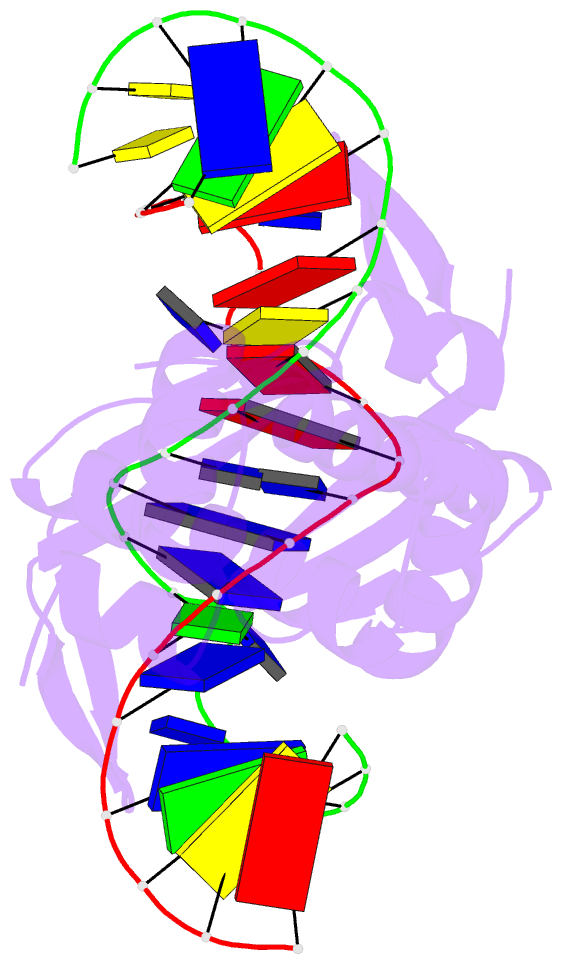
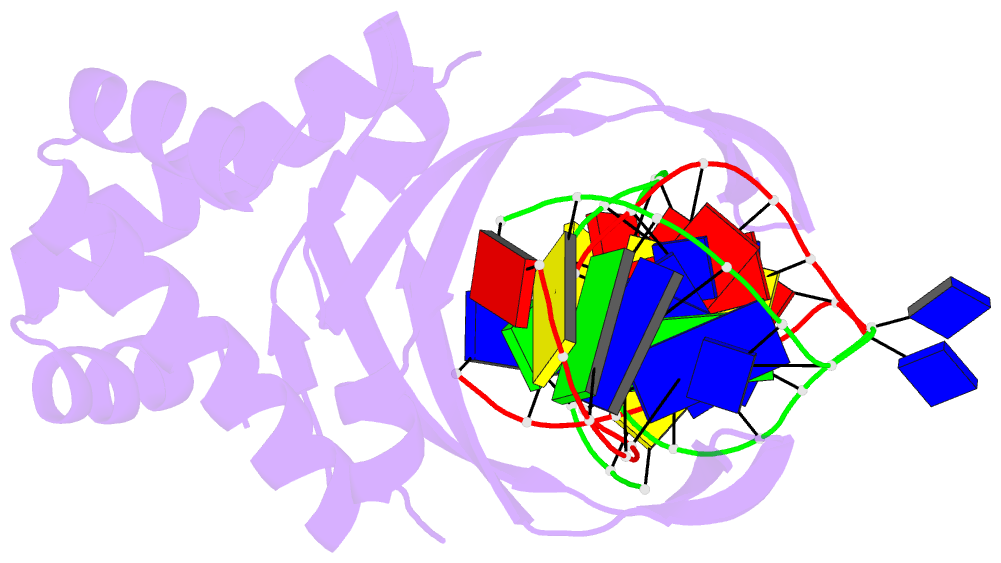
Summary information and primary citation
- PDB-id
-
1p78;
DSSR-derived features in text and
JSON formats
- Class
- DNA binding protein-DNA
- Method
- X-ray (2.25 Å)
- Summary
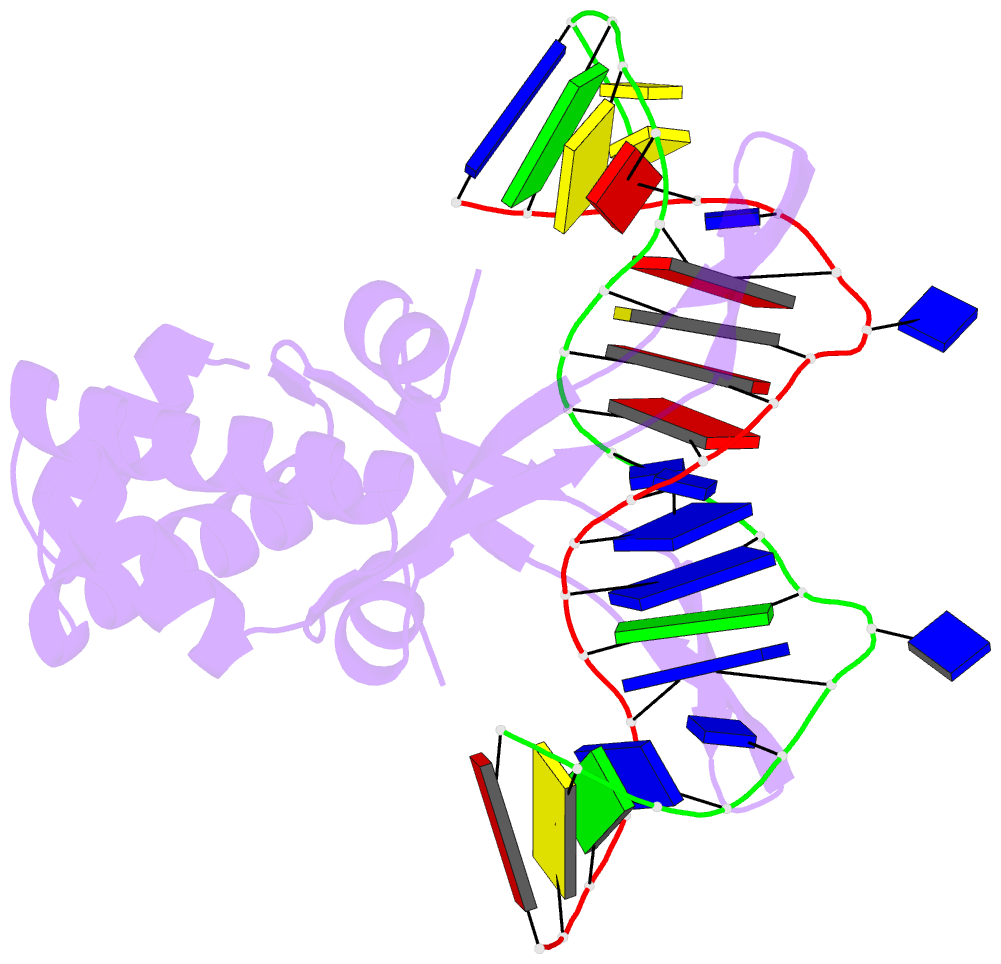
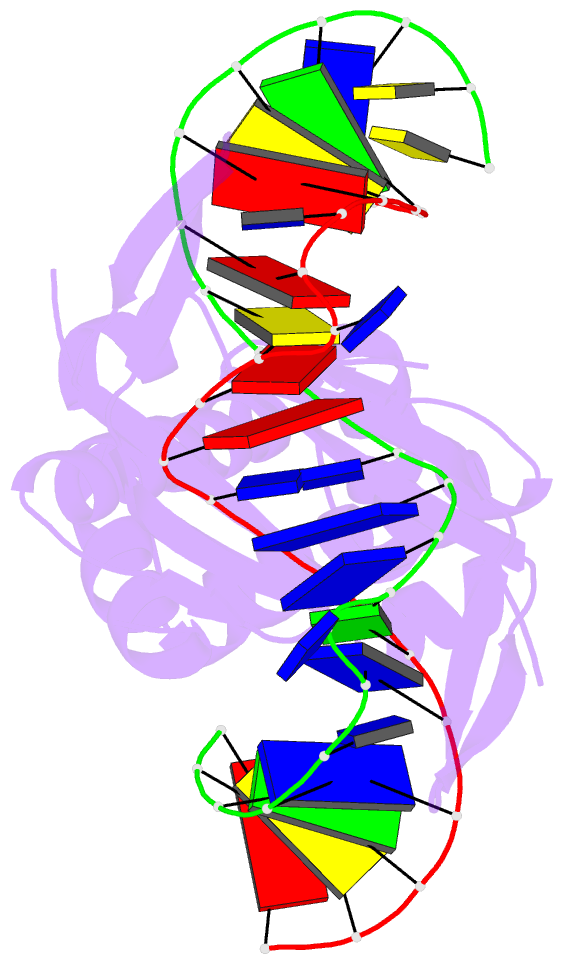
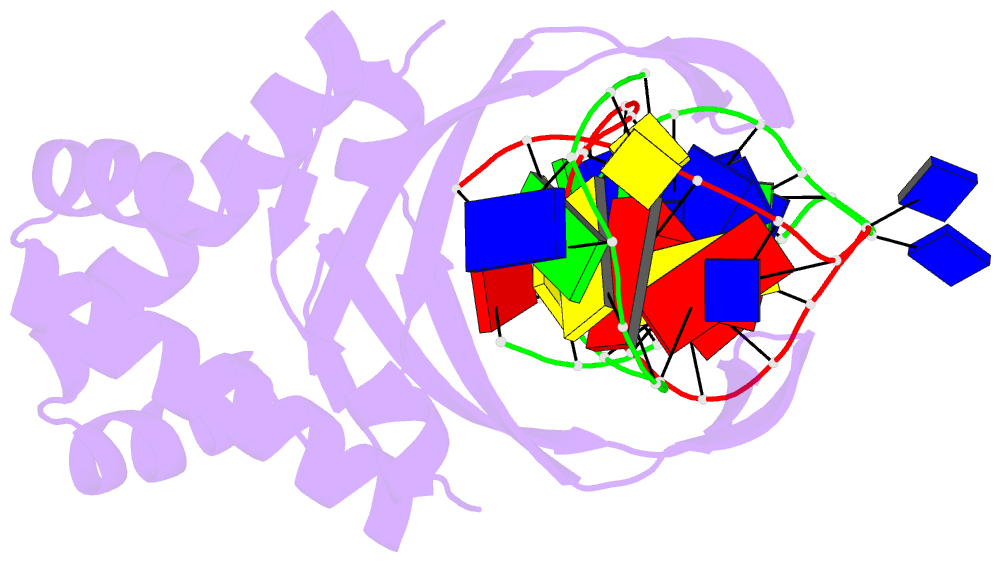
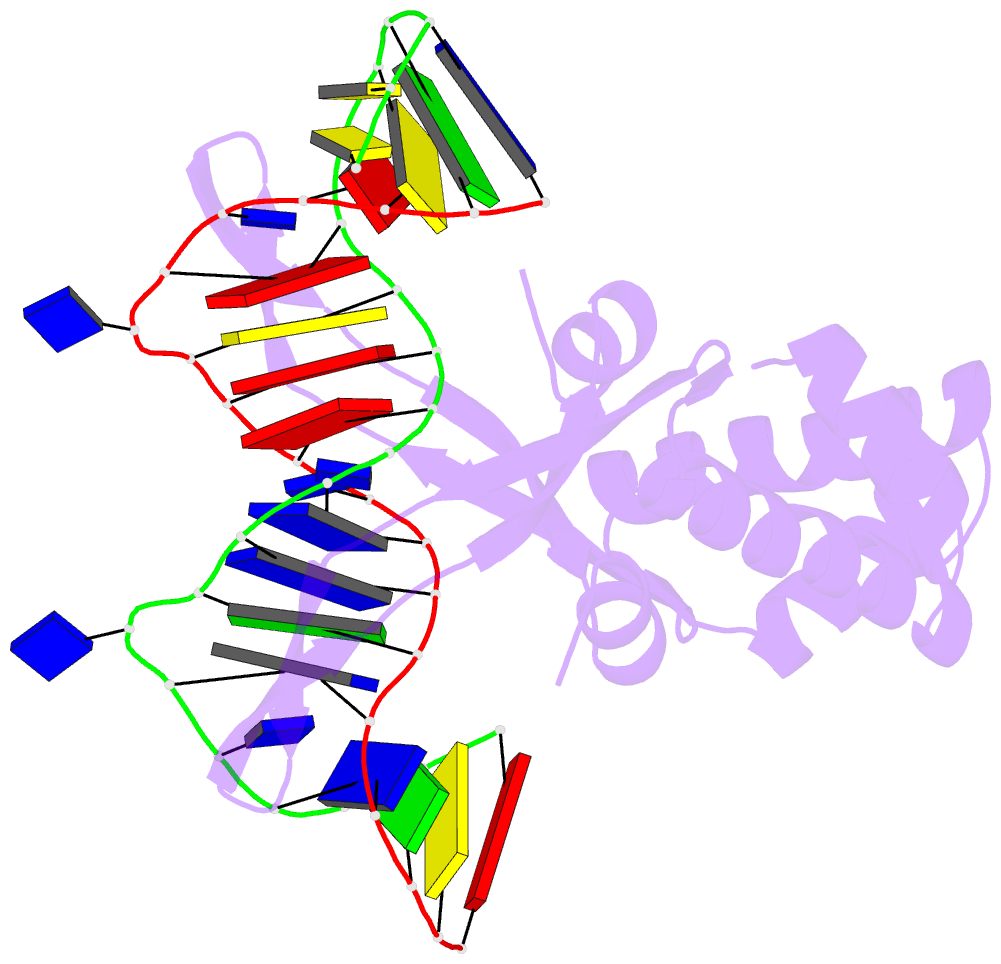
- Anabaena hu-DNA cocrystal structure (ahu2)
- Reference
-
Swinger KS, Lemberg KM, Zhang Y, Rice PA (2003):
"Flexible
DNA bending in HU-DNA cocrystal structures." Embo
J., 22, 3749-3760. doi: 10.1093/emboj/cdg351.
- Abstract
- HU and IHF are members of a family of prokaryotic
proteins that interact with the DNA minor groove in a
sequence-specific (IHF) or non-specific (HU) manner to
induce and/or stabilize DNA bending. HU plays architectural
roles in replication initiation, transcription regulation
and site-specific recombination, and is associated with
bacterial nucleoids. Cocrystal structures of Anabaena HU
bound to DNA (1P71, 1P78, 1P51) reveal that while
underlying proline intercalation and asymmetric charge
neutralization mechanisms of DNA bending are similar for
IHF and HU, HU stabilizes different DNA bend angles (
approximately 105-140 degrees ). The two bend angles within
a single HU complex are not coplanar, and the resulting
dihedral angle is consistent with negative supercoiling.
Comparison of HU-DNA and IHF-DNA structures suggests that
sharper bending is correlated with longer DNA binding sites
and smaller dihedral angles. An HU-induced bend may be
better modeled as a hinge, not a rigid bend. The ability to
induce or stabilize varying bend angles is consistent with
HU's role as an architectural cofactor in many different
systems that may require differing geometries.