Summary information and primary citation
- PDB-id
-
1dcv;
DSSR-derived features in text and
JSON formats
- Class
- DNA
- Method
- X-ray (2.5 Å)
- Summary
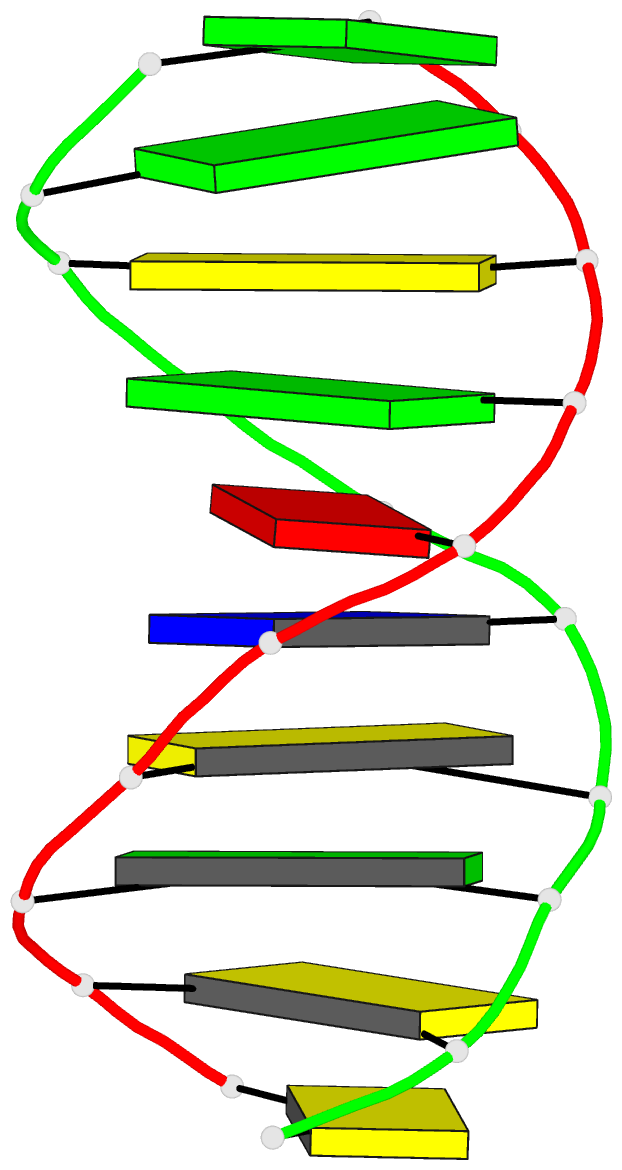
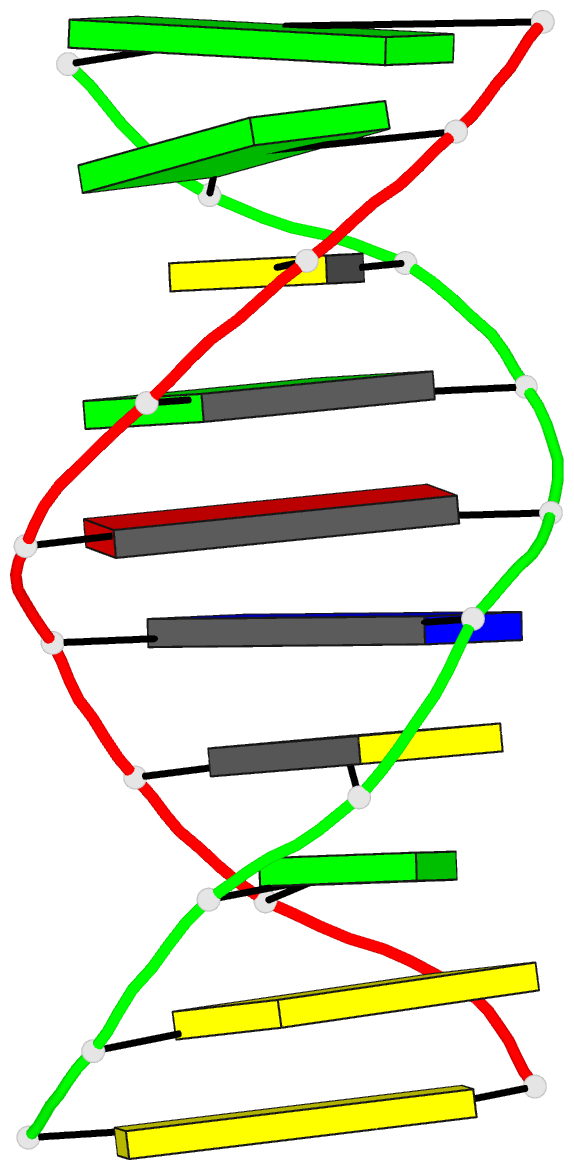
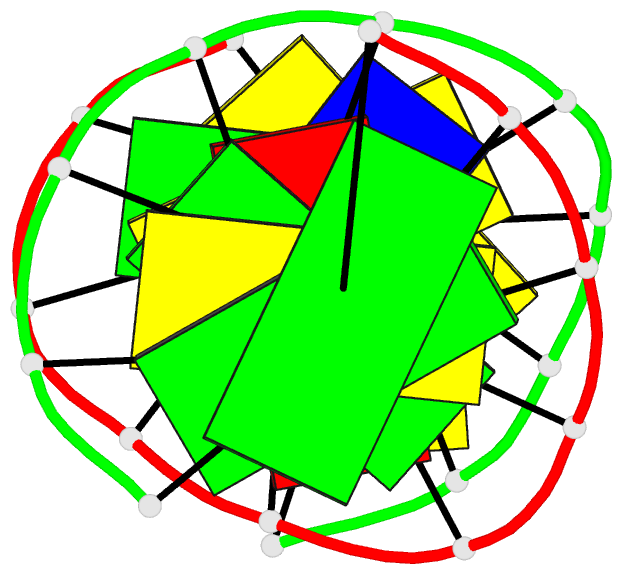
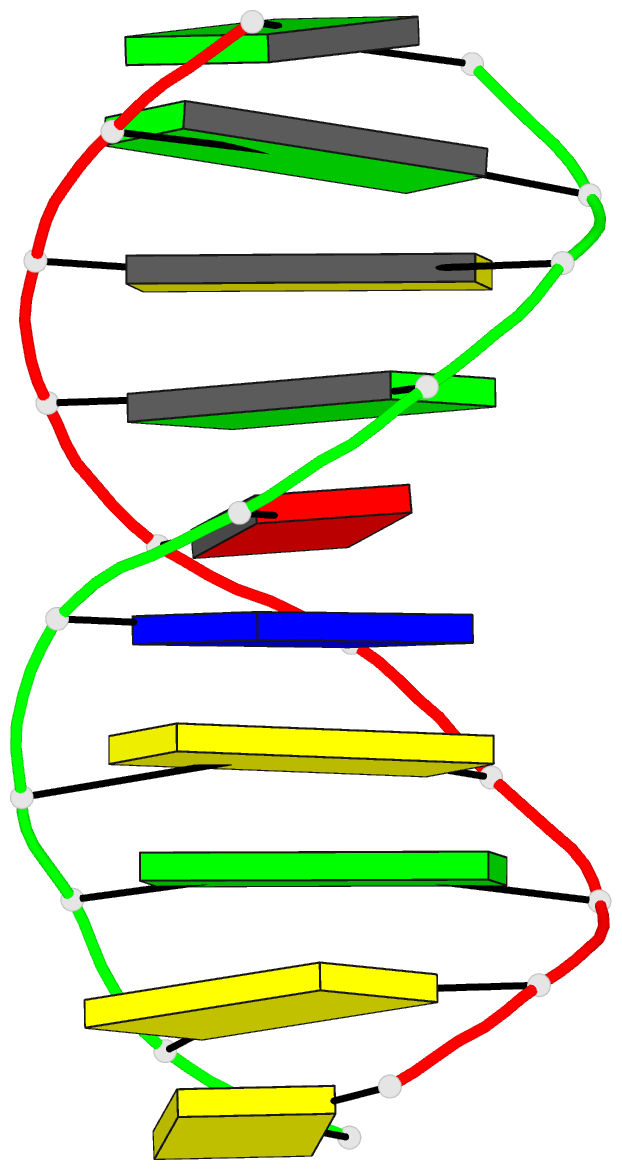
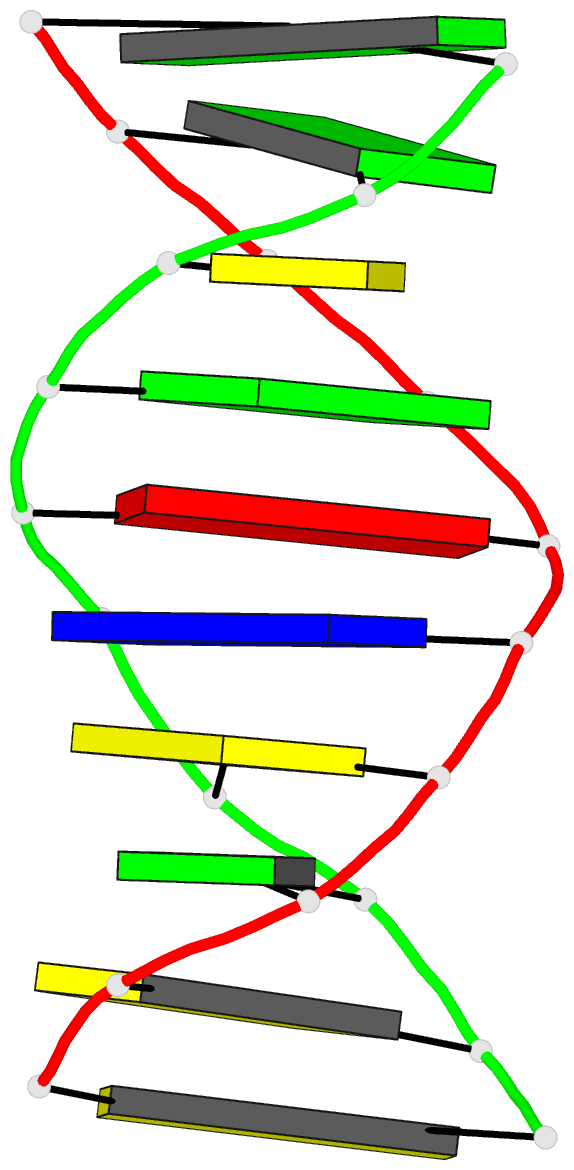
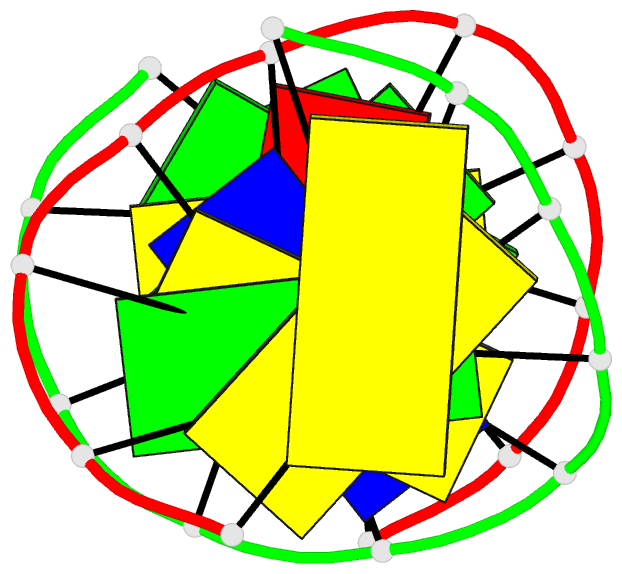
- B-DNA decamer with central ta dinucleotide
- Reference
-
Eichman BF, Vargason JM, Mooers BH, Ho PS (2000):
"The
Holliday junction in an inverted repeat DNA sequence:
sequence effects on the structure of four-way
junctions." Proc.Natl.Acad.Sci.USA,
97, 3971-3976. doi: 10.1073/pnas.97.8.3971.
- Abstract
- Holliday junctions are important structural
intermediates in recombination, viral integration, and DNA
repair. We present here the single-crystal structure of the
inverted repeat sequence d(CCGGTACCGG) as a Holliday
junction at the nominal resolution of 2. 1 A. Unlike the
previous crystal structures, this DNA junction has B-DNA
arms with all standard Watson-Crick base pairs; it
therefore represents the intermediate proposed by Holliday
as being involved in homologous recombination. The junction
is in the stacked-X conformation, with two interconnected
duplexes formed by coaxially stacked arms, and is crossed
at an angle of 41.4 degrees as a right-handed X. A sequence
comparison with previous B-DNA and junction crystal
structures shows that an ACC trinucleotide forms the core
of a stable junction in this system. The 3'-C x G base pair
of this ACC core forms direct and water-mediated hydrogen
bonds to the phosphates at the crossover strands.
Interactions within this core define the conformation of
the Holliday junction, including the angle relating the
stacked duplexes and how the base pairs are stacked in the
stable form of the junction.