Summary information and primary citation
- PDB-id
-
1c9z;
DSSR-derived features in text and
JSON formats
- Class
- DNA
- Method
- X-ray (2.4 Å)
- Summary
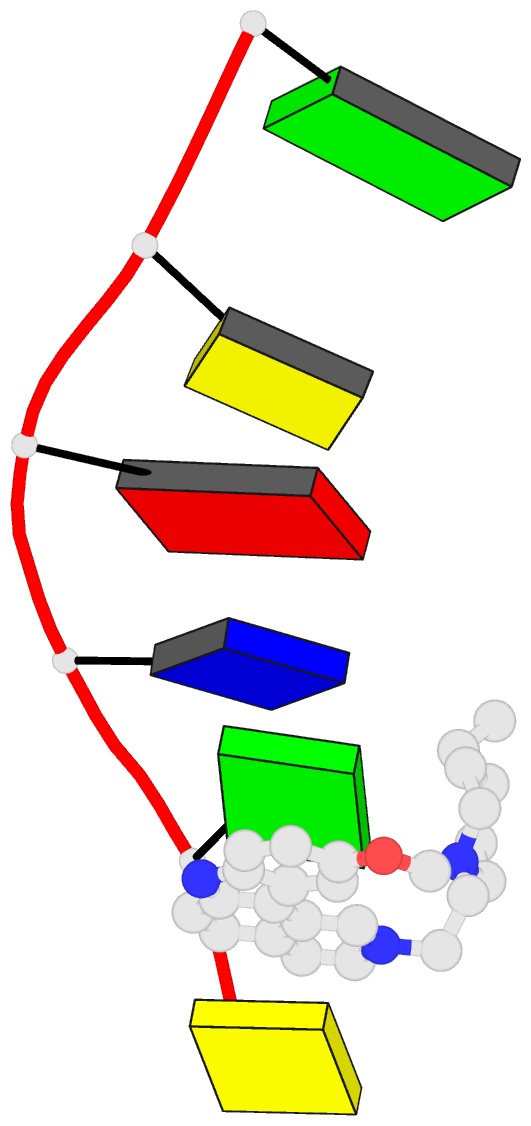
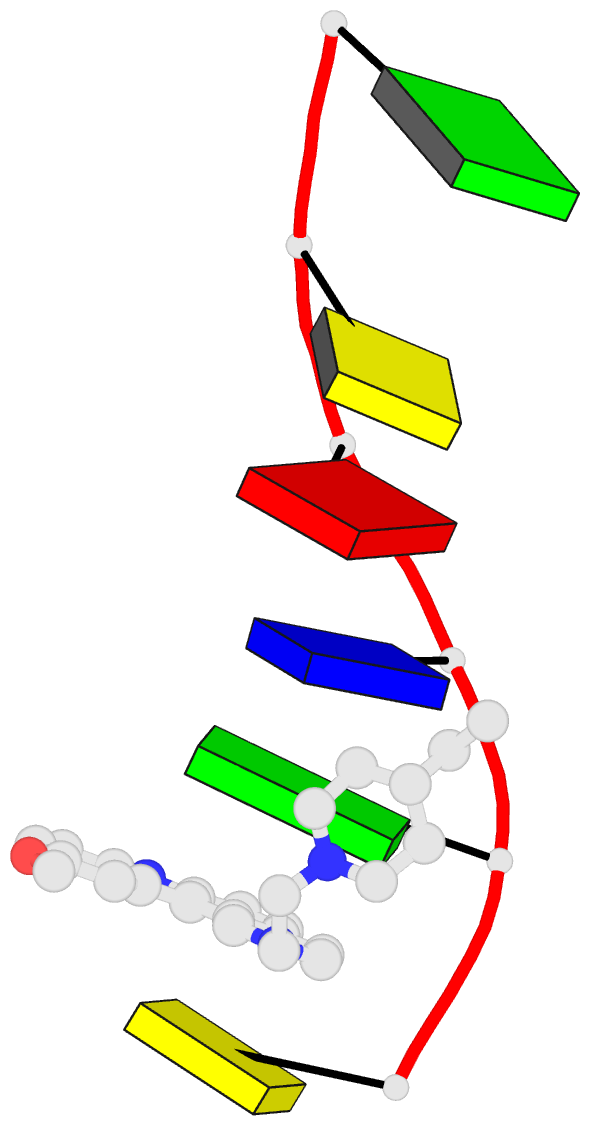
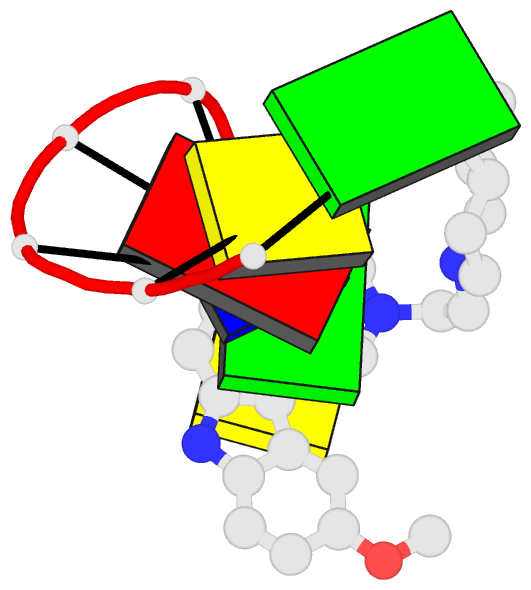
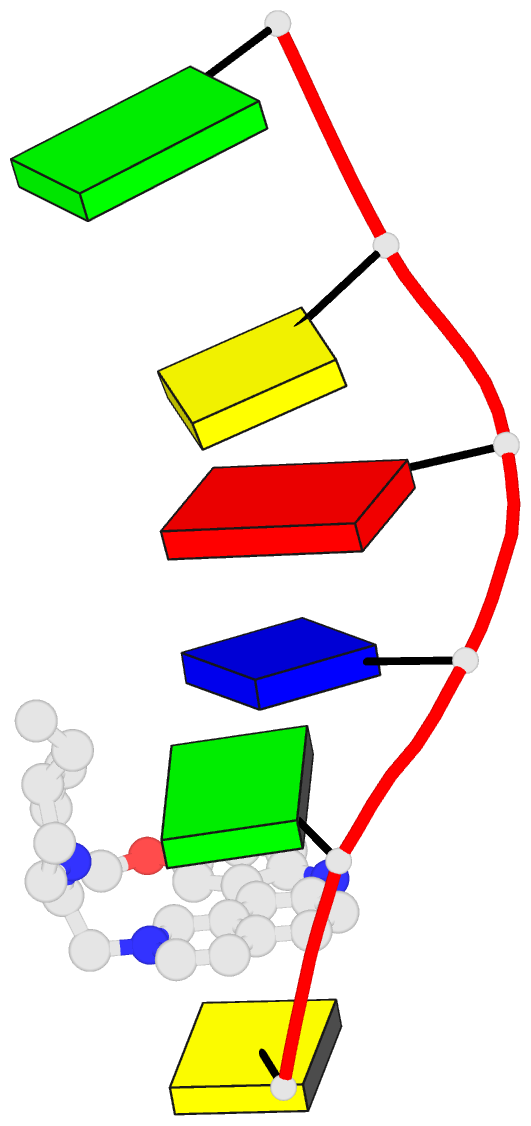
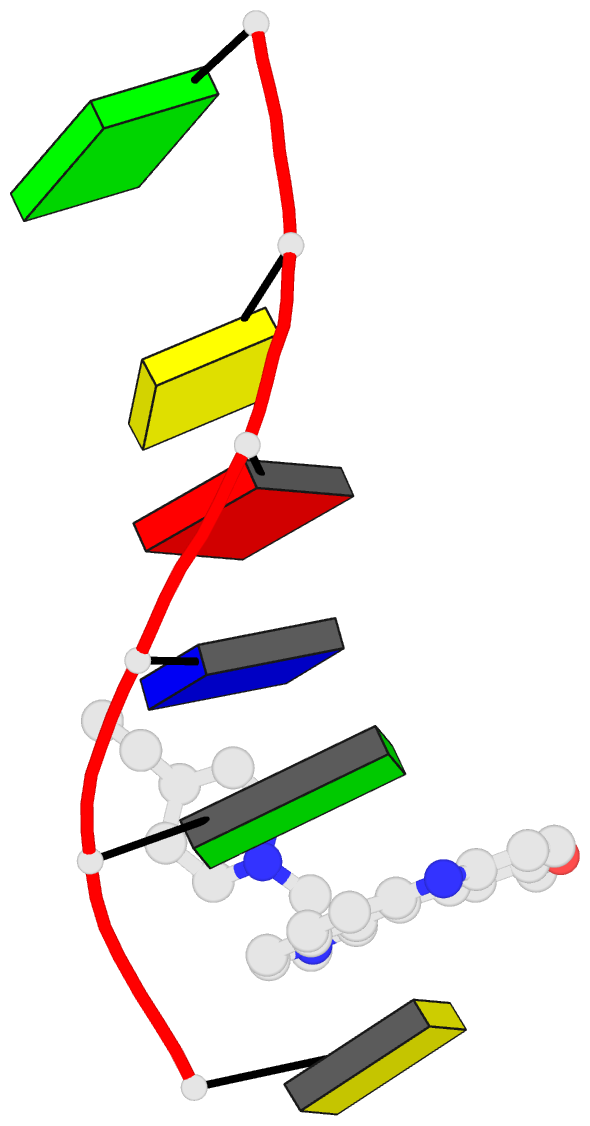
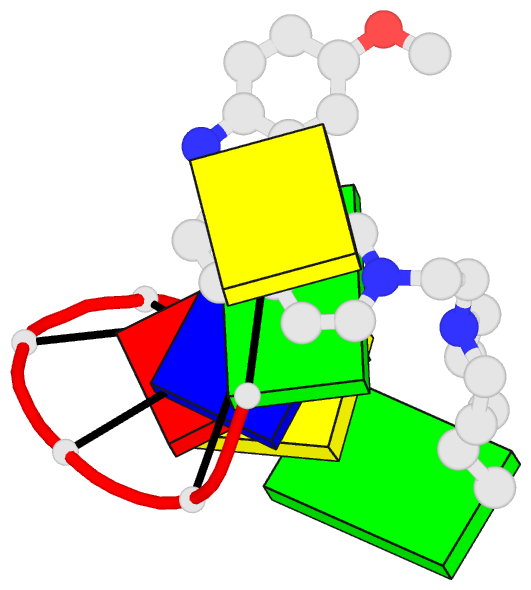
- D232-cgtacg
- Reference
-
Shui X, Peek ME, Lipscomb LA, Gao Q, Ogata C, Roques BP,
Garbay-Jaureguiberry C, Wilkinson AP, Williams LD (2000):
"Effects of
cationic charge on three-dimensional structures of
intercalative complexes: structure of a bis-intercalated
DNA complex solved by MAD phasing."
Curr.Med.Chem., 7, 59-71.
- Abstract
- We characterize intercalative complexes as either "high
charge" and "low charge". In low charge complexes, stacking
interactions appear to dominate stability and structure.
The dominance of stacking is evident in structures of
daunomycin, nogalamycin, ethidium, and triostin
A/echinomycin. By contrast in a DNA complex with the
tetracationic metalloporphyrin CuTMPyP4 [copper (II)
meso-tetra(N-methyl-4-pyridyl)porphyrin], electrostatic
interactions appear to draw the porphyrin into the duplex
interior, extending the DNA along its axis, and unstacking
the DNA. Similarly, DNA complexes of tetracationic
ditercalinium and tetracationic flexi-di show significant
unstacking. Here we report x-ray structures of complexes of
the tetracationic bis-intercalator D232 bound to DNA
fragments d(CGTACG) and d(BrCGTABrCG). D232 is analogous to
ditercalinium but with three methylene groups inserted
between the piperidinium groups. The extension of the D232
linker allows it to sandwich four base pairs rather than
two. In comparison to CuTMPyP4, flexi-di and ditercalinium,
stacking interactions of D232 are significantly improved.
We conclude that it is not sufficient to characterize
intercalators simply by net charge. One anticipates strong
electrostatic forces when cationic charge is focused to a
small volume or region near DNA and so must consider the
extent to which cationic charge is focused or distributed.
In sum, ditercalinium, with a relatively short linker,
focuses cationic charge more narrowly than does D232. So
even though the net charges are equivalent, electrostatic
charges are expected to be of greater structural
significance in the ditercalinium complex than in the D232
complex.